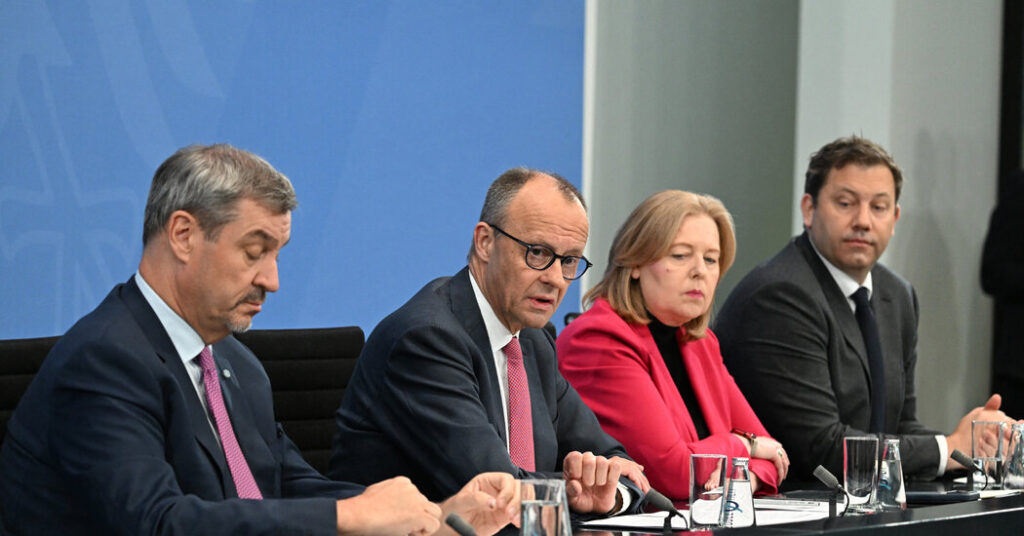
Germany cut fuel taxes for two months, costing $1.9 billion. Canada announced a plan to slash taxes on gasoline, diesel and aviation fuels until early September — at a cost of $1.7 billion. Those actions took place just in the past few days.
So far, since the war in the Middle East began, dozens of countries have cut taxes, subsidized energy bills and provided cash relief to households, racking up ever higher levels of emergency spending.
Now, with the prospects growing of a prolonged energy crisis, even if a cessation of fighting were to take hold, policymakers are raising alarms about public debt and urging governments to show restraint with their support measures.
On Wednesday, the International Monetary Fund acknowledged that the uncertainty created by the conflict would put pressure on lawmakers to increase their support for households, but warned that many countries were coping with stretched public finances, and some were staring down unsustainable debt levels.
“Fiscal policy must respond cautiously — providing support where needed without pushing public finances closer to the brink,” the Washington-based institution said in a report published Wednesday on its blog.
The risk is that the immediate economic costs of the conflict could balloon into a bigger fiscal crisis if governments increase borrowing to fund sweeping aid programs. Even after traffic eventually resumes through the Strait of Hormuz, the impact on supply chains for energy, fertilizers and other commodities could linger for months and possibly years. That means households and businesses would have to contend with sustained higher inflation and slower economic growth. And at the same time, calls for more support will grow.
This month, Italy extended a fuel tax cut by a month, to the beginning of May, costing about $590 million. In Australia, fuel tax cuts were expanded to provide additional relief worth about $285 million, and legislation was introduced to extend cuts through June. In Greece, the government introduced a “fuel pass” to provide cash to drivers and motorcycle owners on low incomes, as part of a support package worth $354 million, alongside other support for businesses.
But the situation is growing stark, especially in Asia, which imports much of its fuel from the Middle East. On Wednesday, Japan said it would set up a financial framework to provide up to $10 billion to support Southeast Asian countries so they could buy oil and other commodities.
A group of finance ministers from nearly a dozen countries, including Britain, Australia and Japan, said on Wednesday that it was committed to managing the economic response to the crisis in a fiscally responsible way and targeting measures at the most vulnerable.
“Even with a durable resolution of the conflict, impacts on growth, inflation and markets will persist,” the group wrote. “We are committed to managing the economic response to and recovery from this crisis in a coordinated, responsible and responsive way.”
During the Covid-19 pandemic and then, in 2022, the energy shock when Russia invaded Ukraine, governments spent heavily and often indiscriminately to bolster the budgets of households and help businesses. Now, the room to maneuver is more limited. Global public debt is 94 percent of gross domestic product and is expected to reach 100 percent by 2029, the I.M.F. said.
“Global growth was robust in 2025, yet there was no meaningful progress in repairing budgets,” the I.M.F. wrote. “In many countries, deficits stayed high, debt kept rising and interest bills grew rapidly.”
The pressure on budgets are also structural. In Europe, countries are spending more on defense while contending with the cost of supporting aging populations and transitioning more of their energy to low carbon sources.
At the same, countries around the world are squeezed by additional risks, the I.M.F. said. Longstanding trade alliances are fragmenting; artificial intelligence threatens to disrupt economies; and more governments rely on private investors to absorb government debt instead of their central banks.
The warnings echo those that the European Central Bank and the European Commission have made. On Tuesday, Christine Lagarde, the president of the central bank, said lawmakers should provide only temporary and “targeted” support measures, while the commission was trying to coordinate the bloc’s response so that measures had clear end dates.
For countries with tight public finances and burdensome interest payments, the critical challenge is how to fund emergency support without more borrowing.
The war is already making interest payments larger because investors are pushing up government borrowing costs in anticipation of central banks’ needing to raise interest rates to suppress inflation. Britain sold 10-year debt on Tuesday with a yield of 4.92 percent, the highest since 2008.
Eshe Nelson is a Times reporter based in London, covering economics and business news.
The post Debt Alarms Ring as Countries Rack Up More Emergency Spending appeared first on New York Times.