MUSKISM: A Guide for the Perplexed, by Quinn Slobodian and Ben Tarnoff
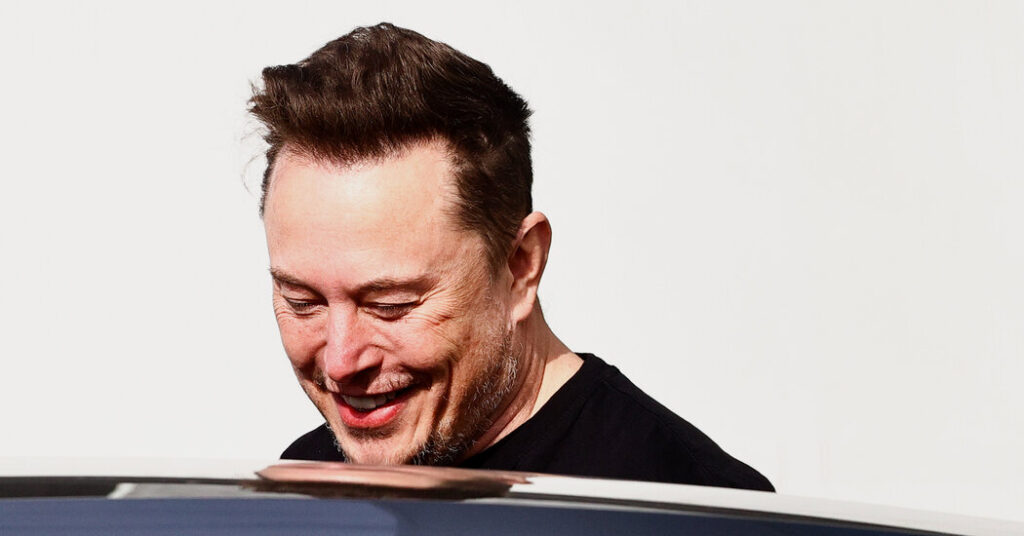
“Muskism: A Guide for the Perplexed” begins with a simple proposition. We live in a bewildering moment defined by a bewildering man: Elon Musk.
Not that the book’s authors, Quinn Slobodian and Ben Tarnoff, believe there’s much to be gained by peering into Musk’s soul. Muskism, like Fordism, is not an individual but a system. Henry Ford was the industrialist who pioneered the use of the assembly line and the $5-a-day wage. Fordism characterized the form of 20th-century capitalism that paired “mass production with mass consumption.” Musk is the entrepreneur who sells electric cars and satellite service (among other things). Muskism characterizes a new, technologically driven political economy that dismantles state institutions with one hand while promoting self-reliance, or the fantasy of it, with the other.
The ensuing cycle is virtuous for Musk and vicious for almost everyone else. If your self-reliance requires a Tesla charger or Starlink access, you have to plug into infrastructures that Musk owns. Other tech billionaires may want consumers to become entirely reliant on their products, but Musk has been operating on a different scale, helping to sell the idea that the public good is so degraded that consumers can count only on him. Slobodian, a historian, and Tarnoff, a technology writer, note that one of Muskism’s defining traits is this paradox of autonomy and dependency.
Much has been made by others of Musk’s apparent transformation in the last two decades — from Silicon Valley nerd worried about climate change to chainsaw-wielding billionaire eviscerating government agencies. The authors concede that Musk is anything but a systematic thinker with a coherent set of beliefs. But Muskism — shorthand for the kind of world that Musk is actively trying to bring about — inevitably reflects some of his abiding preoccupations.
The authors pluck out some themes, beginning with his childhood in apartheid South Africa. Musk, an enthusiastic reader of sci-fi novels, was relentlessly bullied as a child. For someone who fantasized about other worlds in outer space, South Africa felt provincial. But it was also an early example of a “biometric state.” In order to implement apartheid, the government used computers to accumulate enormous amounts of personal data. Slobodian and Tarnoff argue that this form of “reactionary technocracy” is something that Silicon Valley — especially in its right-wing incarnation — shares with apartheid South Africa. It’s the reductio ad absurdum of an engineer’s mind-set. Human society is too messy and unpredictable. It needs to be “optimized” and disciplined “like a factory floor.”
A goal of South Africa’s “fortress futurism” was the perfection of state-sponsored racism. Musk has said that one reason he wanted to leave South Africa was to avoid conscription into a military force intent on “suppressing Black people.” The straight-arm salute, the apparent endorsement of an antisemitic conspiracy theory, the xAI chatbot spewing falsehoods about “white genocide” — all of that would come later. In 1989, Musk left for Canada and then the United States. He settled in North America but, the authors write, “apartheid South Africa came along like a spore in his luggage.”
Slobodian and Tarnoff skillfully guide us through the subsequent decades, as Musk made his fortune and learned some lessons that would become foundational to Muskism. “State symbiosis” was one. Musk isn’t the anti-government libertarian many think he is, even if it behooves him to talk like one. Rather, the government can provide valuable infrastructure on the cheap. One of Musk’s early companies was Zip2, a business directory that supplied driving directions. It relied on digital maps that used data from GPS satellites built by the Pentagon. In the early years of the Obama administration, Tesla was one of the struggling start-ups that survived in part because of a huge federal loan. And SpaceX, most obviously, has always been enmeshed with the state: “The company got its start as a military contractor during the war on terror.”
Another tenet of Muskism is what the authors call “financial fabulism.” This is the mix of soothsaying and realism that entrepreneurs like Musk deploy to raise money for their companies. The idea is to be memorable and inspire confidence. Acquiring Twitter has allowed Musk to further erode the power of traditional media while drawing “investors deeper into his reality.” Even when Musk posts statements that seem asinine or completely unhinged, the authors argue that he is merging with an ecosystem that selects for attention-getting shenanigans — another kind of “symbiosis.”
A striking turn in “Muskism” takes place right here, at the part of the book where the authors discuss Musk’s acquisition of Twitter. They show how bothered he was by Twitter’s track record of galvanizing egalitarian social movements. Hashtags like #MeToo and #BlackLivesMatter took off on the platform. “Muskism had always been committed to a vigorous defense of hierarchy,” Slobodian and Tarnoff write. Musk, who gave himself the title of Technoking at Tesla, turned Twitter, now X, into a platform “that would reaffirm the power of the boss.”
What follows is an acceleration of Muskism while its founding figure gets increasingly immersed in the bizarre culture of his platform. When an X user pointed out to Musk that Grok, the platform’s A.I. chatbot, had stated (accurately) that in America, right-wing violence had claimed more lives than left-wing violence, Musk promised action. Grok, instructed to be “politically incorrect,” started identifying itself as “MechaHitler.”
The book brings us through the Muskian upheavals of last year, when Musk’s Department of Government Efficiency descended on federal agencies. Slobodian and Tarnoff depict DOGE as the zenith of Muskism. DOGE turned over government functions to its preferred A.I. models, treating the state “not as a space of deliberation but as lines of executable code.” The account of those events is surreal, until you remember that they actually happened, sometimes with deadly consequences.
It’s a measure of Musk’s cosmic wealth that the unlikely phenomenon of Muskism has gotten this far. Unlike Trumpism, which is inextricably entwined with one man, Muskism — with its uncanny mix of ruthless state power and juvenile memes — is already bigger than its namesake. Perhaps nothing captures the core of Muskism’s values better than this preposterous yet factual headline from last summer, cited by the authors: “Grok Rolls Out Pornographic Anime Companion, Lands Department of Defense Contract.”
MUSKISM: A Guide for the Perplexed | By Quinn Slobodian and Ben Tarnoff | Harper | 241 pp. | $30
Jennifer Szalai is the nonfiction book critic for The Times.
The post How ‘Muskism’ Is Changing the Way America Works appeared first on New York Times.