The blinds were half-drawn, softening the July light to a gray wash. Lavender lotion and disinfectant hung in the air. Around the bed, a small circle of nuns had gathered — women from the Sisters of Charity of New York, an order that helped shape the city for two centuries and was now nearing its end.
Sister Anna had curled into herself, bracing against pain the morphine could not reach. When an aide stepped forward to straighten her legs, Sister Mary Kay Finneran spoke with the authority of someone who had watched too many bodies fail.
“Leave her be,” she said. “That should have been done two months ago. Now, just let her be.”
Mary Kay had spent days praying a single line: Please God, take her home, take her home.
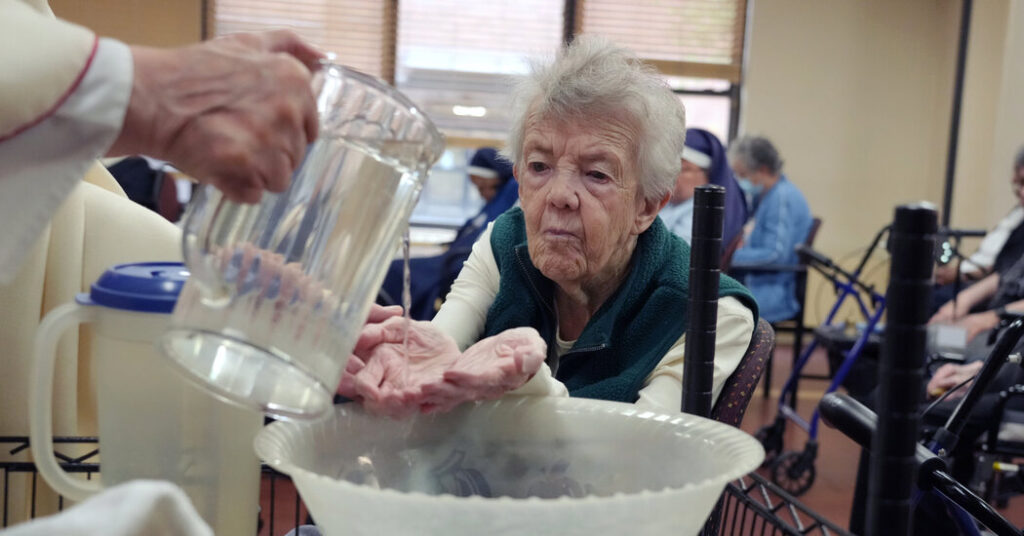
They were on the ninth floor of the Kittay Senior Apartments, a subsidized housing tower in the Bronx. While the rest of the building was a bustle of secular city life, the ninth floor felt like a world apart, a small community of the order’s most infirm sisters, women who needed tending as they tended to one another.
Anna was a woman of few possessions — one crucifix, one rosary — but her devotion was full. Years ago, when Mary Kay was too sick to leave her room, on oxygen and unable to get to Mass, Anna had brought her communion every day, without being asked.
She and Mary Kay lived across the hall from each other, trading jokes about the food and, if devotions of the hour called for it, sitting together in silence. Every Sunday at 3, Anna telephoned her sister back home. When her hands shook too much to dial and her hearing dimmed, Mary Kay held the phone to Anna’s ear and watched recognition move across her face.
Soon there would be no more Sundays.
Anna’s breathing stretched into ragged intervals.
Five seconds between inhalations.
Then eight.
Then 12.
Mary Kay counted each one, her palm rising and falling with what remained of her friend’s life.
Anna had yet to let go.
‘When needed, try to be there’
For 209 years the Sisters of Charity have cared for New York — nursing Civil War wounded in a hospital where Central Park now stands, taking in survivors of the Titanic, tending to gay men during the AIDS crisis when much of the city looked away, staffing parish schools for generations of working-class families. The Foundling, which they opened in 1869, became one of New York’s largest child welfare agencies and survives today under lay leadership.
Now 124 sisters remained in the entire order, median age 87. For nearly 30 years no one had entered and stayed. The congregation was finishing its story by choice — completing the mission, they called it — and would cease to exist when the last sister died. The only question left was how to finish well.
Sister Mary Kay was 87. “Don’t tell anyone,” she said, dryly. Her lungs were failing. Her sight had narrowed to shadows. She would not make it to the order’s final days. But she had her own question to answer, the same one in smaller form: how to finish a life spent caring for others — and then, at last, how to let go.
She woke before dawn most mornings for prayer over the phone, an hour shared with a friend in Atlanta. They sat in 20 minutes of silence, a practice Mary Kay called her listening post for God. Then a psalm or Scripture, and a word drawn from a small deck of angel cards: trust, courage, expansiveness.
Only then did she begin her rounds.
Slight and stooped, she eased down the corridor with her walker. Her mind remained sharp and her body could still be summoned to duty. There was a spark in her dimming eyes, and when she laughed, you could hear the young woman she had been.
When she was displeased, her voice rang down the hallway — a fire that took decades to build, and has never gone out.
She was the floor’s unofficial mayor — a former nurse who had known most of these women since she was a teenager in the order. Among them, she remained the most able-bodied, the clearest-minded, the one who noticed who did not appear at meals or who had a tremor in her voice. “When needed, try to be there — it’s as simple as that,” she said. “That’s how we all were as younger women. It is how I try to be now.”
The women she moved among were daughters of another New York — Irish mostly, others Italian, born to the Catholic parishes of the midcentury city.
Mary Kay stopped to help a sister who sat in a chair and struggled to lift her head. When fear rose in the woman’s eyes, she sat with her until it passed. Some nights a bell rang unanswered in the dark; Mary Kay heard it, rose, held a hand until the crying stopped. She moved through the day this way, tying a bib here, straightening a blanket there, simply because she saw it needed doing.
One afternoon, word reached her that Sister Gloria Degnan, 97 and blind, had been ringing her bell for help without answer. Mary Kay left her walker in the hallway and went in, took Gloria by the arms, turned her slowly, and angled her into the floral recliner by the window.
“Your hands are cold,” Gloria said. “Why didn’t anyone come?”
“Happy birthday,” Mary Kay said. “What are you now, 27?”
“Twenty-seven?” Gloria said. “I wish. Well, actually, that I don’t wish.”
“Well, you’re 97,” Mary Kay said. “Not bad.”
Melissa Perez, the floor manager, had known Mary Kay since they worked together at a now-shuttered nursing home for the sisters. “There are a lot of former bosses here,” Ms. Perez said with an affectionate look. “But Mary Kay is in a league of her own.”
Mary Kay did not pretend the contradiction away. “Oh yeah, micromanaging, in control, do it my way,” she said, before laughing. She traced it back: a father who drank too much, a chaotic house, a child who became the one who made things right.
Of the remaining sisters — including 66 who did not yet need full-time care — most lived at the convent at the University of Mount Saint Vincent, a stately campus above the Hudson River where the order moved in the 1850s. Some still worked. A few had cars. They had their own community there. When they could no longer manage, the move was often to Kittay, where aides watched over them as best they could.
When someone suggested Mary Kay might be happier at the convent, she was not diplomatic. “God, no,” she said. “Too lavish. This place is within the mission. It’s how someone in the Bronx would live. No frills.”
At Kittay, the elevators seemed to break constantly. The dining room was blandly institutional. Mary Kay kept a jar of peanut butter in her room and ate from it when the meals were not enough. Necessity and shared frailty had forged the ninth floor’s closeness.
Her corner room looked out over the neighborhood where she grew up. Macular degeneration has reduced the view to shapes: the park she played in as a girl; St. Nicholas of Tolentine Church, where she learned the Baltimore Catechism; the dark bulk of her childhood tenement block, still standing.
The window was a gift she had not sought.
A vote on the mission
In April 2023, Mary Kay watched her order’s future unfold from the bed in her small room. A laptop sat on a rolling table; an aide angled the screen so she could see the hotel ballroom in New Jersey where the nuns had gathered to vote on their dissolution.
They were not alone in this. Sixty years ago there were 180,000 Catholic nuns in the United States. Their numbers had fallen by nearly 80 percent. When Mary Kay joined in 1956 the order was on its way to 1,400. Now a small fraction remained.
In the hotel ballroom, the congregation’s president stepped to the microphone. Her nose ran. Her knees trembled. She read the motion: The Sisters of Charity of New York will no longer accept new members and will complete its mission when the last sister dies.
Mary Kay had been angry when the proposal first surfaced. “I was not 100 percent in agreement,” she said. “I didn’t want to talk about how we were closing. I wanted to hear about how we were going forward.”
But as the vote approached, the habits of a lifetime pressed against the anger. Trust, she told herself, was the only option left.
The nuns held voting cards — green for yes, red for no. Some sat in wheelchairs. Some clutched walkers. A few green cards went up first. Others saw them. More green cards rose. Then more.
When her name was called, an aide held up a phone.
“Yes,” Mary Kay said.
The vote was unanimous. For nearly a minute, no one spoke. Then the congregation’s president bowed her head, and thin voices lifted into a looping chant: “Ubi caritas et amor, Deus ibi est” — Where charity and love are, God is there. The sisters clamored to bring up the Slate, a binder with “Re-membering” etched on its cover. One carried it to the stage.
Since the beginning, the Slate recorded every sister in the order who had died. Each name was read aloud on the anniversary of her passing, a ritual repeated on this solemn, singular day. Sister Mary Camilla Loughlin in 1887; Sister Mary Constance Meyer in 1967; Sister Mary John Callan in 1992.
“Someday my name will be in that binder,” she said, stating the inevitable plainly. One more entry in a two-century genealogy.
She was 14 when her brother Michael burned himself with matches. He had been born deaf. At St. Vincent’s Hospital, the Sisters of Charity cared for him with a tenderness that remains her North Star.
The order that Elizabeth Ann Seton, the first American-born saint, sent to New York in 1817 staffed and in some cases founded 188 schools and colleges, plus missions reaching across two continents. They were, without fail, the ones who showed up.
When Mary Kay entered in 1956, she was still a girl, with a boyfriend she wasn’t sure she could leave. On her first day at the convent, one of her biological sisters helped her unpack. Mary Kay reached for a pair of dress gloves, but her sister took them gently and set them aside.
“You will not be needing those anymore,” her sister said.
In Mary Kay’s telling, she became the “holy picture” nun — quiet, obedient, afraid. When her father died suddenly, the order allowed her one hour at his wake and forbade her from the cemetery.
“I should have ranted and raved,” she said, thinking back, the fire returning to her voice. “What do you mean, an hour? My mother just lost her husband. We all lost our dad.”
On March 10, 1957, she walked to the altar to receive the order’s black habit and a new name: Sister Michael Maureen. The church required her to leave her given name behind. She doubted none of it then.
Then the world cracked open. Vatican II upended the old rigidities. She exchanged the habit for secular clothes — the order’s call was to be among the people, not above them — reclaimed her own name, moved into an East Village walk-up surrounded by the counterculture.
All of this led her to St. Patrick’s Cathedral on April 30, 1972.
The war in Vietnam raged, and the sisters decided on a silent rebuke. They lay face down in the center aisle during Communion. Parishioners had to step over Mary Kay to receive the Eucharist.
“I remember shaking,” she said. “I was so nervous.”
“This was not a nice thing to do,” she continued. The timid Mary Kay who had entered the order would have blanched.
Police officers lifted them; seven were arrested. Mary Kay slipped out a side door, but the transformation was complete. She learned that the church she loved could be wrong and that staying silent was not the same as staying faithful.
That fire never extinguished. Decades later, when she could no longer march, she joined protests over Zoom, and clapped with glee when her order publicly rebuked Cardinal Timothy Dolan for praising Charlie Kirk.
The brightest entries in the ledger of her life were in the high mountains of Peru, where she worked with Indigenous villagers, delivering babies and setting bones during the mid-70s.
But that life was interrupted by a call from Atlanta, where one of her biological sisters was struggling and three young nephews were adrift.
Mary Kay went, despite her superior’s disapproval. She worked nights at a hospital and spent days trying to keep the boys steady. On her desk at Kittay, she kept a letter one of them, Paul, wrote when he was 13: “You have been like a mother to me. I just hope you stick around.”
Paul was the steadiest of the boys. He was killed at 19 in a motorcycle accident.
“I was so mad at God,” she said. “I really had strong conversations with God about why Paul was taken.”
“You took a boy who could have found his way,” she told God. “The best boy.”
She stopped.
“I hear people talk about this beautiful relationship with Jesus,” she said. She searched for the words. “Mine is not like that. It is a little more questioning and mystery. That is why it is called faith.”
A final prayer
On the July afternoon when Sister Anna finally let go, the light had dimmed to dusk. Her breathing intervals had grown longer. The other nuns went to supper. Mary Kay stayed.
She leaned close, speaking loud enough so that her nearly deaf friend might hear. She told Anna she loved her. She thanked her for who she was. She said how glad she was that they had met. Then: “You can let go. Everything is taken care of.”
Anna’s chest stopped rising. Mary Kay waited, counting silently.
Fifteen seconds.
Twenty.
Mary Kay closed her eyes. It was done.
The nuns soon crowded back into the room, wheelchairs bumping walkers, pressing close around the bed. They prayed a psalm: “Out of the depths I cry to you, O Lord.” They followed the gurney to the elevator, still praying. Mary Kay kept her hand on Anna’s chest as the last warmth slipped away.
The end
Seventeen sisters gathered one afternoon in the community room to fill bags of trinkets and sweets for migrant children. They worked methodically. A sister with failing eyesight felt each piece of candy for damage, passing the good pieces to a partner who, despite a fading memory, never missed a count. One, two, three.
Barbara Burke, a lawyer who volunteered on the ninth floor, worked alongside them — showing up the way the sisters once showed up for the city. When the bags were filled, the sisters wrote notes to the children. On one card, in her shaky handwriting, Mary Kay wrote: We are praying for you.
“I’m out there doing what you did your whole lives,” Ms. Burke told them.
“That’s what will need to happen,” Mary Kay said. “Lay people will need to fill the gaps when we are gone.”
The past year had been hard on her lungs, her bladder, her bowels. She had prayed to die.
“I really welcome death,” Mary Kay said. “I don’t wait for it. I’m ready. I know it’s coming. But I’m not afraid.”
Dinner on the ninth floor was served early. On a recent evening, Mary Kay offered her usual updates: a baseball score, a reminder that the coronavirus was circling again. When she pushed back her chair, she paused. “May I have permission to leave,” she asked, smiling. “We still are polite around here, are we not?”
Mary Kay steered her walker toward her room. Above her bed, written in green felt pen on white paper: NO 911. NO ER. YES HOSPICE.
Among the things she had worn longest was a small silver signet ring, the word charity misspelled in a tight arc around its face: C-H-R-I-T-Y. A few weeks ago, she gave the ring to her niece, who hesitated, feeling undeserving because she does not live as the sisters do. Her niece wears it now.
Mary Kay had long insisted on a private end: She wanted only two or three close friends at her bedside. But she changed her mind. “I cannot say that anymore,” she said. “I do not have a right to tell somebody they cannot come and pray.”
“I’m growing,” she said. “Learning to give up control.”
She knew what she wanted: her hand held, not her arm stroked. She had planned for her funeral. She chose Micah 6:8: do justice, love mercy, walk humbly with your God. For the recessional, she wanted something joyful. “Definitely not ‘Ding Dong the Witch Is Dead,’” she said, a wink in her voice. She had settled on “Ode to Joy.” She made arrangements for her body to be donated to science.
On her desk lay a projected timeline from the motherhouse. The gatehouse at Mount Saint Vincent, empty by 2029. By 2035, perhaps 30 sisters left.
Perhaps.
“Some days,” she said, speaking of the ninth floor, “I find myself wondering if I am going to be the one who turns out the lights.”
Outside her window, Manhattan’s skyline flickered to life. She knew where the buildings stood: the church, the hospital.
Before sleep she prayed. Not for more time.
Not anymore.
“Just for grace,” Mary Kay said. “Grace at the end.”
Kurt Streeter writes about identity in America — racial, political, religious, gender and more. He is based on the West Coast.
The post Will Sister Mary Kay Turn Out the Lights? appeared first on New York Times.