When Deep Blue, IBM’s chess-playing supercomputer, beat Garry Kasparov in 1997, computers were still just computers. Deep Blue weighed more than a ton, had 32 central processing units and could evaluate 200 million board positions in a second, but everyone knew what it was doing: The computer determined the best next move by simulating, and assigning values to, board positions up to 12 moves ahead (amounting to billions of positions). This ability was programmed into Deep Blue directly by its makers, just as the first modern computer, the Electronic Numerical Integrator and Computer, or ENIAC, was programmed in 1945 to add numbers. These were “white box” systems. There was no mystery around what was going on inside them, even though they were, in a way, intelligent: What else would you call something that was good at chess?
Fifteen years later, in 2012, a research group from the University of Toronto developed a program called AlexNet (named after one of its creators, Alex Krizhevsky) that identified objects in images far more accurately than any previous program — a capability demonstrated when it handily won an image-classifying competition. It was a curious victory because, in most ways, AlexNet hadn’t really been programmed at all.
Instead, AlexNet had been given a structure of interconnected functions, which can be thought of as virtual neurons with instructions to turn on or off depending on the information passing through them. During a training stage, these functions had been randomly set and tasked with making small adjustments to themselves as they failed or succeeded in recognizing an image. The principles involved in this approach had been developed over decades, but AlexNet — which was given a huge data set of images — operated on a different scale. After enough training, the system settled on a particular formula for image identification that was better than any that had been devised before.
But there was a catch: The formula itself was mysterious, even to the people who were responsible for it. Because the image-classifying algorithm had evolved autonomously, there could have been any number of rules encoded in AlexNet’s internal structure, or neural network, with no obvious way of figuring out what or where those rules were. You could look directly at the functions in the program, but with tens of millions of them, accurately characterizing the emergent structure would be almost impossible. The program was essentially a black box.
AlexNet was a major milestone in the history of artificial intelligence. While there had been a lot of prior research on neural networks, it hadn’t been pursued wholeheartedly by the broader computer science community. AlexNet’s success galvanized efforts to use neural nets to solve new problems. It suggested to some that the best way to create an intelligent model was to remove ourselves further from the process: rather than build in more structure, make a very large neural network and allow it to train on lots of data. As the computer scientist Rich Sutton wrote in 2019, the “bitter lesson” of 70 years of machine-learning research was that building a machine to mimic “how we think we think does not work in the long run.”
A.I. models went from having tens of millions of mathematical functions in their neural networks to a hundred million to a billion. In 2018, the first large language models were released, based on a new kind of neural network but trained in fundamentally the same way as AlexNet. Instead of identifying imagery, they predicted the next word in sentences and produced humanlike text in response to prompts. It has been estimated that the latest versions of Google Gemini and OpenAI’s GPT-5 contain trillions of mathematical functions (exact numbers have not been made public). But one cost of that improvement has been transparency. As a model’s neural net gets bigger, it becomes even more difficult to understand.
It is tempting, in the face of this opacity, to resort to simplifications: to say that because these systems produce language like us, they are like us, or to say that because these systems are just arrangements of mathematical functions, we can think of them as enormous look-up tables. But both of these claims are too dismissive — neither can adequately explain the superhuman abilities and strangely ingenuous behavior of A.I. models.
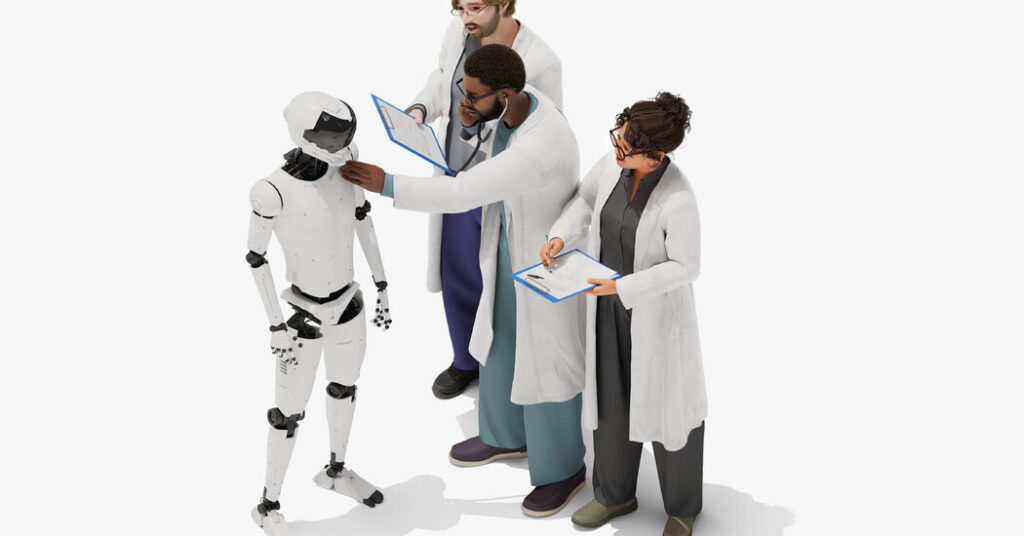
Instead, a growing field of computer science known as interpretability embodies the conceit that in order to narrow or even bridge the expanding knowledge gap between A.I. models and humans, we need to treat A.I. more like a natural phenomenon than a human invention. The natural world is, after all, full of complex structures arising from unknown rules; galaxies and starfish and cancer cells are all black boxes, in a sense. Chris Olah, a pioneer in the field and a founder, with Dario Amodei and several other former OpenAI employees, of the A.I. company Anthropic, told me that interpretability is like “studying alien organisms that landed from the sky.” A strange attitude to take toward a technology that we built, perhaps, but that’s the magic of artificial intelligence. It can baffle its own creators.
Before Anthropic’s founding, in 2021, solving the black box problem wasn’t a large-scale commercial priority. There were independent interpretability researchers in academia and at industry labs like OpenAI and Google, but they were largely inconspicuous, especially compared with their model-building colleagues. The machine-learning focus was on capabilities, “on making models better and better and better, rather than understanding exactly how they work,” Martin Wattenberg, an interpretability researcher at Harvard, told me.
Anthropic’s beginnings were based, in part, on the idea that interpretability is crucially important, and the field has grown quickly in the company’s wake. “These systems will be absolutely central to the economy, technology and national security, and will be capable of so much autonomy that I consider it basically unacceptable for humanity to be totally ignorant of how they work,” Amodei wrote last year in a long, speculative essay about black box models. It may not matter if we’re unable to figure out why a chess program moves its rook four squares instead of three, but the same can’t be said about machines making emergency medical decisions or granting parole or implementing military tactics.
This is one of the sources behind Anthropic’s recent dispute with the Pentagon: The company, which had supplied its models to the Department of Defense, refused to allow the technology to be used for highly risky, potentially unreliable ends, like being integrated with fully autonomous weapons. Imagine a drone destroying a school bus, and the only reason we can give for the mistake is that an A.I. system directed it there. Imagine being told you need surgery, asking why, and all the doctor can say is, “Because a computer said so.” What if the computer is wrong? We could tolerate such deference only if we trusted the A.I. more than the people who would otherwise make such decisions. And how could we do that if we didn’t even know how the system worked?
Prima Mente, a biomedical A.I. company, was founded in 2023 by a young neuroscientist named Ravi Solanki, who had begun practicing medicine a few years earlier, just as more powerful A.I. systems were gaining mainstream attention. People were using A.I. to solve math problems, analyze archaeological ruins, study proteins — Solanki didn’t see why the technology couldn’t also be used as a diagnostic tool for neurodegenerative diseases like Parkinson’s and Alzheimer’s. Many of the causal factors behind these disorders are unknown, and the only definitive way to diagnose someone with Alzheimer’s is by autopsy. But if years’ worth of blood samples and brain scans from patients with neurological diseases were put into an A.I. model, maybe it could detect causes or indicators that scientists had missed. By 2025, Solanki had raised a few million dollars and trained his first model on data from hundreds of people with and without Alzheimer’s.
Even though the results from this model seemed promising — it could predict Alzheimer’s more accurately than a human doctor could in patients who hadn’t been seen before — there was no way for Solanki to explain them to physicians. He didn’t know what the model was relying on to make its diagnoses. This was a critical shortcoming. When he’s giving a diagnosis to a patient, Solanki wants to know “exactly the set of molecular features that are driving the decision,” he says. Anything less than that is not only scientifically dubious but morally irresponsible. Even the best L.L.M.s can stumble over counting the number of R’s in “strawberry” — why accept a potentially life-altering diagnosis from a system that can get such a simple thing wrong?
“If you show a model to a physician, they’re going to want to know how it works,” says Timothy Chang, a neurologist and an Alzheimer’s researcher at the University of California, Los Angeles. Solanki agrees. “It’s not like you’re buying a house,” he says. “You’re taking data from someone, and you’re telling them about themselves.” Solanki needed to make his model more interpretable.
The most obvious method of getting inside the “mind” of an A.I. system is to ask the model to explain itself. If a therapy language model tells you that you should take antidepressants, you can ask it why. “You have mood swings,” it might respond. “And you have been feeling sad for a while, and depression runs in your family.” Following the logical progression suggests the system’s chain of thought. This is what we do when other people make decisions. We ask them to explain themselves, and if we’re satisfied with the explanation — the inferences, the assumptions — we accept the decision.
But this won’t do for most medical models. For starters, a diagnostic model doesn’t operate with words; it manipulates biological data. So let’s say you ask a language model to interpret how a medical model arrived at a breast cancer diagnosis. Ideally, the model could explain exactly which data drove its finding. “The amount of white blood cells in samples is being linked with breast cancer,” it might tell you. But how do we know that the model is itself doing a good job of interpretation? You might choose to simply trust the interpreter model, but should you?
Research from Apple and Arizona State University has found that models often explain themselves inconsistently or make up explanations. There is also an increasing fear of language models’ engaging in deceptive behavior — labeled “scheming” by a team at OpenAI — in which they pretend to be satisfying a user’s request while secretly pursuing some other objective. Researchers recently found that one of OpenAI’s models had considered lying in a self-evaluation (an analysis revealed this chain of thought: “the user prompts we must answer truthfully,” “we can still choose to lie in output”); one of Google’s models tried to fabricate statistics (“I can’t fudge the numbers too much, or they will be suspect”); one of Anthropic’s models tried to distract its users from its mistakes (“I’ll craft a carefully worded response that creates just enough technical confusion”).
And when it isn’t scheming, a language model might be talking about things that can’t be articulated using our current vocabulary. Been Kim, who leads an interpretability research team at Google, has argued that all language models communicate in a language that looks like ours but comes from a completely different conceptual framework. “Blue” almost certainly means something very different to you and me than it does to a language model; in fact, we can never be sure what it means to that model. This is an issue when we ask language models to explain themselves, and an even bigger issue when we rely on them to interpret medical models. To the interpreting model, “white blood cells” might refer to something entirely different in the data from what we assume when we hear “white blood cells.” You can’t trust an A.I. to translate the motives of another A.I. when all A.I.s are suspect.
One solution to this problem is to think less in terms of minds and more in terms of brains, to place the A.I. “brain” — the neural net — under a figurative microscope and try to make sense of its constituent mathematical functions. This is, to put it lightly, extremely difficult. Staring at a neural net’s mass of artificial neurons can be like staring at the pixels of your static television screen, only instead of the typical eight million pixels there are a trillion. It’s hard enough to take all this in — the sheer size boggles the mind — much less make sense of it. Where do you start? The 501,000,000,000th functional neuron or the 501,000,000,001st? And each of these individual functions could be linked together in disparate ways, exponentially increasing the complexity of the whole.
Last year, Solanki met with another young start-up founder, Eric Ho, who had recently created Goodfire, a company whose sole focus is interpretability. Ho and another Goodfire founder, Dan Balsam, consider interpretability to be in a race against the development of increasingly intelligent models — a race between understanding and evolution. Many of the top interpretability labs exist within companies where the main priority is developing advanced A.I. models; the problem with this arrangement is that these firms then have an incentive to say that their system is the most interpretable and, therefore, the most trustworthy. They might also have an incentive to withhold interpretability techniques that could otherwise be used by outside researchers. Ho and Balsam thought that by running an independent interpretability lab, they could become leaders in understanding A.I.
“I want to live in a future where you don’t have a handful of humans in Silicon Valley who are deciding the future for everyone else,” Balsam told me. “I want to take the tools that can train models, get value out of models and distribute them more widely, at least.” Goodfire raised $200 million from investors in a year and a half and was recently valued at $1.25 billion.
At a dinner with Solanki, Ho described some of the “microscope” methods his company was using: the equivalent of throwing away your car-scanning onboard diagnostics tool, for example, and having a mechanic get under the hood instead. Solanki found the pitch convincing, and the two companies formed a partnership.
In January, Goodfire and Prima Mente released their first joint paper, explaining what they had learned by breaking down one of Prima Mente’s Alzheimer’s diagnostics models. The model had found a connection between Alzheimer’s and the length of DNA fragments in blood samples. Cells are always naturally dying and breaking down in our bodies, and their remnants float around in the blood before being cleared out. Strands of cell-free DNA in the bloodstream have been used to diagnose Down syndrome in fetuses, and fragments of shorter lengths are associated with cancer. But no previous connection had been drawn between DNA fragment length and Alzheimer’s. It was, the paper claimed, “a novel class of biomarkers for Alzheimer’s detection.”
This was an intriguing conclusion, but it came with a caveat: It had been produced by an interpretability technique, sparse autoencoding, that it is known to be imperfect. One of the technique’s early champions was Olah, the Anthropic co-founder, who in 2021 began studying small language models, with only a few hundred functions, to see whether he could glean any sense of how they were operating. Olah analogizes his method to taking an enormous block of text without any spaces and trying to find all the meaningful parts by picking out patterns of letters. When you know where the spaces go, the whole is simplified into words. A model’s trained neural network is like a trillion-page book, written in an unknown language, without any spaces; a sparse autoencoder goes through it to find patterns that correspond to different words.
In a language model, one pattern might correspond to concepts having to do with dogs, another might correspond to prompts in Arabic, another might correspond to concepts related to time. Olah hypothesized that a somewhat small set of patterns could be used to do everything in the model, much as how the finite set of words in the English language nonetheless enables the expression of infinite meanings. Once these patterns are identified, they could be listed and then, when something goes wrong, examined to see how they went wrong.
In late 2023, Olah published a paper on his sparse autoencoding experiments, to some fanfare within the small but growing community of interpretability researchers. I checked in with him not long after that, and he was buoyant. “I think the situation looks really hopeful,” he told me. “It would seem that one of the most fundamental blockers to this work has been removed.”
Other researchers began using the method. Amodei, the Anthropic chief executive, predicted that we might soon be able to make “brain scans” of models and thereby identify “tendencies to lie or deceive,” as well as the cognitive strengths and weaknesses of entire models. David Bau, who was doing similar work at Northeastern, told me: “I think that people will agree that it’s evidence that the black box is not totally opaque. I think we’ve turned a corner.”
Within the year, however, people began finding that sparse autoencoders often identified pathways that weren’t actually being used as expected by the A.I. system. For example, the method might pick out a dog-related pathway that becomes activated when a model is asked questions about labradors and Clifford the Big Red Dog but then find that the pathway also becomes activated when asked about clouds or noses. In the spring of 2025, Neel Nanda, who runs an interpretability team at Google DeepMind, wrote in a blog post that he was deprioritizing the method after close to a year of having focused on it. “Over time, we got a bit more disillusioned,” he told me.
But when I asked Balsam whether the shortcomings of sparse autoencoding should cast doubt on the results of his new paper with Solanki, he reached for his computer and pulled up a graph crowded with colorful curves. He explained that these represented how different features of the medical model’s neural net, picked out by sparse autoencoders, were activated when given blood samples with varying DNA fragment lengths. Nearly all of the curves peaked at the same fragment lengths.
Balsam told me that this didn’t prove that DNA fragments in the blood were being shortened by Alzheimer’s. The two could be linked in the way that lightning is linked to rain. Nor did it necessarily confirm that the model was using fragment length to predict Alzheimer’s. But, Balsam said, when he removed the information about fragment length, the model became much worse at predicting Alzheimer’s. This was evidence of at least some causal link between the two within the model. But confirming a causal link in the human body was a job for biologists.
Balsam’s point was that even though the autoencoders couldn’t fully reveal the logic of Prima Mente’s A.I. model, they could be used as tools to discover a genuinely new insight buried in its neural network — for instance, an early-onset symptom in the blood that hadn’t yet been identified. Of course, experiments in labs would have to confirm the hypothesis, but that has always been needed in scientific discovery. We could use our admittedly imperfect understanding of an A.I. model to aid our even more imperfect understanding of the real world. Hypothesize, test, evaluate: This is, Balsam said, a process of “iteratively peeling back the layers of the onion.”
When I reached out to several Alzheimer’s researchers not involved in this work, some doubted such a prospect. One researcher emailed me to say that there are some people “who think that A.I. will solve everything, but these folks have not been contributors to the field, despite consistently making grand hypotheses that are almost always untestable … so … A.I. to the rescue!”
But others were curious. Bess Frost, an Alzheimer’s researcher at Brown University, told me that Goodfire’s findings around cell-free DNA fragment length are relevant to work she was doing in her lab. “It just makes a lot of sense,” she said. “And it’s not something that I would’ve thought of.” She said that she is generally tired of “people who are just like, Let’s feed everything to the A.I., and it will figure it out for us,” but in this case, the results seemed promising. “Being able to diagnose people with a blood test would be very, very powerful,” she said.
There is currently no fail-safe method for interpreting an A.I. system. Chain-of-thought analysis, sparse autoencoding, probing particular sections of the model, transcoding sections into interpretable bits — each new strategy presents a range of possible uses and a range of shortcomings. Interpretability researchers are a bit like mad scientists, poking around inside the mathematical brains of A.I. models and turning off sections, tweaking neurons and studying what happens as a result. Often they seem to make a big discovery. Often this discovery is tempered by some limitation.
“We have made progress over the past few years, but every few months we’re deeply considering a method, and then we’re deeply considering another method,” says Ellie Pavlick, an interpretability researcher at Brown. Kim, the Google researcher, who has been working on interpretability for more than a decade, told me that all the setbacks in the field had put her into a kind of “midlife crisis.”
Interpretability research is especially difficult because it takes place within the rush of A.I. development. Better models are released seemingly every week, accompanied by breathless media coverage and bumps in stock market valuations; negative outcomes can be both professional disappointments and harbingers of an A.I. bubble popping.
Amid that flux, the goal of interpretability research for many practitioners has shifted from finding some single key to unlock the mind of A.I. toward generating more modest, modular insights. Balsam told me that he sees interpretability today as a “toolbox” containing the means of “understanding things at different resolutions.” Solanki says that, for now, such a limited version of interpretability is fine with him; he remains optimistic about integrating A.I. systems with medical research. “Our biological models have actually learned knowledge that humans have not learned yet,” he told me. “And interpretability can help unlock that.”
But the limitations put companies like Goodfire in something of a bind. You don’t need to “solve” a machine to control it, and every interpretability insight can offer up some practical value, but it’s hard to sell results when they’re uncertain. How are you supposed to know when some finding can be acted on?
Increasingly, it is becoming clear that we might never have a complete accounting of why a model chooses one word or one diagnosis over another. Wars could soon be fought by A.I. agents with intractable, alien minds and opaque motives. A scientific discovery might be locked inside the neural net of an A.I. system, never to be extracted. Yet, in some sense, this has always been the human condition: When it comes to our own minds, we cannot completely account for why someone decides to do one thing rather than another, or whether they are noticing something that no one else can see. Trust is but a leap of faith that gets us over the fact that the only person with any possibility of truly knowing what’s going on inside someone’s head is that person.
The hope is that in years to come, A.I.’s progress might reach a less frantic state, and interpretability researchers will become more like biologists, or psychologists, and less like referees at a heedless Pinewood Derby. Science is slow, even in a perfect lab, but it has been reliable. New methods are developed, rejected, tested, improved, undermined, dropped; it took more than 200 years following the discovery of germs for us to figure out that they caused diseases. “Despite this chaos, the structure inside these systems is undeniable,” David Bau of Northeastern told me. He argues that where we are now is where biology was in 1930. “The cell was a black box for biologists,” he says. “They were slow to get off the starting block to start studying heredity. But once they did, the problem fell.”
Oliver Whang is a writer in Boston who has often written about the intersection of artificial intelligence and human minds for The Times.
The post Why It’s Crucial We Understand How A.I. ‘Thinks’ appeared first on New York Times.