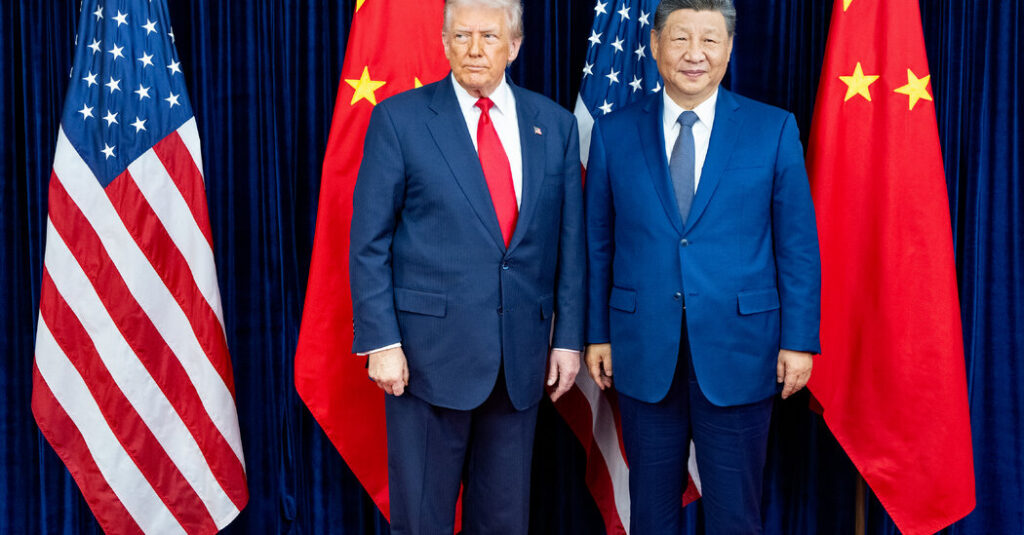
When China declared on Monday that the U.S. blockade of Iranian oil leaving the Strait of Hormuz was “dangerous and irresponsible,” it was a brief window into President Trump’s latest challenge: how to keep the Iran conflict from upending an emerging détente with China.
Mr. Trump is expected to land in Beijing in four weeks, in what was imagined as a carefully planned, highly orchestrated effort to recast the relationship between the world’s two largest economies.
The president has already delayed the trip once, and White House officials insist there is no discussion of putting it off again, even if the United States is still choking off Iranian oil exports. Ninety percent of those exports — more than 1.3 million barrels per day — were purchased by China before the American and Israeli attack began on Feb. 28.
At first the Chinese were relatively quiet about the military action, knowing that the shipments already at sea and an impressive stockpile of emergency reserves of oil would likely tide them through. They ignored Mr. Trump’s demand that China send warships to keep the strait open. They produced standard-issue calls for both sides to stand down.
But once the blockade began on Monday, and facing the prospect that Chinese-flagged cargo ships, some manned by Chinese crews, could be turned away by the U.S. Navy, the tone shifted.
China’s leader, Xi Jinping, made his first public comments on the war on Tuesday, saying that the world could not risk reverting “to the law of the jungle.” He never mentioned the United States or Mr. Trump. But he did not need to, adding during a meeting with the crown prince of Abu Dhabi that “maintaining the authority of international rule of law means not using it when it suits us and abandoning it when it doesn’t.”
It was a clear reference to Mr. Trump, who in January told The New York Times that “I don’t need international law,” adding, “I’m not looking to hurt people.” He made it clear that he would be the arbiter of when international legal constraints applied to his actions.
China’s foreign ministry, playing its accustomed role in signaling between Washington and Beijing, took a tougher line, accusing the United States of a “targeted blockade” that “will only aggravate confrontation, escalate tension, under the already fragile cease-fire, and further jeopardize safe passage thorough the Strait of Hormuz.”
For his part, Mr. Trump has largely refrained from uttering much criticism, even when it became clear last week that U.S. intelligence agencies had obtained information that China might have sent a shipment of shoulder-fired missiles to the Iranians, for use in the conflict. The intelligence was not definitive, and there is no evidence that Chinese missiles have been used against U.S. or Israeli forces.
“I doubt they would do that,” Mr. Trump said. He quickly added that “if we catch them doing that, they get a 50 percent tariff,” employing his go-to threat against any country defying his will. But he has dropped the subject, perhaps recognizing that any threat of new tariffs could derail his hopes of announcing a trade deal, the lowest-hanging fruit in U.S.-China diplomacy.
“President Trump has created the circumstance where two of his biggest goals are in direct conflict,” said Kurt Campbell, a former deputy secretary of state under President Joseph R. Biden Jr. and the chairman of the Asia Group, which he founded.
“One is to monitor and control all cargo coming through the strait, which includes China’s,” he said. “And the other is his desire for a manifestly positive visit to Beijing.”
Mr. Trump’s ambassador to China, David Perdue, was in the Oval Office late on Tuesday, discussing the upcoming visit. National security officials said that before the Iran conflict broke out, Treasury Secretary Scott Bessent had negotiated the outlines of economic initiatives the two countries would announce.
Far less progress has been made on the major security issues, according to U.S. officials, including how to talk about the future of Taiwan, or China’s fast-growing nuclear arsenal, or its military buildup in the South China Sea and the confrontations it has sparked with the Philippines.
With a month to go before Mr. Trump lands in Beijing, it is still unclear how the two leaders will structure a conversation about the blockade — if it is still in force — or about the display of U.S. military power that began with the seizure of Nicolás Maduro of Venezuela, then proceeded with Mr. Trump’s attack on Iran.
But there is considerable evidence the Chinese military is intently focused on how the United States pulled off both attacks. Chinese officials appear concerned about the speed at which the Iranian leadership was decapitated in the opening hours of the war.
“There is a lot of speculation about what can break the U.S.-China détente, and undermine the summit,” said Rush Doshi, an assistant professor at Georgetown University and former adviser to Mr. Biden on China. “It hasn’t been issues like A.I. chips, or even rare earths,” he added, referring to two areas of intense competition between the two nations. “But it could be Iran.”
The blockade, Mr. Doshi said, could “create awkward dynamics” if there is a confrontation between the Navy and commercial Chinese ships, though both have seemed eager to avoid that. “And the second is reports that China is considering sending lethal assistance to help to Iran,” which senior congressional and intelligence officials appear to take seriously.
David E. Sanger covers the Trump administration and a range of national security issues. He has been a Times journalist for more than four decades and has written four books on foreign policy and national security challenges.
The post Trump’s Blockade Risks Upending an Emerging Détente With China appeared first on New York Times.