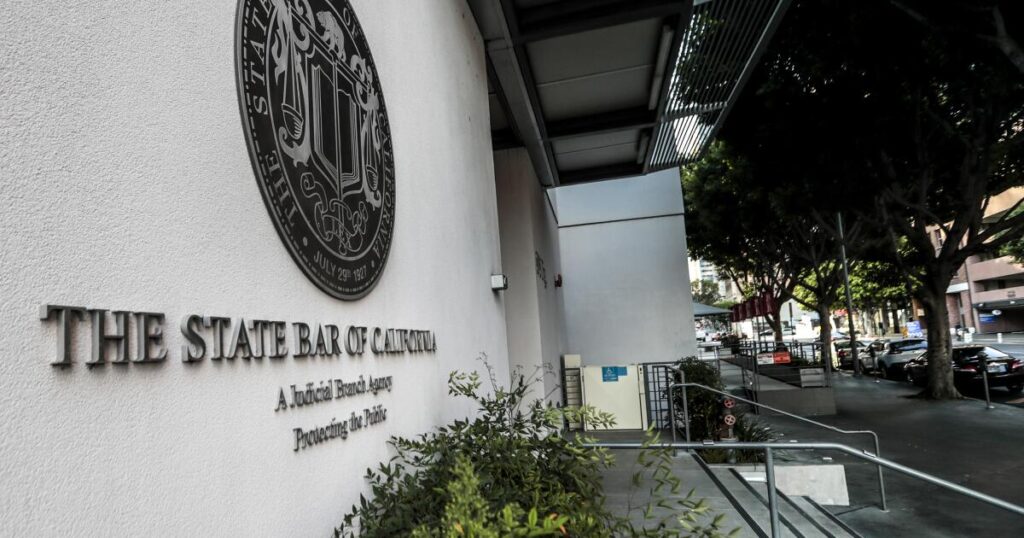
Three attorneys are facing discipline from the State Bar of California after allegations that they cited nonexistent legal decisions in submitted court documents that were written using artificial intelligence.
The State Bar of California recently filed notices of disciplinary charges against Omid Emile Khalifeh, an attorney based in Los Angeles, and Steven Thomas Romeyn, an attorney based in Scottsdale, Ariz., accusing them of misusing AI. The State Bar Court has not ruled on the allegations.
The State Bar Court this month also approved a set of disciplinary measures against Sepideh Ardestani, a Beverly Hills attorney, who was sanctioned for submitting nonexistent and erroneous citations in a March 2025 federal court filing.
Khalifeh, Ardestani and Romeyn could not immediately be reached for comment.
In California, attorneys are allowed to use generative AI tools to draft legal documents. However, they are responsible for verifying all information included in their filings.
Chief trial counsel George Cardona said the three cases demonstrate how justice is undermined when attorneys fail to confirm the accuracy of their submissions to the court. AI tools are known to hallucinate, or make up information.
“Courts and clients must be able to trust that the filings attorneys submit are accurate, supported, and compliant with professional standards,” he said in a statement Monday. “Technology can assist legal practice, but it does not replace an attorney’s duty of competence, diligence, and honesty.”
The State Bar has filed six misconduct charges against Khalifeh related to his alleged misuse of AI in a trademark case filed in federal court in Los Angeles.
Khalifeh is accused of submitting a citation of one case that did not exist and two citations that were not relevant to the arguments for which they were cited in an April 2025 document. He is also accused of violating the court’s standing order, effective Jan. 28, 2025, that requires attorneys disclose any use of generative AI when submitting filings.
When the court flagged these concerns, Khalifeh responded saying he had used AI, but insisted that all citations included in the brief came from real judicial decisions.
“Following drafting, I reviewed, revised, and supplemented all portions of the brief, including those that were informed by the use of Lexis+ AI or based on prior templates,” he wrote in May 2025. “I independently verified the factual and legal accuracy of the content and confirmed that all arguments and authorities were appropriate to the issues presented.”
The court responded by once again raising concerns that one citation was nonexistent and two other AI-assisted citations had only “tenuous” relevance to the case at hand. Khalifeh then admitted he couldn’t verify the existence of one citation and withdrew it from the filing.
Romeyn is accused of submitting irrelevant and nonexistent citations in an October 2025 filing for a personal injury case in Orange County Superior Court.
Once the court flagged concerns, Romeyn disclosed using AI and admitted that he had reviewed and verified several of the citations but did not verify every single citation prior to filing.
The State Bar Court will rule on whether Romeyn and Khalifeh committed professional misconduct and could recommend that their licenses to practice law be suspended or that the attorneys be disbarred. The California Supreme Court determines whether to impose the recommended discipline.
Ardestani, the Beverly Hills attorney, admitted that she was not forthcoming regarding her use of nonexistent and erroneous citations in filings for a wage-and-hour class-action complaint filed in federal court in Sacramento in March 2025.
She did not admit to using AI but claimed that the incorrect citations were a result of her handwritten notes from another matter. She did not provide any documents to support these explanations, according to the State Bar Court.
The Eastern District of California said the time it spent reviewing her alleged misconduct was a “waste of limited time and judicial resources in a district that has labored under a longstanding caseload crisis.”
The disciplinary stipulation approved by the State Bar Court on April 6 calls for a one-year period of probation with conditions including a 30-day suspension of Ardestani’s license. She must also complete ten hours of continuing legal education focused on technology, including at least five hours focused on the benefits and risks of AI tools in legal work.
The post Attorneys used AI to write court filings, cited fake legal decisions, State Bar alleges appeared first on Los Angeles Times.