President Trump faced a groundswell of criticism from Christians across the political spectrum on Monday for his social-media posts attacking Pope Leo XIV and depicting himself as a Jesus-like figure.
The president’s tirade on Sunday night against Pope Leo, one week after Easter Sunday, accused him of being too liberal and “weak on crime,” and even falsely claimed credit for the pope’s election.
For months, tension between the White House and the Vatican has been mounting amid the turbulence of the Trump administration’s aggressive deportation and military operations. Mr. Trump’s extraordinary eruption on Sunday night, the first major attack from the president against the pope, put on unavoidable display the starkly divergent moral visions of the two most powerful Americans in the world.
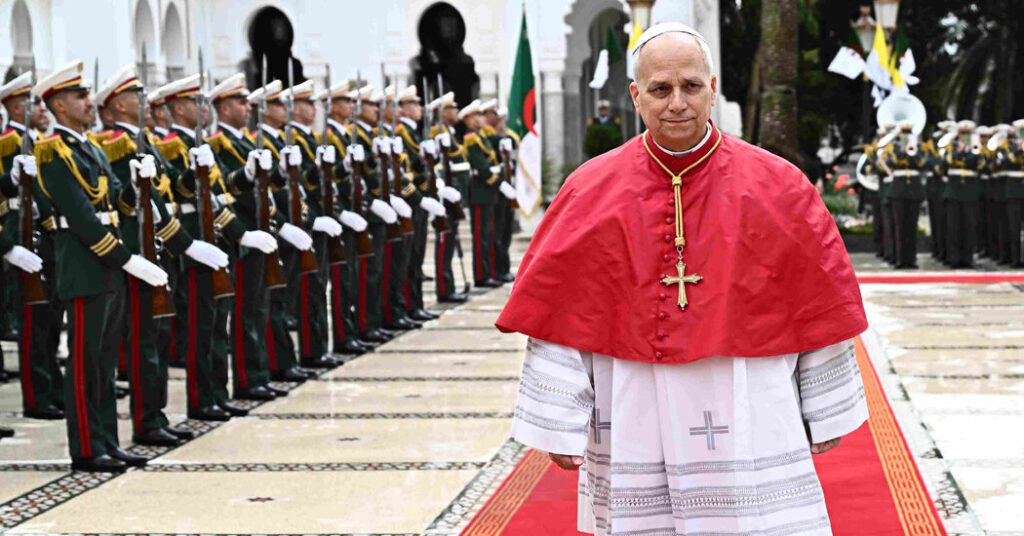
Pope Leo, leader of the world’s 1.4 billion Catholics, has rebuked Mr. Trump recently for his comments about Iran, and has condemned the violence stemming from wars in the Middle East. He replied on Monday morning to Mr. Trump’s eruption as he departed for a 10-day pastoral trip to Africa.
“I have no fear of the Trump administration, or speaking out loudly of the message of the Gospel, which is what I believe I am here to do,” the pope told reporters on his way to Algiers.
By late morning on Monday, the Jesus image, which had been posted on the president’s account on Truth Social, seemed to have been taken down.
Archbishop Paul S. Coakley, the president of the U.S. Conference of Catholic Bishops, issued a highly unusual statement to directly defend the pontiff late Sunday night.
“I am disheartened that the president chose to write such disparaging words about the Holy Father,” he said. “Pope Leo is not his rival; nor is the pope a politician. He is the Vicar of Christ who speaks from the truth of the Gospel and for the care of souls.”
Several bishops across the political spectrum followed. Cardinal Blase Cupich of Chicago said that “the substance of Pope Leo’s message should be the focus of discussions not distractions.”
In Las Vegas, Archbishop George Leo Thomas said he was “grateful to God for sending us Pope Leo XIV, who is willing to speak truth to power just when we need him the most.”
Early Monday morning, Bishop Robert Barron, a prominent conservative voice who serves on Mr. Trump’s Religious Liberty Commission, called on the president to apologize.
Mr. Trump’s comments were “entirely inappropriate and disrespectful,” he said in a social media post. “It is the Pope’s prerogative to articulate Catholic doctrine and the principles that govern the moral life,” he said, adding that Mr. Trump had shown more respect for religious liberty than any other president in Bishop Barron’s lifetime.
Mr. Trump’s attack was reminiscent of his repeated anger at Pope Francis, who took many vocal stands against Mr. Trump and even suggested that he was “not Christian” before he became president.
Many conservative American Catholics then saw the papacy as too aligned with the agenda of former President Barack Obama, as Francis prioritized issues that resonated with many progressive Catholics like climate change and immigration.
But Pope Leo’s soft-spoken style and return to more traditional elements of Catholic life have endeared him to many conservatives.
Sunday’s outburst was “astounding,” said Father Robert Sirico, president of the Acton Institute for the Study of Religion and Liberty, a policy group that endorses free-market economics. He said it reminded him of when the prominent atheist Christopher Hitchens attacked Mother Teresa.
Both men seemed “unable to grasp” the” moral horizon from which the church speaks, thus making any reasonable exchange impossible,” Father Sirico said. Later he added that Catholics were “not obliged to treat every prudential judgment of the pope on foreign policy or crime as infallible.”
“The church’s mission is not to micromanage Pentagon strategy or crime bills,” he said.
Tim Busch, a co-founder of the NAPA Institute, a conservative Catholic-oriented network, declined to comment.
Leading Catholics in the Trump administration, including Vice President JD Vance and Secretary of State Marco Rubio have so far not commented publicly.
Other prominent conservatives, and not only Catholics, quickly expressed outrage at the apparently A.I.-generated image that Mr. Trump posted of himself as a Jesus-like figure healing a sick person.
“Does he actually think this?” Riley Gaines, the anti-transgender rights activist, posted on social media. “God shall not be mocked.”
David Brody, an evangelical journalist with the Christian Broadcasting Network, called on Mr. Trump to take it down.
Last year, after the death of Pope Francis, Mr. Trump posted a photo of himself as pope and joked that he would like to be the next pope.
Some observers wondered if Mr. Trump was responding to Sunday night’s “60 Minutes” segment that featured a rare sit-down interview with the three highest-ranking American cardinals who lead archdioceses — Cardinals Cupich, Robert McElroy of Washington and Joseph Tobin of Newark — and who vocally condemned American foreign policy this year, citing events in Venezuela, Greenland and Ukraine.
Cardinal Tobin said on Monday that Mr. Trump’s actions and statements “convey a grave misunderstanding of the Holy Father’s ministry and a troubling lack of respect for the faith of millions.”
“The graphic exploitation of sacred imagery is deeply offensive and undermines the reverence owed to what believers hold most dear,” he said.
Elizabeth Dias is The Times’s national religion correspondent, covering faith, politics and values.
The post Trump Attack on Pope and Posting of Jesus Image Draws Widespread Criticism appeared first on New York Times.