Shipowners and shipping experts said they did not expect a large number of vessels to return quickly to the Strait of Hormuz as the United States began a military effort Monday to end Iran’s control of the crucial waterway.
In particular, they said, the U.S. plan lacked detail on how commercial vessels would be protected if they decided to go through the strait.
“It is still unclear how the safety of the passage of commercial ships will be ensured,” said Jerry Kalogiratos, chief executive of Capital Clean Energy Carriers, a shipping company that operates oil and gas tankers.
The uncertainty of protection and fear that Iran may attack commercial vessels in response to the United States’ move mean that the number of ships going through the strait will most likely remain extremely low.
After talks between the United States and Iran over the weekend did not lead to a peace deal, President Trump said the United States would act to stop Iran from using the strait to its own advantage.
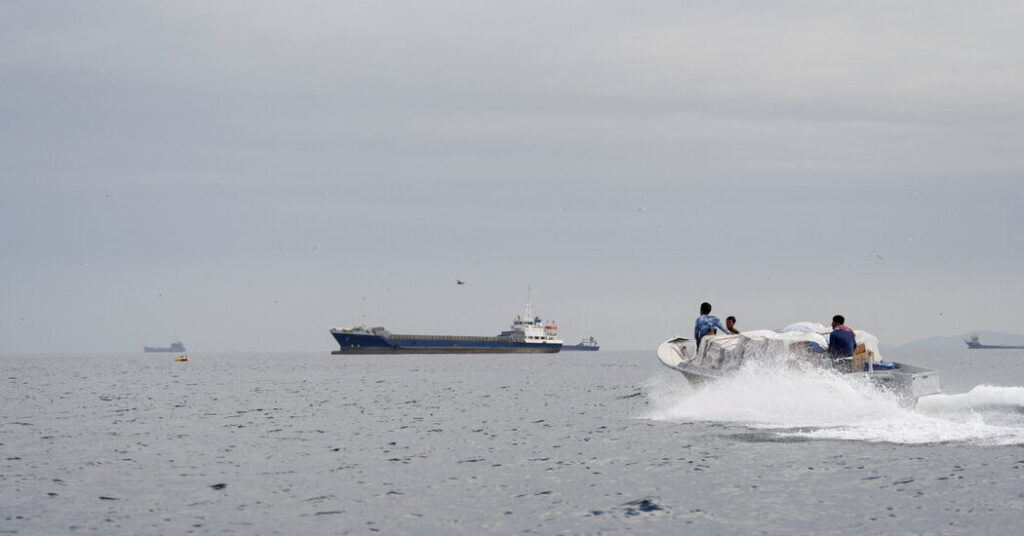
Iran has been allowing a small number of ships, its own vessels included, to pass through the strait, using a route that runs close to Iran’s coastline and can involve docking at Iranian ports. The United States Central Command acted on Monday to stop those shipments but said it would allow non-Iranian traffic.
Fourteen vessels went through the strait on both Saturday and Sunday, according to Kpler, a maritime data firm. Those figures represented an uptick in wartime traffic, but are still well below the more than 120 ships that went through before the war daily.
“There is still a trickle of trade making its way through,” said Alexis Ellender, an analyst at Kpler, adding that the risk appetite of major shipping companies is “incredibly low.” Two vessels linked to Iran went through the strait on Monday, before the U.S. blockade began, according to Kpler.
Last week, there were 244 tankers west of the strait in the Persian Gulf, and 156 tankers east of the waterway, according to S&P Global Market Intelligence.
Iranian officials have signaled that Iran would strike back against the blockade.
On Sunday, Mohsen Rezaei, a former commander who is now a senior adviser to the supreme leader Mojtaba Khamenei, said Iran had “large, untouched levers” to counter any naval blockade, and that the country would not be pressured “with tweets and imaginary plans.”
Arsenio Dominguez, the head of the International Maritime Organization, the U.N. agency responsible for shipping safety and security, said on Monday that he did not expect the blockade to have a big effect, given that the number of ships passing via the strait was already extremely low.
“An additional blockade just doesn’t really help anything in finding a solution to the conflict,” he added at a news conference in London.
The drastic reduction in tankers leaving the Persian Gulf through the strait has cut off a large share of oil and gas supplies to the world, pushing up the prices of gasoline, diesel and other energy products. Iran has used its de facto control of the strait as leverage against the United States and Israel during the war.
In announcing the blockade, Central Command said it would “not impede freedom of navigation” of ships leaving ports from other, neighboring countries, and said it would provide more information to commercial mariners.
The announcement signaled that the United States was willing to work with shipping companies that it deemed neutral in the war, yet there were few details on Monday on how it would do so. And some experts said it fell short of a commitment to shield vessels from Iranian attacks.
“It hardly constitutes a promise to protect non-Iranian shipping, which is likely the problem that the commercial companies and ship masters want solved,” said Eugene Gholz, an associate professor of political science at the University of Notre Dame and expert on the Strait of Hormuz.
Mr. Kalogiratos, the shipping executive, said the current information from the United States isn’t enough to “materially change” its risk assessment of the passage.
“The essential element here is the perception of safety for shipowners, operators and our seafarers, and clear rules of engagement as far as the transit is concerned,” he said.
Several countries have opposed Iran’s stranglehold on the strait, not only because it has led to higher energy costs, but also because the waterway was not controlled by any country before the war and ships could pass through freely.
“It is important to safeguard freedom of navigation in Hormuz and ensure that all ships transit freely and safely,” said Noam Raydan, a senior fellow at the Washington Institute for Near East Policy. “But I don’t expect Iran to make this U.S. mission easy.”
She said ships may remain reluctant to enter the Persian Gulf through strait and find themselves unable to exit.
Commercial ship operators may be more likely to send their vessels through the strait if there is a naval escort as protection against Iranian attacks. Early in the war, Mr. Trump said United States might provide an escort but later pressed other countries to do so.
President Emmanuel Macron of France said on Monday that France and Britain would organize a conference in the coming days to assemble a multinational mission to secure passage for ships in the Strait of Hormuz. The two countries have already held planning meetings for a coalition of up to 35 countries.
“This strictly defensive mission, distinct from the belligerents, will be deployed as soon as the situation permits,” Mr. Macron said on social media.
Mark Landler contributed reporting.
Peter Eavis reports on the business of moving stuff around the world.
The post Shipping Companies Remain Reluctant to Sail Through Strait of Hormuz appeared first on New York Times.