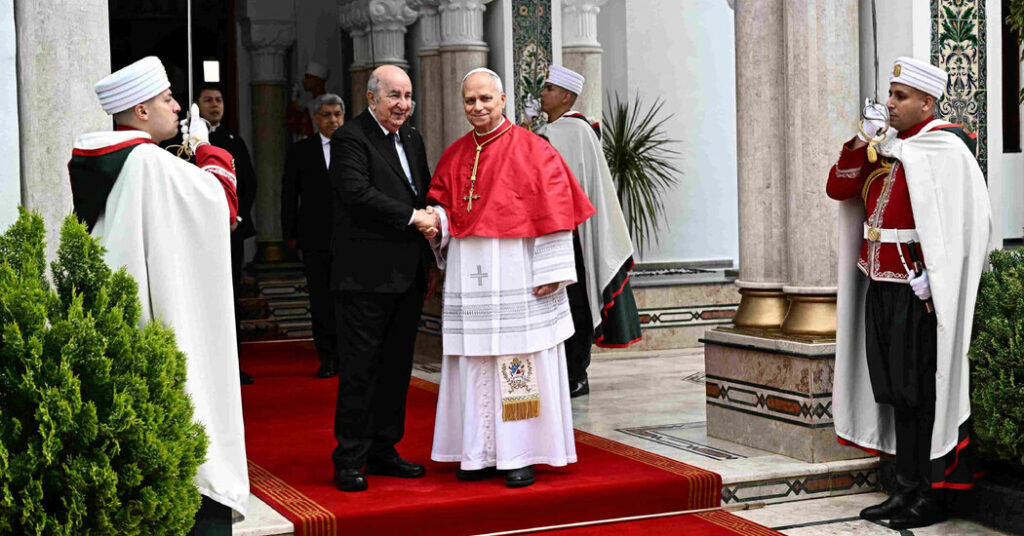
Pope Leo XIV’s standoff with President Trump is the latest example in which a pope ventured into geopolitical territory, at times directly clashing with the secular authorities or even provoking political change. Here are five other examples, including Pope John Paul II, who helped inspire anti-Communist activists, and Pope Benedict XVI, who inflamed relations with the Muslim world.
1. Pope Francis and migrants
Pope Francis, who led the church from 2013 until his death last year, was considered the most outspoken of recent pontiffs, regularly voicing opinions on climate change, poverty and migration.
Weeks into his papacy, on his first papal trip out of Rome, Francis described migrants as “brothers and sisters” while visiting Lampedusa, a tiny Italian island that had become the point of arrival for thousands of migrants crossing the Mediterranean Sea from Africa. That same month, he struck a more compassionate tone on homosexuality than his predecessors, asking, “If someone is gay and he searches for the Lord and has good will, who am I to judge?”
Though Francis rarely confronted the politicians and dictators he visited, he was sometimes more direct. Meeting in 2021 with Viktor Orban, the hard-right, anti-migrant prime minister of Hungary, Francis told him that God was not a strongman who silenced enemies and that a country’s religious roots should allow it to extend “its arms toward everyone.” (Mr. Orban lost national elections on Sunday.)
Francis’ vision, expressed in major documents like the encyclical “Laudato Si,” or “Praise Be to You,” linked Catholic theology to protecting the environment while denouncing the perceived excesses of global capitalism as exploiting the poor.
2. Pope Benedict XVI and Islam
Benedict XVI, who was pope from 2005 until his resignation in 2013, inadvertently provoked riots in which several people died in 2006 when he quoted a Byzantine emperor saying that Islam had brought “things only evil and inhuman.” The Vatican said his words had been misinterpreted, and Benedict visited Turkey later that year as a way to make amends.
3. Pope John Paul II and Poland
John Paul II, the first Polish pope, visited his homeland in 1979, the year after his election as pontiff. Speaking to students in Krakow, the pope told Poles, “Do not be afraid.”
It was a message that Polish leaders later said helped to inspire the pro-democracy movement that overthrew the Communist dictatorship. A year after his visit, activists formed the Solidarity labor movement, which helped propel the collapse of Communism in Poland in 1989. That helped accelerate the collapse of other Communist governments in Eastern Europe, including in East Germany and Bulgaria.
4. Pope Paul VI and peace
Paul VI, the pontiff from 1963 to 1978, instituted the “Day of Peace,” an annual event since held by the Vatican on the first day of each year to promote efforts to end conflict.
John Paul II cited Paul VI’s appeals for peace when he opposed the Iraq invasion in 2003. So did Leo in his criticism of the Iran war over the weekend: “I make his appeal my own this evening, relevant as it is today.”
5. Pius XII and the Holocaust
While other popes attracted attention for their words, Pope Pius XII, who led the church from 1939 to 1958, has long been scrutinized for what he did not say about Nazism and the Holocaust.
After the Vatican unsealed the archives of his papacy in 2020, researchers found a letter that showed that the Holy See had been told in 1942 that up to 6,000 people, “above all Poles and Jews,” were being killed at a Nazi death camp in Poland.
Some have used such material to cast Pius XII as the pontiff who remained shamefully silent as the Nazis massacred Jews during the war. Others say that Pius, who has long been considered for sainthood, worked behind the scenes to encourage the Roman Catholic Church to save thousands of Jews and other victims of persecution.
Elisabetta Povoledo is a Times reporter based in Rome, covering Italy, the Vatican and the culture of the region. She has been a journalist for 35 years.
The post Many Popes Have Been Entangled in Politics. Here Are 5 of Them. appeared first on New York Times.