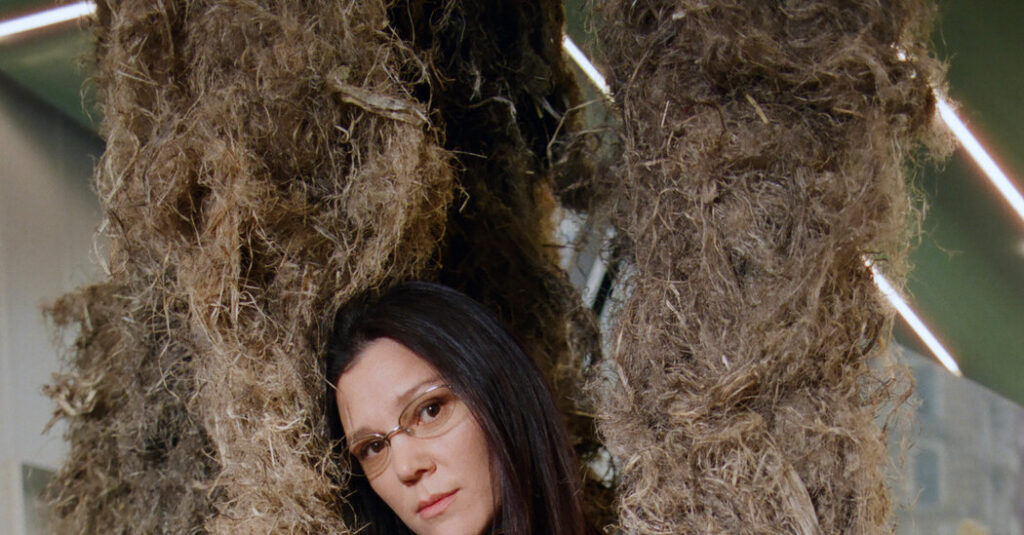
If a prehistoric woolly mammoth came back from extinction, with Rapunzel-like fur, it might resemble the monumental green flax and hemp installation by the artist Klara Hodsnedlova that christens the soaring atrium stairway of the New Museum’s expansion.
From her hometown in the Moravian Slovakia region of the Czech Republic, Hodsnedlova, 36, creates hulky “tapestries” that weave together fine embroidery and carved sandstone sculptures with cast-glass talons that recall fossils or bones culled from the distant past, or a mysterious future.
At the New Museum, her tactile work, with dreadlocks, cascades down four floors and hugs the staircase designed by OMA before pooling on the floor, giving off a slightly musky aroma. “When I imagine an exhibition, I often think of it as a landscape, creating a forest where the body can move between vertical forms and be surrounded like an embrace,” Hodsnedlova said during a visit last month for the opening of the museum.
Her organic fibers are part of a centuries-old tradition of cultivating and harvesting plant materials in the Czech Republic. She fashions her cocooning pelt-like forms by hand, dyeing the strands with natural pigments.
Her work is her U.S. debut, after noteworthy European exhibitions including at the Hamburger Bahnhof-Nationalgalerie der Gegenwart, a cavernous former train station in Berlin. Her tapestry at the New Museum opened in tandem with the kaleidoscopic exhibition “New Humans: Memories of the Future” curated by the museum’s artistic director, Massimiliano Gioni, and containing 16 newly commissioned works. “Klara returns to futures that have not yet occurred,” Gioni said. “It’s a good beginning for the museum’s new journey.”
The artist had not laid eyes on the atrium — which was under construction until the 11th hour — before she designed her piece.
“It’s a pretty brave and bold thing for a young artist to do a four-story sculpture in a space she hadn’t seen,” said Gary Carrion-Murayari, the museum’s senior curator. “The ambitious scale of her work and the new gallery space are a fortuitous pairing.”
Hosnedlova is part of the first democratic post-Communism generation, learning about socialism “just from books,” she said. Her practice is deeply rooted in her homeland, a place she describes as “a paradox” where industrial facilities and lush green hills converge. After seven years in Berlin, and the birth of their son two years ago, she and her husband, Igor Hosnedl, a painter, moved back to the town of Uherske Hradiste — about four hours from Prague — to be closer to their families.
She did not have an arty upbringing: Her father is a truck driver, and her mother is a hairdresser. But through them she “received a message of freedom” as a child, she said, though she had no inkling that being an artist could be a career.
With Hosnedl, a fellow creative soul whom she met in high school, Hosnedlova attended the Academy of Fine Arts in Prague, only to find that the painting and sculpture studios were annoyingly male-dominated. Uninterested and stressed by working on large canvases, she gravitated to textiles, which was still treated as a lesser art discipline. She had enjoyed sewing her own clothes as a child, and relished the calm.
She and her husband first visited New York as art students, and it was far from relaxing. They spent a summer at a salmon plant in Alaska, plucking caviar from an assembly line to earn the money to fly to New York to visit galleries; they slept in a Slovakian Church in Manhattan.
Hosnedlova’s sandstone sculptures function as outsize lockets for her photorealistic embroideries. They are drawn from the public sculptures popular in socialist-era towns.
“For children, these sculptures were not museum objects but something to climb on, part of the landscape of play,” Hodsnedlova said. “But I later realized how strongly these encounters stayed with me, shaping my sensitivity to materials and my awareness of how bodies inhabit space.”
That awareness was on bountiful display in the atrium before the museum’s reopening in March, where the artist had choreographed a scene with a group of amateur female performers recruited on Instagram. Before filming she brushed their hair with products from her mother’s salon. The performers were dressed in gossamer costumes with wire or leather corsets and netlike skirts that brought to mind Ophelia reincarnated as a retrofuturist. They nestled languorously on the staircase and draped arms across the perforated metal balustrade glowing from within with the green fluorescent light from OMA.
The performance, shot privately for the installation with the help of a drone, dramatized how Hodsnedlova’s sheltering tendrils offer a foil to Rem Koolhaas and Shohei Shigematsu’s controlled, angled architecture. Viewed from Prince Street, the installation appears apparition-like amid the tube lights, especially at night.
The embroidered cotton images embedded in her sculptures — one can see the detail of a sleeve, a hand or lit match — are drawn from past performances. It’s Hodsnedlova’s way of creating what she calls “a tangible archive” in thread.
“That Klara can so convincingly render flesh, flame, smooth metal or soft fur in the medium of thread seems miraculous,” said Susanna Greeves, the global director and museum liaison for White Cube, the London-based gallery that represents her, along with Kraupa-Tuskany Zeidler in Berlin. (The artist introduced living mycelium and Reishi mushrooms into a recent immersive show at White Cube’s Bermondsey space in south London.)
Among the local fabricators and craftspeople with whom she collaborates is her uncle Josef Smid, who built the massive steel armature conceived as the vertebrae that binds the New Museum tapestry.
The formidable cast glass claws on the sculptures were produced by Lhotsey Studio, which follows in the tradition of the world-renowned cast-glass artists Stanislav Libensky (1921-2002) and Jaroslava Brychtova (1924-2020), who developed a mold-melting technique that allowed them to translate abstract concepts into glass. Their works include reliefs of falling meteorites for Jested Tower, a “hyperboloid” example of Eastern Bloc modernism on a mountaintop near the Czech Republic city of Liberac — a National Cultural Monument and one of many Czech buildings that have inspired Hodsnedlova’s embroideries.
Before she turned to art, she pursued a Ph.D. focused on the Czech modernist designer Adolf Loos (“the university is still writing, ‘please finish’” she said with amusement.) She also interpreted the Loos’s color combinations of wood, stone and textiles into an embroidery in one of his former interiors.
Her work is often described as “utopian” or “dystopian,” and she admits that it can seem alien. “They use weird words like ‘apocalyptic,” she said. “It may look futuristic or sci-fi, but I’m not thinking about a period of time with my sculptures. Aesthetically you don’t know if it’s made 200 years ago or nowadays.”
With the attention from the New Museum, her career is thriving but she feels it may be time to explore a new material. She is considering bronze. “I like when I don’t know what I’m doing 100 percent,” she said.
The post What’s That Musky Aroma at the New Museum? appeared first on New York Times.