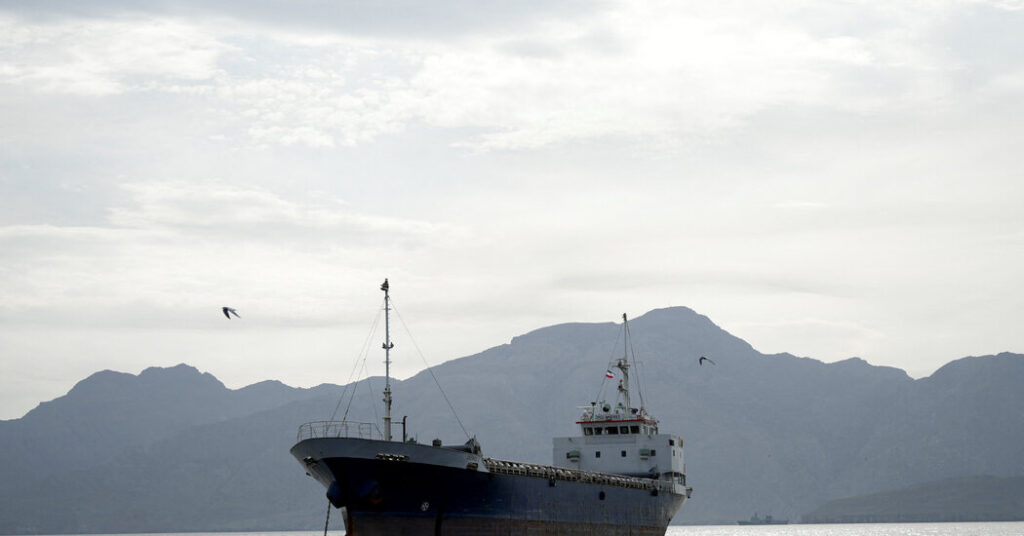
President Trump’s announcement over the weekend of a complete U.S. blockade of Iranian ports was another surprise shift in his zigzagging efforts to bring Iran to heel and reopen the critical Strait of Hormuz to international shipping.
The U.S. Navy will block access to Iran’s ports starting on Monday and intercept any ships that pay Iran for safe passage, Mr. Trump said, suggesting that other militaries would join the effort.
“We think that numerous countries are going to be helping us with this also,” he told Fox News on Sunday.
Early Monday, there was no sign of volunteers.
Prime Minister Keir Starmer of Britain said his country would not support a blockade. His Australian counterpart, Anthony Albanese, said his government had not been asked to help and instead called for “de-escalation” of the conflict.
Mr. Trump’s proposed blockade “makes no sense,” Spain’s defense minister, Margarita Robles, said in a television interview on Monday. “Since this war started, nothing makes sense,” she said. “This is another episode in the downward spiral the world has been dragged into.”
The American-Israeli war on Iran, now in its seventh week, has scrambled global trade, roiled energy markets and inflicted economic distress on countries across the world, harming American friends and foes alike.
Mr. Trump’s sudden announcement of the blockade on Sunday did not appear to brighten the increasingly gloomy sentiment. Oil prices surged on Monday and stocks fell, suggesting that investors did not expect the blockade to swiftly fix the damage the war has caused.
The blockade appears to be Mr. Trump’s latest effort to exert pressure on Iran to negotiate after direct talks between U.S. and Iranian officials in Pakistan over the weekend failed to yield a breakthrough.
Some experts questioned whether the tactic would work.
Ahmet Kasim Han, a professor of international relations at TED University in Ankara, Turkey, said Mr. Trump could be overestimating how effective the economic pain of a blockade would be in changing Iran’s position.
“Iran is already hurting, and they have shown that they are willing to take more than a couple of hits,” he said. “The Iranian regime is not one that cares for the well-being of its citizens, and there is no civil society that can raise its voice against the regime in the face of economic calamity.”
Mr. Han added that Mr. Trump’s message was undermined by his announcement that other countries would help impose the blockade without saying which ones.
“This habit of saying that people are on board with him while not naming them diminishes his credibility, and that does not work well for U.S. standing internationally,” he said.
Many governments did not have an immediate direct response to Mr. Trump’s announced blockade. Among those who did, most instead called for a return to negotiations.
“It is, in my view, vital that we get the strait open and fully open, and that’s where we’ve put all of our efforts,” Mr. Starmer told BBC Radio 5.
“We want to see de-escalation, and we want to see those negotiations resumed,” said Mr. Albanese of Australia, who was preparing to embark on a diplomatic tour across Asia aimed at securing fuel and fertilizer supplies. He called the lack of progress in the talks between Iran and the United States over the weekend “disappointing.”
In Beijing on Monday, Guo Jiakun, a spokesman for China’s foreign ministry, called for a cease-fire and for all parties to show restraint.
“China is willing to continue to play a positive and constructive role,” he said.
China is a major recipient of fuel through the Strait of Hormuz.
Reporting was contributed by Michael D. Shear in London, Laura Chung in Sydney, Australia, Carlos Barragán in Madrid and Lily Kuo in Taipei, Taiwan.
Ben Hubbard is the Istanbul bureau chief, covering Turkey and the surrounding region.
The post Trump Said Other Countries Would Help Blockade Iran. So Far, There Are No Takers. appeared first on New York Times.