For much of the past four years, Hungary was a persistent source of irritation for Ukraine. An outlier in Europe, Hungary maintained friendly relations with Russia while blocking critical European Union funding for Kyiv and stalling its path toward integration into the bloc.
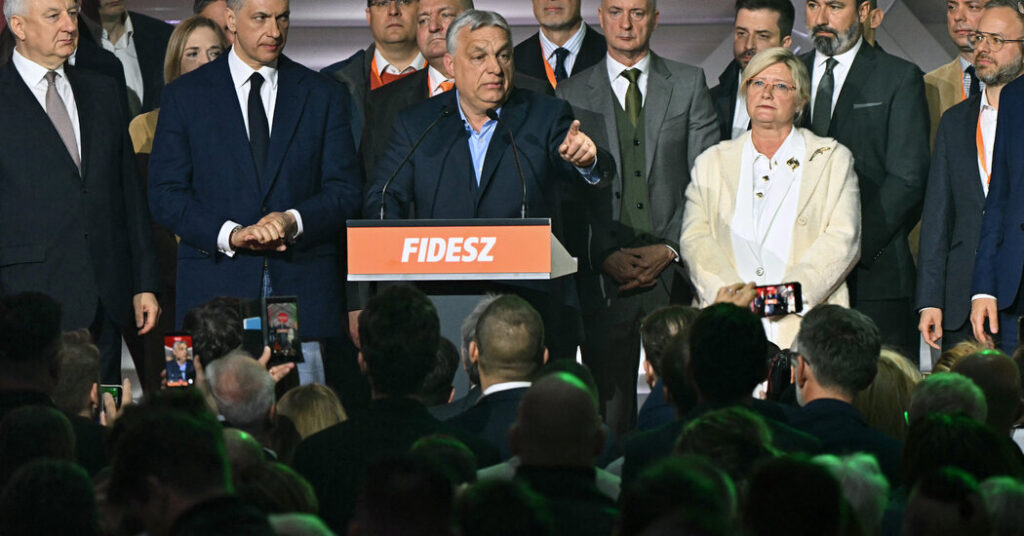
After the election defeat on Sunday of Viktor Orban, Hungary’s longtime prime minister and the architect of its pro-Kremlin policy, many Ukrainians were hoping for a turning point.
One Ukrainian lawmaker celebrated in Budapest’s streets by chanting, “Russians, go home!” — a slogan embraced by supporters of Peter Magyar, the victorious opposition leader. President Volodymyr Zelensky of Ukraine struck a more diplomatic tone in a congratulatory message to Mr. Magyar on social media, but the Ukrainian leader’s hope for improved ties was clear.
“Ukraine has always sought good-neighbourly relations with everyone in Europe and we are ready to advance our cooperation with Hungary,” Mr. Zelensky wrote.
In the immediate term, Sunday’s election result could deliver a much-needed financial boost for Ukraine. Since February, Mr. Orban has blocked a 90 billion euro loan to the country, leaving the government at risk of running out of funds by the end of spring. His defeat is expected to clear the way for the loan to be disbursed.
“It looks as if this sort of Trojan horse for Russia within the E.U. may disappear,” said Andreas Umland, a policy fellow at the new European Policy Institute in Kyiv. “That was the main problem of Ukraine: Hungary functioned not as a E.U. member but as an agent of Russia within the E.U.”
In the longer term, it is unclear how Mr. Magyar’s victory might benefit Ukraine.
Mr. Magyar adopted a clear anti-Russian stance during his campaign, separating himself from Mr. Orban, who was aligned ideologically with the Russian president, Vladimir V. Putin, and relied on Russia for critical energy imports.
But Mr. Magyar has stopped short of endorsing additional financial aid to Ukraine, and he has opposed an accelerated timeline for the country’s integration into the European Union, saying that Ukraine should meet all the standard requirements before being admitted. The Hungarian electorate has been divided on both of those issues.
Ukraine has long had a complex relationship with Hungary, with which it shares a 64-mile border in its west. Tensions have often centered on the sizable ethnic Hungarian minority in Ukraine’s Zakarpattia region — up to 150,000 people. Disputes over language and education rights have strained ties, which Mr. Orban has exacerbated through an assertive policy of backing Hungarian minorities abroad.
The relationship hit a low during the war as Hungary, while initially condemning Russia’s aggression, maintained friendly ties with the Kremlin and increasingly worked against Ukraine’s interests in Europe. In particular, Budapest consistently blocked the opening of E.U. accession talks for Ukraine, cementing its reputation as a spoiler in Kyiv and becoming a recurrent target of criticism by Ukrainian officials.
“Every ‘Viktor’ who lives off European money while trying to sell out European interests deserves a smack upside the head,” Mr. Zelensky said at the World Economic Forum in Davos, Switzerland, this year, in a reference to Mr. Orban.
The tensions worsened before the Hungarian election, with Mr. Orban making hostility to Ukraine a centerpiece of his campaign.
Mr. Orban accused Ukraine of delaying repairs to a pipeline crossing its territory that carries Russian fuel to Hungary and Slovakia. He called this an effort to damage Hungary’s economy and to blackmail it into supporting Ukraine in the war.
In response, Budapest blocked the 90 billion euro loan. It went on to veto new E.U. sanctions against Russia, and then it seized millions of euros in cash and gold from Ukrainian armored bank vehicles traveling through Hungary, suggesting the money was of dubious origin.
Hungary’s blocking of the loan has been a burden for Ukraine, which desperately needs the funds to sustain its war effort as the fighting continues unabated and peace negotiations have largely fizzled out. A cease-fire for Orthodox Easter, brokered with Russia over the weekend, appeared to largely falter, with each side accusing the other of numerous violations.
About two-thirds of the loan money had been earmarked for purchasing weapons, while the rest was intended to support the Ukrainian budget and economy. Without the funds, a top Ukrainian lawmaker warned in February, Kyiv may be headed toward a “financial tragedy.”
Constant Méheut reports on the war in Ukraine, including battlefield developments, attacks on civilian centers and how the war is affecting its people.
The post Defeat of Orban Removes Ukraine’s Biggest Nemesis in Europe appeared first on New York Times.