Some doctors in the military are being told to not see patients. Pilots are grounded. A police investigator was forced to abandon her cases. An aircraft carrier headed to war without a critical nuclear reactor supervisor.
Those professionals and thousands of others have been pulled from military jobs for one reason: They are transgender.
President Trump ordered a ban on trans service members days after taking office, saying it was necessary to improve operations and cut costs in the military. Instead trans troops say, highly trained professionals have been removed from positions with little planning, leaving their teams short-handed.. When they disappeared from their jobs, they stayed on Defense Department books for months unable to be replaced and being paid to do nothing.
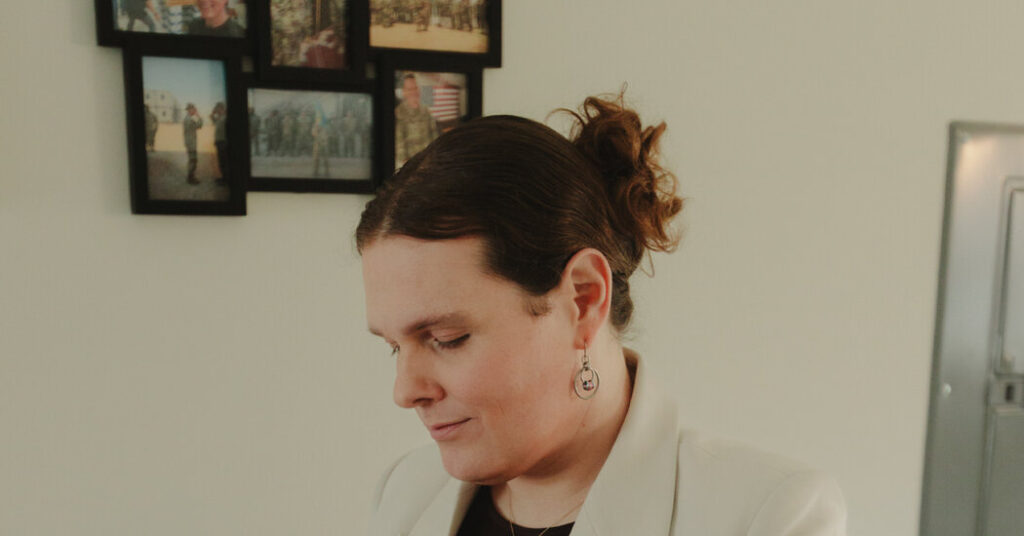
“It is the biggest waste I’ve ever seen,” said Capt. Katie Benn, a decorated air defense officer who was has served in the Army for 13 years. “I’ve proven I’m good at my job. They just won’t let me do it.”
The captain was scheduled to deploy to Iraq in June. She had broken her apartment lease near Fort Campbell, Ky., and packed her duffel bags when she was abruptly told by her commander that she couldn’t go because she was trans. Since then, she has been sitting at home.
She keeps her duffels packed, hoping that the Army will call and tell her to deploy. No one has.
“I’m trained to take care of soldiers, and my soldiers are over there in harm’s way,” she said. “It kills me to not be there with them.”
The Defense Department has stayed silent on how many troops have been forced out, how the ban has affected operations, and how much has been spent on severance checks and paid leave. The department and all of its service branches declined to comment.
President Trump, when he signed the executive order last year, said being transgender “conflicts with a soldier’s commitment to an honorable, truthful and disciplined lifestyle.”
Defense Secretary Pete Hegseth has been outspoken. In public comments he described allowing people to identify as a gender other than their sex at birth as an “insidious, radical, woke ideology.” Trans troops, he said, express a “false gender identity” that “cannot satisfy the rigorous standards necessary for military service.”
Mr. Hegseth has refused to meet with trans troops who say they can meet those standards. In May, he told an audience, “No more dudes in dresses, we’re done with that shit.”
When the ban was announced, the military gave trans troops a choice: Leave voluntarily for double the separation pay, or be forced out. In both cases, troops spent months waiting for the military to take action.
Some who opted to leave started to be discharged in December. Those who didn’t volunteer are largely still waiting.
The New York Times found the group included at least 10 doctors and eight lawyers. The government paid for their education, requiring years of military service in return. But many of them are now being discharged before they have served their obligation.
The Army paid for three years of law school at Harvard for Ryan Gunderman. In exchange, the Army expected the young captain to serve for six years as an Army lawyer.
She had served less than two when she was put on leave. She chose to leave the Army voluntarily, and after more than six months on paid leave, she was discharged in January.
“They spent more than a half a million dollars on me, just in education,” the former captain said in an interview. “Can you think of another organization that would look at my credentials and say, ‘OK, let’s get rid of her’?”
Trans service members filed two federal civil rights cases in early 2025 challenging the ban. Both are still pending. In May, the Supreme Court allowed the ban to take effect while the cases move forward.
Many of the troops forced into administrative leave have specialized training that is now going unused.
Navy Chief Petty Officer Parker Moore supervised about 80 sailors who ran the nuclear reactor on the aircraft carrier U.S.S. Abraham Lincoln.
Last year, the Lincoln was preparing to deploy when Chief Moore was put on leave. The rear admiral in charge of the carrier ordered the chief back to the ship, saying in a memo, “Your technical expertise, deckplate leadership, professionalism, loyalty and character are necessary for day-to-day operations.”
The Navy eventually pulled the chief from the job anyway. The Lincoln deployed from San Diego in November. Chief Moore was discharged in December.
The Lincoln is now involved in combat operations against Iran.
“I have had really bad guilt about not being there,” Chief Moore said. “That’s my job. I was good at it. Others have to do extra because I am not there. They’re in a hard place. If something goes wrong in the reactor, it affects the whole ship.”
To many, the cost of being forced out runs deeper than money. They say that they were forced to abandon the values of duty and honor that they vowed to uphold.
Julia Becraft, an Army sergeant first class, had been deployed to Afghanistan three times and awarded the Bronze Star. She was slated to lead a platoon when she was told to stay away from her battalion at Fort Hood, Texas. She was put on paid leave, where she remains.
The order was so devastating that she checked herself into an Army mental health hospital. Of the 20 soldiers in the hospital at the time, four were transgender, dealing with the mental effects of the ban, she said.
“It makes you lose faith in the whole system,” she said in an interview. “All I ever wanted to be is a soldier. I used to be proud of it. Now I don’t know if I could ever bring myself to put on the uniform again.” She started to cry, then added, “It sucks that they’ve taken that from me.”
The number of trans people in the military is small. The government said in a court filing last year that there were 4,240 trans troops — about 0.2 percent of the two million in uniform.
The cost of providing medical care, including psychotherapy, hormone therapy and surgery, was $52 million over 10 years, according to the court filing. The Defense Department spent more on lobster tails in September than it spends in a typical year on transgender-specific medical care.
Kathleen McNamara served in the Air force as a social worker for 12 years and left as a major in 2024. During her time in uniform, she said, she had to discharge a trans service member who could not meet performance standards.
“If a trans person can’t meet the standard, there are established ways to put them out of the military,” said Ms. McNamara, who led a recently published review of 58 studies of trans troops that found no evidence that they hinder military operations.
In her last assignment with the military, she said she worked with a transgender physician who was “the best doctor I’ve ever met.”
“He was an all star, a top researcher, a great doctor,” she said. “And one day he was just forced out.”
As other troops wait to be discharged, their names often still occupy job positions on personnel lists, meaning their units can’t replace them and must operate short-handed.
“It’s such a waste; it’s so frustrating,” said Sabrina Bruce,who as a master sergeant in the Space Force led a team near Washington, D.C., that protects classified satellites from cyberattacks. “There was no one to backfill me. I was just gone. And they couldn’t get a replacement for months because I was still on the books.”
Some troops have tried to use the time they spend on paid leave to prepare for civilian life. Alyxandra Demetrides was a Blackhawk helicopter pilot deployed in Thailand when the ban took effect. She was abruptly sent home.
In the year since, she has flown nearly every day, but not for the Army. She used her G.I. Bill tuition benefits to train as a commercial airline pilot.
On March 1, she was discharged. A year of paid leave and separation pay added up to more than $300,000, she said.
“That’s a lot to pay someone to not do their job,” she said. “They say this policy was about fairness and efficiency, but it seems pretty clear that it’s not.”
Some troops are determined to stay and fight. Sgt. Clara Davis was a military police officer who supervised patrol shifts and led investigations at the Army’s Schofield Barracks in Hawaii. She had been deployed to South Korea and Bahrain. She thought it would be easy to make a case to the Army that she deserved to stay.
In February, she was one of the first soldiers to challenge her removal before a review board. It turned out to be pointless, Sergeant Davis said.
The board would not allow her to appear unless she dressed in a male uniform and cut her hair short. She refused. For the next six hours, she sat in another room, trying to listen to her own hearing through a bad phone connection. She was not allowed to speak.
Sergeant Davis was represented by a lawyer named Priya Rashid. Ms. Rashid called Sergeant Davis’s commander and co-workers to testify. All said the sergeant was a good soldier who should be retained, she said.
“None of it made a difference,” Ms. Rashid said. “The board kept saying they had no choice. They didn’t even look her in the eye when they separated her.”
The decision to separate the sergeant is not the end. All decisions by a military branch’s review boards must be approved by the branch secretary. The Army has given the sergeant no sign of when that will happen.
In the meantime, she is still living in the barracks, unable to work but collecting a paycheck.
“It’s torture — all I want is to do my job,” she said. “But I’m not going to give up. If they want to take this uniform, they’re going to have to fight me.”
Dave Philipps writes about war, the military and veterans and covers The Pentagon for The Times.
The post For Many, Ban on Transgender Military Service Means Full Pay but No Work appeared first on New York Times.