It looks like an ordinary staircase. At the School of American Ballet, 25 steps lead to an uncommon place in this competitive, muscle cramping world: a sanctuary for dancers. Below it is a maze of barre-lined studios. But here is a space dedicated to something more than pirouette prep and petit allegro. It’s a place to strengthen and to heal the body and the mind.
The Artistic Health and Wellness Student Center, which opened in September, is a $4.7 million expansion of the school, the training ground for New York City Ballet. Tanner Benton-Mundorff, 19, recalled his reaction when he first saw the space that occupies the sixth floor of the Rose Building at Lincoln Center.
“It was shocking,” he said. “It’s one of the best things that’s happened since I’ve been here And I’ve been here for five years.”
Madelyn McKean, 18, another student, added, “We were all walking up the stairs, and everyone was like, oh my gosh, this is crazy.”
It was like finding a hidden room in their apartment, one built especially for them — their bodies, their minds and their artistic health.
Being in the lobby of the school, brimming with children, can feel like being caught in a vortex of leotards and tights. You take care to watch your step. But the center, which is reserved for older students, is calm.
“Sometimes when we’re done with class, we need to take a couple of minutes to chill and calm down,” Benton-Mundorff said. “We get pretty overstimulated and all of the children’s division kids are running around.”
“It’s a lot,” McKean said.
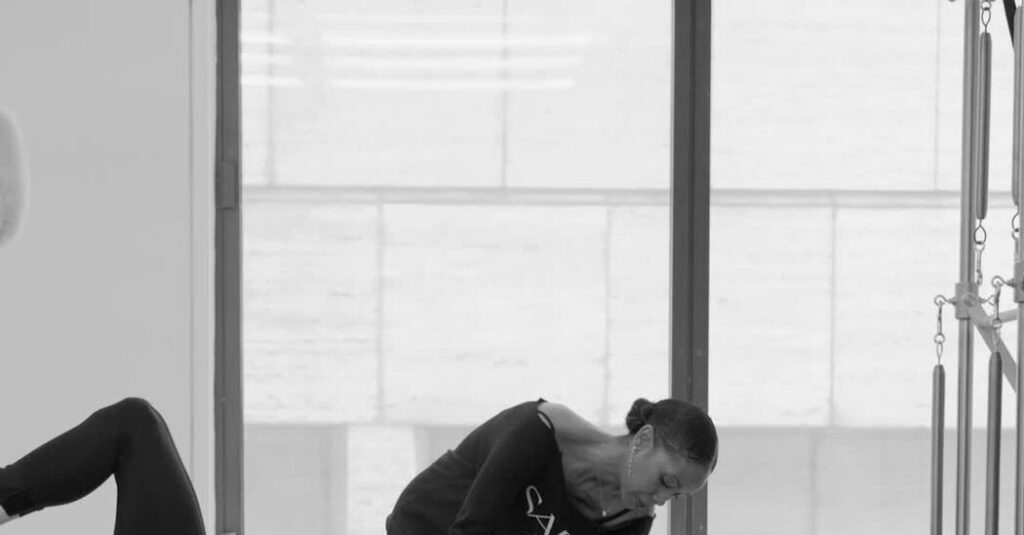
Even with its sunlit lounge, the center is more than a quiet place to rest. There are soundproof study rooms, a spacious Pilates studio and a strength and conditioning space full of the equipment, including heavy weights, that every dancer-athlete needs but that ballet institutions don’t always provide. There are private rooms for mental health, nutrition counseling and physical therapy.
The new center is part of a larger push to prioritize mental and physical health services in ballet and is on par with — or even exceeds — what major professional ballet companies in the United States offer. Here, though, it’s for students, and that is a game changer: If they can learn skills when they’re young, dancers will have an easier time navigating a career that can be fraught, mentally and physically.
Ballet is hard enough — and then there’s being a teenager. The center’s curriculum is intended to address the needs of student dancers, as athletes and artists and young people coming into their own. Along with counselors, nutritionists and physical therapists, elite instructors in Pilates and strength and conditioning are on hand to help.
Katy Vedder, a director of student life, said that the school has long been committed to wellness. But now, with the center, “that work has really evolved,” she said. “It’s become more intentional, more integrated, more visible and accessible.”
Aesha Ash, the school’s head of artistic health and wellness, said the center operates under a whole-person philosophy that acknowledges a dancer is more than a body on a stage. “Of course we want them all to get a job,” Ash said. “It’s more, let’s give them the tools for life. We don’t want them just participating. We want them learning and growing.”
Maintaining wellness is a lifelong pursuit. “It’s continuing to stay on top of their mental health and nutrition and understanding that those things are as important as every other part of their training,” Ash said. “They all are part of the same ecosystem.”
When Ash first joined the permanent faculty in 2020, her role was “not only working with the artistic side,” she said, “but also overseeing the physical wellness of the dancers.”
A former City Ballet dancer, Ash started a rehabilitation class and brought in Marimba Gold-Watts, a Pilates instructor who was a big hit with students. “We grew out of the space to the point where I felt that it was no longer conducive for our dancers to be in such a small room,” Ash said. “We had kids in between reformers and spreading out down the hallway.”
It was gratifying to see so many students taking advantage of the class, Ash said, but it became impossible to teach. “So, I just kept going back to the rest of leadership and saying, ‘We need more room.’”
The school had been looking to expand and enhance its existing programs in the Rose Building for the past decade. Space was increasingly an issue. A ballet studio was also used as a strength training room; physical therapy tables were tucked in a corner of the Pilates room, which was too small for the equipment. In 2023, when the school learned that the Metropolitan Opera Guild was leaving its sixth-floor space, it pounced.
The wellness center has not only expanded the school’s footprint, but added elite instructors who are able to offer more hours for training. There are two nutritionists and two psychologists who provide counseling and educational programs, which students can book using an online appointment system. The center is dedicated to shifting the idea — and the stigma — that counselors are only for when there is a problem, reframing them instead as a tool equal to Pilates or strength and conditioning.
“It’s looking less at counseling and thinking of it more as coaching,” Ash said. “You want to build a relationship. That’s less of the sort of one-off counselor that you see every once in a while when things are not great. We really want them to be coached, to have these people that just deeply know who they are.”
Stepping into a room teeming with teenage girls, baggy sweats pulled over their leotards as they consult clipboards with their individually designed workout programs is like entering a new age. They dead lift with serious weights, they sweat through chin-ups and they leave with a bounce in their step.
Simone Gibson, who turns 18 this week, said that the training allows her to get into her muscles, to use the power of her back and arms to help her in turns. “Before I came here, we’d have a conditioning, but it would be a little jog and a really light weight,” she said. “It was like, we do so much in class, it has to be enough. But it truly isn’t.”
The female students are hooked, maybe even more than the male students. “I do feel like it gives something back to our female dancers,” Ash said. “There’s this sense of ownership.” Weights don’t lie. “It’s like, I went from 10 pounds and now I’m pushing 15 over my head,” Ash said. “What that does for your psyche.”
Jason Harrison, the strength and conditioning coach who also works with dancers at City Ballet, designs fitness programs for each student, and is there to supervise form and make adjustments. McKean said, “You can go to him and be like, ‘I need to work on standing leg strength in adagio,’ and he can find certain exercises that will benefit that.”
A frequent conversation Harrison has had with students is making sure that they eat. A new initiative at the center provides them with snacks for before and after workouts. “External loads are too stressful for the body to be able to do it in a fasted state,” Harrison said. “Now the students will come in, ‘Hey, do you mind if I go get a snack?’ So that’s been the biggest thing: Teaching them you cannot do this without food.”
In a dance context, Harrison views training as injury prevention. “If somebody has to strain a little bit less, two things happen,” he said. “They’re more likely to jump and land safely because their nervous system has been there before.”
And if dancers don’t have to strain, he said, “they can focus on being an artist.”
With the center, Ash has leveled the playing field by making top-of-the-line training available to all students — not just to those who have money or the knowledge of who to turn to. For most her career, Ash said, “I spent a lot of wasted time discovering my body, rediscovering, uncovering and playing catch up. And that was time that could have been spent honing into my craft and my artistry.”
The wellness center, Ash said, is what she needed as a dancer herself, especially as the only Black woman in the advanced divisions at the school and then at the company. “There was so much I was having to tackle,” she said. “I didn’t have time to think about resources and nutrition. All of my work was just figuring out how to build myself up so that I didn’t implode with all the pressures that I put on myself.”
Ash knows that only a handful of the school’s graduates will make it into City Ballet, and that some students won’t end up in the dance industry at all. “Whether they’re going to be a dancer, whether they’re going to be a parent, whether they’ll just be a good friend, whether they’re going to a C.E.O.,” she said, “these are tools not only for onstage, but in their lives.”
They’re learning the intricacies of ballet, of course, but also about the longevity of their bodies and their resiliency. “I want give each student back their power,” Ash said. “We’re so used to just being taught at, spoken to. This particular space is helping them to see their fullest potential and how they can maximize that. When you have understanding of the body and in particular your body, it is so empowering.”
Cinematography by Jensen Gore
Gia Kourlas is the dance critic for The Times. She writes reviews, essays and feature articles and works on a range of stories.
The post A Wellness Center for Young Ballet Students (Snacks Included) appeared first on New York Times.