PRINCE FREDERICK, Md. — The local commissioners were 90 minutes into their meeting when they turned to the matter that had drawn dozens of residents and nearly a thousand more watching online: a vote that could delay the arrival of two massive data centers in Southern Maryland, including one on land intended for a public park.
Commissioner Mike Hart urged his Calvert County colleagues to not be seduced by the promise that the data centers would deliver tens of millions of dollars in fresh tax revenue, a pot large enough to pay for a wish list of items such as turf playing fields, a new sheriff’s headquarters and a property tax cut.
A more pressing need, Hart contended, is what communities elsewhere are considering as they seek to slow the spread of data centers — a moratorium allowing officials time to study how the tech warehouses that make online activity possible would affect the area, including whether they would generate intolerable levels of noise.
“What I know about a data center fits in this pinkie,” Hart told his four fellow commissioners, all of whom, like him, are Republican. “The responsible thing to do is to buy time and get the right people in place to help us through this.”
Over the past two decades, data centers have emerged as a robust economic engine for local governments across the country, a welcomed technological innovation that serves as the infrastructure to a faster, easier life. But the proliferation of the energy-hungry facilities, fueled by an explosion in digital demand during the pandemic and the advent of artificial intelligence, is provoking fierce opposition as concerns mount over strained electrical grids and soaring utility rates.
The backlash was evident last month in a Pew Research Center poll finding that more Americans believe data centers adversely affect the environment and quality of life, even as they are more likely to see the facilities’ potential economic benefits.
In Virginia’s Loudoun County, home to about 200 data centers, the country’s highest concentration, officials have said they don’t want more. In Maine, legislation to ban most data centers until 2027 is advancing in the State House, while New York lawmakers have proposed a three-year pause. Sen. Bernie Sanders (I-Vermont) and Rep. Alexandria Ocasio-Cortez (D-New York) recently introduced a billthat would impose a nationwide moratorium on new AI data centers.
“Opposition has been expanding along with the intensity,” said Miquel Vila of Data Center Watch, an AI security firm’s research project that tracks resistance to the facilities. During a three-month period in 2025, communities around the country blocked or delayed 20 projects, a number greater than the total opposition over the previous two years, according to the group.
The backlash took a violent turn in Indianapolis last Monday, when a gunman fired shots into the home of a local council member who voted to rezone an area in his district to allow for a data center. The shooter left a handwritten note that read, “NO DATA CENTERS,” said the council member, who was not harmed.
It was the next day when Calvert’s commissioners convened and considered Hart’s proposed two-year moratorium.
“We’re moving too fast,” he warned his colleagues, who were silent as the crowd applauded.
Like a three-alarm fire
A 50-mile drive south of Washington, Calvert is Maryland’s smallest county, with a population of 92,000 on a strip of land bounded by the Chesapeake Bay on one side and the Patuxent River on the other.
The county is home to no data centers at the moment. But explorations by two developers, including Amazon Web Services (AWS), has roiled residents, who now find themselves attending data center protests for the first time, researching esoteric subjects like sound reverberations, and glued to commissioners hearings as if they’re the latest episode of a hot series streaming on Netflix. (Amazon founder Jeff Bezos owns The Washington Post).
“They’re worried that someone is putting something over on them and they don’t know what it is,” said Len Zuza, 83, a retired federal budget examiner who has lived in Calvert for 20 years. “This could change the character of the community. It’s the unknowns that are making people nervous.”
Calvert residents learned about the data center plans in ways that only intensified their worries. In one case, chatter spread on social media after someone spotted an online AWS job listing for a data center construction manager in the county. At an early March public meeting, an AWS official acknowledged that the company was interested in building a data center campus — as many as eight buildings — on 2,000 acres adjoining the county’s nuclear power plant.
It was at that meeting that a commissioner, Earl “Buddy” Hance, referred to a nondisclosure agreement he had signed with AWS, a statement he later recanted, saying he had misspoken and had made that arrangement with another data center company no longer involved with the county.
Nevertheless, for weeks, many residents were left with the impression that the discussions with AWS were secret — an impression that was amplified when they learned that the county had a confidentiality agreement with another developer, Natelli Holdings, which also is exploring building a data center in Calvert.
“What the heck is proprietary about a data center?” asked Valerie Pasch, 52, a nurse who grew up in Calvert and still lives there. “It’s not like it’s Grandma’s crab cake recipe. I think the proprietary information is all the bad stuff they don’t want us to know.”
Natelli Holdings wants to build a data center on 133 acres that it hopes to purchase from the county and then turn over to a tech company it has not identified. That land was donated to the county by the Dominion Energy utility in 2018 for the purpose of building a park, a project Calvert officials say they have not been able to fund. As part of a proposed deal, Natelli Holdings has pledged to spend $30 million building a park on another parcel a couple of miles away if Calvert officials approve its data center plan.
The offer has not impressed many residents who are still awaiting the park they were promised. “If you want to build a park, great, but don’t do it as a trade-off,” said Carol Hall, 81, a retired federal contractor who has lived in Calvert since 1974. “I just don’t see the benefits. If we have to pay higher property taxes, so be it. I don’t trust any officials — I don’t care who they are — to make a decision that impacts every family in this county.”
The suspected secrecy and rapid-fire developments have left residents scrambling to understand the scope of potential change to their landscape.
Steve Coleman, 64, an engineer, felt compelled to seek answers at a recent commissioners’ meeting — his first — where he introduced himself during the public comment period as someone who “doesn’t do Facebook, Twitter, nothin’.”
“I’m not attached to these phones and all this stuff that these people are,” he said.
Still, Coleman said, he hasn’t been able to escape the pervasive speculation. “This has gone from a small flame to a three-alarm fire,” he said. “I can’t keep up.”
‘We’re not schmooz-able’
Hart, the commissioner who proposed the moratorium, moved to Calvert as a child in the 1970s, when his father retired from the Air Force and built a house. The county’s population was just over 30,000 in those years, or roughly a third of what it is today.
There were so few people, said Hart, 57, a liquor store owner, that as a 10-year-old, he could drive his dad’s pickup truck on county roads without being detected and filled his time fishing, crabbing and hiking in the woods. Four decades later, he said he wants to preserve, as much as possible, what it felt like in Calvert back then.
“I know I’m a dinosaur,” he said. “But what’s so broke about Calvert County that you have to fix it?”
He does not share other commissioners’ worries about Calvert’s tax revenue, which budget officials say is not growing at the same pace as expenses. In the 1970s, county officials say, the opening of the nuclear power plant — also opposed by residents at the time — delivered new revenue that helped Calvert transform its poorly performing schools.
Now county officials view data centers as a way to meet future financial demands. “Costs are going up high,” said Hance, the commissioner and a fourth-generation Calvert farmer. “The state is pushing more costs on us. The question is, where is that money going to come from?”
The possibility of data centers in Calvert has drawn support from the Maryland Tech Council, a trade association, and labor leaders who say that the construction would create thousands of jobs for local workers.
John McGuffin, 57, a retired schoolteacher, is that rare Calvert resident who has publicly embraced the data centers, saying they would generate enough revenue to preserve the county’s rural character and reduce the financial pressure to attract more residents and housing.
“I don’t mind it being in my backyard,” he told the commissioners recently. “I’d rather have that than 5,000 more homes.”
At another meeting in late March, a Natelli Holdings executive, Tom Natelli Jr., sought to allay concerns about the data center his company hopes to develop, saying its location — an industrial zone, next to a landfill and a thousand feet from the nearest home — would minimize its intrusion on daily life.
He promised to host a community meeting, at which his team would answer all questions about potential noise, utility rates and whatever else anyone wanted to know.
From the dais, Catherine Grasso, a commissioner, warned Natelli that the county’s residents “are not dummies.”
“Nobody is going to schmooze us,” she said. “We’re not schmooz-able.”
A boisterous meeting
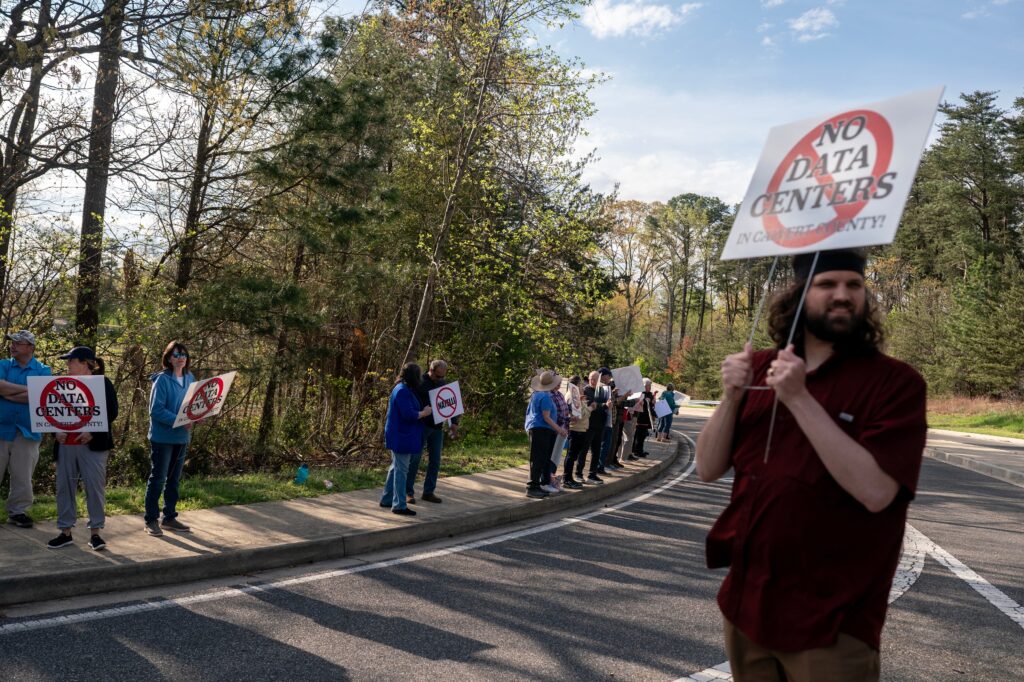
On the night of his community meeting at a local high school, Natelli passed a boisterous pack of protesters outside, many of them holding signs that read “No Data Centers.”
He was ready for the pushback. His plan was to make introductory remarks, then direct the crowd to different tables to ask his team about various issues. Breaking up the audience, he said in an interview prior to the meeting, would help him avoid the “pitchfork mentality” that can take over large gatherings.
“I want to have constructive conversations,” he said. “I’m not here to be yelled at.”
The yelling began nonetheless, moments after he introduced himself to the more than 150 people assembled in the gym.
“No data center!” someone shouted.
“You’re in the wrong place, buddy!” another man called out.
“Guys, are you gonna let me get through this presentation?” Natelli asked.
When he mentioned the park he wants to build, a woman in the bleachers said the community already had land reserved for that and “all of a sudden we’re told it’s not what is happening now.”
Natelli declined to take questions from the crowd and pointed people to the information tables. Then he headed to his own table, and answered questions for more than an hour.
“In two years, we’re gonna have robots in the house cleaning up — the world’s a circuit board,” Dennis Bowling, 72, a retired technician, told him. “There are benefits, but no one wants it in their backyard.”
“I know,” the developer said. “But change is coming.”
“Like a freight train,” Bowling said.
The board votes
The next day, the commissioners’ vote on the moratorium occurred so quickly that people in the audience could be heard saying, “What?” when the board’s president announced it had been defeated by a 3-2 vote.
“Why?” someone in the audience asked.
“Explain your vote!” someone else shouted.
Hart and Grasso supported the moratorium. Hance and two other commissioners, Todd Ireland and Mark Cox, voted no. The county, they said, could review the data centers’ environmental impacts once the developers formally submit their plans.
“Until you have an actual project, what do you study?” Hance asked.
When the public was invited to speak, Myra Gowans, 76, a retired developer, marched to the microphone and waved to the commissioners who voted against the moratorium.
She was saying goodbye, she said, predicting that voters would defeat them when they seek reelection in the Republican primary in June.
“You’re not going be here anymore,” she promised, as the crowd applauded. “You’re out. You’re gone.”
The post A rural county, promised a park, fears a data center ‘freight train’ appeared first on Washington Post.