Green-Wood Cemetery in Brooklyn once rivaled Niagara Falls as a top destination for day-trippers in horse-drawn carriages who wanted to escape the crowding and commotion of urban life in the 19th century. The cemetery appeared in souvenir booklets, stereo viewers, and on keepsake spoons and clocks.
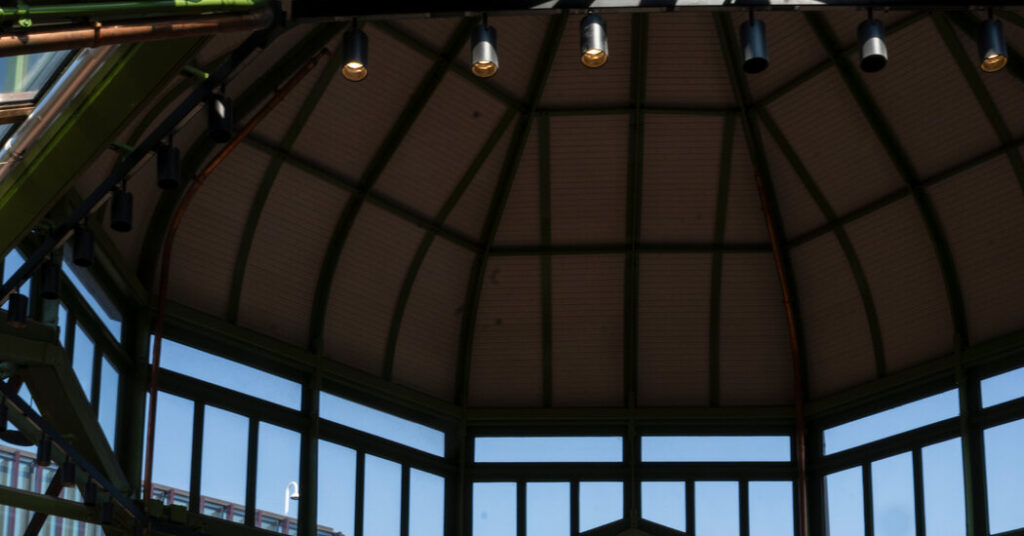
Today, these pieces of Green-Wood’s forgotten past are displayed in a new visitor’s center and exhibition hall, which opens on Thursday across the street from the cemetery’s main entrance. Costing $43 million, it has been built around a meticulously restored 1895 Victorian greenhouse.
Mourners once picked up flowers on this corner to lay on graves, or ordered headstones at a monument maker next door. Now, the domed, copper-and-glass greenhouse will again be the first stop for visitors. The center will showcase Green-Wood’s legacy and serve as a community hub with a classroom for programs, a research archive and changing art exhibits.
“We’ve been calling it our new front door,” said Meera Joshi, the president of Green-Wood Cemetery.
The rambling, 478-acre cemetery is the resting place for more than 583,000 people, including Jean-Michel Basquiat, Leonard Bernstein and members of prominent New York families who shaped the city’s civic and cultural life. Some have surnames like Roosevelt, Pierrepont (Henry Pierrepont was a founder of Green-Wood), Tiffany and Steinway.
The grounds are filled with more than 300,000 monuments and a trove of sculptures on headstones and mausoleums. Last year, it had more than 500,000 visitors.
But once visitors got past the cemetery’s double-arched Gothic Revival entrance carved from brownstone, many did not always know where to go.
The new center can help them plan their visit, starting with a giant map of the cemetery made of porcelain tiles on the greenhouse floor. It marks notable sites like Battle Hill, where the Battle of Brooklyn was fought in 1776. There will be chairs and tables to stay awhile, and once again, a stand to buy flowers.
Over in the exhibition hall, hand-scrawled records trace Green-Wood’s roots back to 1838 when it was founded as one of the nation’s first rural cemeteries, as an alternative to the dark, cramped churchyards in Manhattan. At the time, its founders rejected suggestions to call it “Necropolis,” or city of the dead, in favor of a name that emphasized its lush greenery, woodlands and tranquil views at every turn.
Green-Wood struggled at first to attract interest, but that changed after the family of DeWitt Clinton, the former city mayor and New York governor, was persuaded to dig up his remains from an Albany cemetery and rebury him at Green-Wood in 1844. “It was the ultimate p.r. move — let’s get a celebrity,” said Lisa Alpert, Green-Wood’s senior vice president of development and external relations, who worked on the exhibit.
Sales of burial sites soared, and visitors flooded in to pay their respects to Mr. Clinton. They stayed to explore the miles of winding paths, picnicking beside the headstones.
On a recent morning, Ms. Alpert led the way for a first look at the exhibition hall, where large glass cases are shaped like headstones. Inside one case are used acrylic-paint tubes and brushes visitors left on Mr. Basquiat’s grave, the most visited gravesite in the cemetery. Beside them, from Mr. Bernstein’s grave, are a conductor’s baton and a red New York Philharmonic button.
Another display has a photo of lime-green Monk parakeets, which are native to South America but have squatted on the cemetery’s entrance since at least the 1960s.
According to one story, the parakeets were being shipped to a pet store and escaped from a crate at Kennedy Airport in Queens, about 10 miles east of the cemetery. “They were looking for something high,” Ms. Alpert said. “When they found the Green-Wood arch, they thought, ‘Oh boy.’”
One wall highlights the lives of 46 notable Green-Wood residents (it was a tough selection process), and shows the exact locations of their graves on digital screens. Emma Stebbins is pictured alongside her sculpture, Angel of the Waters, on Central Park’s Bethesda Fountain. Henry Steinway, who occupies Green-Wood’s largest private mausoleum, is represented by a Steinway piano banner.
The writer Pete Hamill used to climb over the cemetery fence with his friends as a teenager, and play hide-and-seek among the tombstones. Years later, he bought a gravesite for himself near William Tweed, the Tammany Hall power broker and crook who was known as “Boss.” He told Green-Wood that he preferred being buried near a rogue who would be interesting to spend eternity with.
The two are together in the exhibition hall, as in the cemetery, with a photo of Mr. Hamill and two of his reporter’s notebooks arranged on the wall next to a political cartoon of Boss Tweed.
A climate-controlled research center will store the cemetery’s records, including a burial registry from the first 100 years that reads like a census survey, with the names of the dead along with their ages, marital statuses, birthplaces, last addresses and causes of death.
Green-Wood, which is a nonprofit organization, was not always so welcoming. In the late 1960s, it restricted public access to the cemetery, in part over security concerns after thieves made off with stained-glass windows and bronze doors from mausoleums. Security guards turned away tourists, allowing in only those holding green cards with the lot number of the gravesite they were visiting.
The cemetery did not reopen its gates until the early 2000s. Under Ms. Joshi’s longtime predecessor, Richard J. Moylan, the cemetery started holding arts and music programs, and classes and groups to educate people about death.
In 2012, Green-Wood spent $1.6 million to purchase the greenhouse, a crumbling city landmark that was the “neglected beauty queen across the street,” Ms. Joshi said. The greenhouse, which still carries the name of the original owner, the Weir family, has been joined with a modern L-shaped building clad in terra-cotta designed by the firm Architecture Research Office.
About half of the $43 million project was paid for with city, state and federal funding and private donations, while the rest came from Green-Wood, Ms. Joshi said. The cemetery, which is free to enter, charges fees for gravesites and services, which are used to maintain its grounds. Graves start at $21,000, and crypts within mausoleums at $50,000.
Robert Hammond, a co-founder of the High Line, the elevated rail line-turned-linear park in Manhattan, said he saw Green-Wood as “social infrastructure” that, like the High Line, was important to preserve and reuse to create more open space in a crowded city.
He added that Green-Wood, with its deep history and solitude, offers an escape that can’t be found in most urban parks. “I think there’s a spiritual element to it, whether you’re religious or not,” he said. “I mean you’re surrounded by mortality and so that’s going to be a very different experience than just looking at tulips.”
Still, many New Yorkers pass by Green-Wood without stopping. The new visitor’s center aims to change that, and help fulfill the cemetery’s original mission of serving as a public resource, Ms. Joshi said.
“It was a place both for people who lost their loved ones as well as for the general public to have some green space and some peace,” she said. “Now, it’s kind of come full circle.”
Winnie Hu is a Times reporter covering the people and neighborhoods of New York City.
The post A Famed Brooklyn Cemetery Wants You to Come Visit … Before You Die appeared first on New York Times.