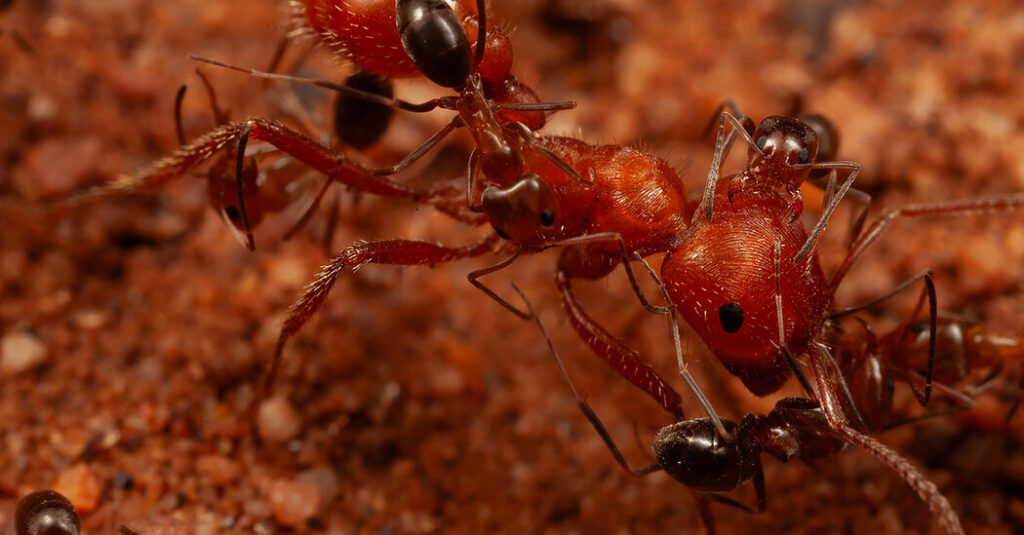
One June morning 20 years ago, Mark Moffett, an entomologist at the Smithsonian National Museum of Natural History, was drinking coffee behind a cottage in Portal, Ariz., when he noticed something odd in the mesquite desert.
On the ground, as Dr. Moffett watched, large red harvester ants spilled from their nests — and some of the insects seemed to be frozen in “a very awkward-looking position,” he recalled recently. On closer inspection, the harvester ants seemed to be approaching the nest entrances of a much smaller ant species and waiting there.
Dr. Moffett observed as the little ants, known as cone ants, climbed aboard the harvesters and licked and nibbled them. The behavior reminded Dr. Moffett of “cleaner fish” — oceanic fish that clean other species of fish. He reached for his camera and documented the interaction.
He set the photographs aside for two decades, figuring he needed more data to make sense of them. But recently, after reviewing them again, he realized he “had the whole story in the pictures.”
Dr. Moffett’s findings, which described a distinctive partnership between these two ant species, were published on Monday in the journal Ecology and Evolution.
“It’s a pretty unique observation,” said Daniel Kronauer, an evolutionary biologist at Rockefeller University who studies ant societies and was not involved with the research. Dr. Kronauer said that he was a “big fan” of small natural history observations like this one, which can guide research in new directions.
To understand what was going on between the two species, Dr. Moffett logged at least 90 interactions over five days. The activity followed a rhythm: It began at sunrise, peaked before midmorning and then wound down before the midday heat of the desert set in. A harvester would approach the entrance of a cone ant nest and adopt a stiff, distinctive posture — legs extended, mandibles agape — and wait. Usually within a minute, a cone ant would climb aboard to lick and nip.
Sometimes as many as five cone ants climbed onto a single harvester at once.
The harvester ants seemed to tolerate the attention for at least a few seconds and for up to at least five minutes, “never biting back,” Dr. Moffett wrote in the study. The interaction ended once the cone ant seemed to annoy the harvester, at which point it would be jolted off “violently.”
What surprised Dr. Moffett the most was the detailed “choreography” of the whole process, he said. On their own, harvester ants groom one another in their nests to remove debris, contaminants and parasites. “So what then could be the advantage of adding an assistant?” he wrote in the study.
Perhaps, he wondered, the cone ants were scrubbing harder-to-reach corners. To better understand what the cone ants might be doing, Dr. Moffett began corresponding with experts who studied similar interactions between other species. Some scientists proposed that the cone ants gained a nutritional benefit — a healthy snack. Others suggested that the cone ants were exchanging pheromones, or chemical signals, with the harvester ants to pacify them and make it easier to interact.
One of the scientists Dr. Moffett corresponded with was Alexandra Grutter, a marine ecologist at the University of Queensland in Australia who has studied cleaner fish for three decades.
To her, the behavior of the ants recalled “cleaning stations,” she said, where “client” fish remain still while other fish or shrimp inspect or pick at its body. Some type of communication was likely to be happening between the ants as well, she said.
Because of the limited information in Dr. Moffett’s study, Dr. Grutter said it was difficult to determine the benefits for either ant species. One hypothesis she proposed was that the ants were exchanging valuable microorganisms, creating a healthier microbiome for the cone ants or for both species.
“What surprised me,” she said, “was the intimate interaction between this huge ant with these gigantic mandibles, and then this tiny, little ant delicately moving among the mouth parts, basically looking fearless in there.”
Alexa Robles-Gil is a science reporter and a member of the 2025-26 Times Fellowship class, a program for journalists early in their careers.
The post For Ants, a ‘Cleaning Station’ in the Desert appeared first on New York Times.