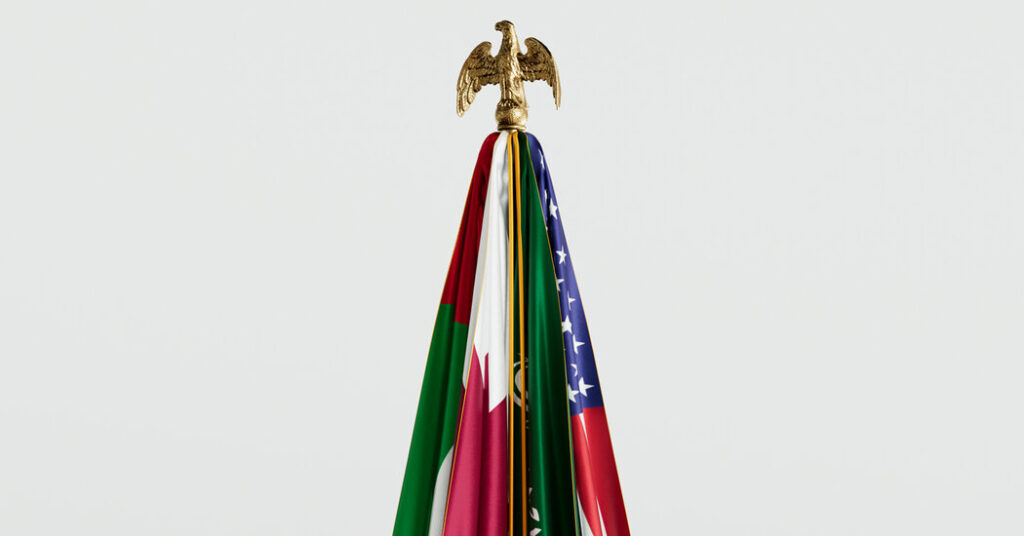
The United Arab Emirates in March 2025 undertook to invest $1.4 trillion in the United States — the largest single-country pledge on record. The commitment, accelerated during President Trump’s visit to the Gulf two months later, covered artificial intelligence, semiconductors, clean energy and the infrastructure of the future. In both countries, it was considered historic.
Nine months later, amid an uneasy cease-fire in the Iran war, the Gulf region is assessing the fallout from Iranian missiles. The economic disruption has been severe: Iran has choked the Strait of Hormuz and hit energy infrastructure, and now America has declared a naval blockade. Governments across the region are reassessing the pace of overseas commitments they can sustain under fire. The implicit bargain, as one economist put it, was that those investment pledges rested on a foundation of regional stability.
For decades, the U.S.-Gulf relationship was described in shorthand: oil for security. The Gulf provided the energy stability; America provided the military umbrella. But that framework was obsolete even before the war started. The United States achieved energy independence. Gulf economies are spending trillions to diversify beyond oil. The terms of exchange have fundamentally changed — and nowhere is this more evident than in the relationship between the United States and the Emirates.
What this moment calls for is not a rupture, but a recognition that the partnership is structurally deeper than either side fully acknowledged, and that it has outgrown the institutional architecture governing it. America and the Emirates need a more honest accounting of what they owe each other, one that goes beyond the ceremonial arithmetic of investment announcements. It requires recognizing that the United Arab Emirates is not simply a source of capital, but is also a strategic co-investor in shared prosperity; that stability in this region is the foundation on which the entire edifice rests; and that even the strongest partnerships require deliberate stewardship to endure.
The Emirates has been the top destination for American exports in the Middle East for 17 consecutive years, with bilateral trade in 2025 generating a $23.8 billion surplus for the United States, the fourth largest it gets from any country. The trade figures capture only one dimension. New York University has a full campus in Abu Dhabi. The Cleveland Clinic runs a major hospital there. The Guggenheim is building a museum on Saadiyat Island.
Sixty-five thousand Americans call the Emirates home; tens of thousands of Emiratis have studied at U.S. universities, and many have returned with deep ties to American institutions. The Abu Dhabi technology company G42 partners directly with American giants such as Microsoft, which has committed $15.2 billion to A.I. infrastructure in the country. The Commerce Department approved the export of advanced Nvidia chips to G42 for a reason: These collaborations serve American interests as much as Emirati ones.
This is not oil for security. It is a 360-degree partnership — economic, technological, cultural and human — that has been built quietly over decades by businesses, universities, hospitals and millions of individual choices. It is the kind of relationship that great powers spend generations trying to construct. And it already exists.
The current crisis has made the invisible visible. The Emirates is not a passive recipient of American security guarantees. It is an active partner that has bet its diversification strategies and sovereign wealth on the stability of the international order the United States leads. When that order is disrupted, the consequences fall first and hardest on the countries nearest the fire.
The Emirates did not seek this war. It has absorbed thousands of strikes on its airports, ports and cities. Its air defenses have intercepted over 95 percent of incoming missiles and drones, according to its Defense Ministry. The country’s response has been to defend its people, keep its economy open and reaffirm its investment commitments. This is resilience in action. That resolve should not be taken for granted.
I have no doubt this relationship will survive the current crisis. The interdependencies are too deep and too mutual. The Emirates’ commitment to the United States is not contingent on any single administration or conflict.
But surviving is not the same as thriving. The U.S.-Emirates relationship has the potential to be the most consequential economic partnership of the coming decades for both sides. American firms increasingly see the Emirates as a launchpad into Africa, South Asia and the wider Indo-Pacific. In the other direction, the country’s vast network of family-run businesses, a largely untapped force in cross-border investment, is ready to deepen its stake in the American economy alongside Emirati sovereign capital.
Whether this partnership fulfills its extraordinary potential will depend on whether both sides govern it as the strategic asset it has become, rather than the transactional convenience it once was.
The missiles have clarified something important: not that the relationship is at risk, but that it has become far too valuable to leave on autopilot.
Badr Jafar is a businessman and the special envoy of the United Arab Emirates minister of foreign affairs for business and philanthropy.
The Times is committed to publishing a diversity of letters to the editor. We’d like to hear what you think about this or any of our articles. Here are some tips. And here’s our email: [email protected].
Follow the New York Times Opinion section on Facebook, Instagram, TikTok, Bluesky, WhatsApp and Threads.
The post The Relationship Between America and the U.A.E. Needs an Upgrade appeared first on New York Times.