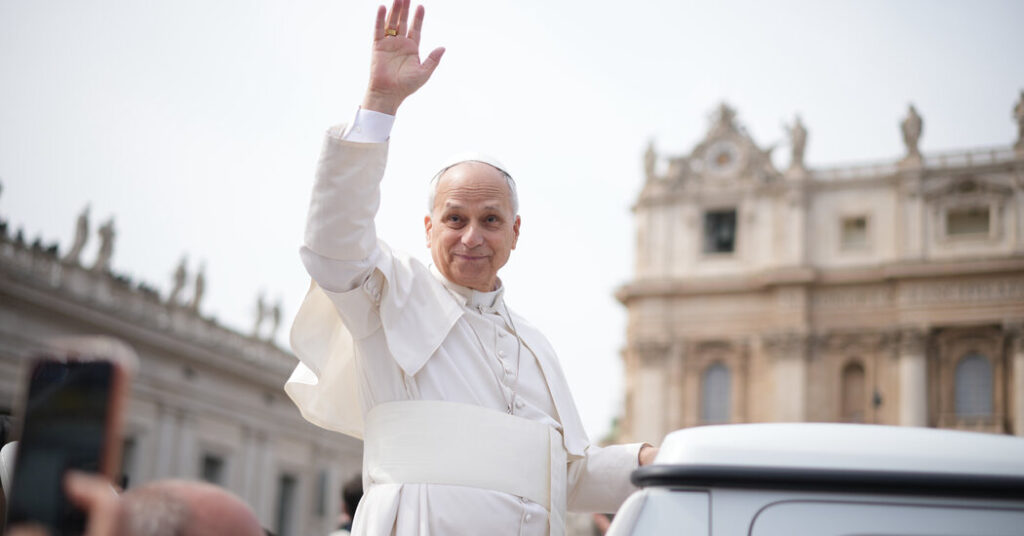
To understand why Pope Leo XIV is traveling to Africa less than a year into his papacy, consider that one in five of the world’s Catholics now live on the continent.
His 10-day trip begins Monday and includes visits to Algeria, Angola, Cameroon and Equatorial Guinea. Aside from Algeria, which is overwhelmingly Muslim, the other three countries are home to substantial numbers of Catholics.
In a sign of the region’s growing importance to the Roman Catholic Church, the pope, the first from the United States, has chosen to visit Africa before traveling to his homeland or South America, where he spent two decades of his career before assuming the papacy.
The pope will not, however, visit the largest Catholic populations in Africa, which are in Nigeria and the Democratic Republic of Congo. Like his predecessor, Pope Francis, Leo is focusing on the “peripheries” of the church, where future growth lies.
In each country, the pope will meet political leaders, visit orphanages or nursing homes or prisons, and conduct Mass in various venues. He is also likely to grapple with issues that cross national borders, including the confrontation between Christianity and Islam in Africa, competition from other Christian Protestant and Pentecostal denominations, and hot-button issues within Catholicism. Those include a move initiated by Francis to allow priests to bless same-sex couples and efforts to accommodate polygamy, a marital practice common in multiple African countries.
Why is Africa a top priority for Leo?
Africa is the world’s poorest continent and a place where foreign investors have exploited desperate workers for financial gain. By going to Africa, the pope is demonstrating the urgency of his focus on the most vulnerable members of the Church.
“Africa is very rich in terms of natural resources and human resources, but poor socioeconomically,” said the Rev. Chidiebere Obiora Nnabugwu, a doctoral researcher of Catholic history in Africa at the University of Leuven in Belgium. “So it will be very interesting for the pope to talk about this.”
The pope is also aware that African Christians have options other than Catholicism. Various Protestant denominations, along with Pentecostal churches, are wooing members, particularly young people.
“More and more young people are tapping into technologies, they’re doing all kinds of wonderful things, they’re dreaming, they’re entrepreneurial, they’re looking for opportunities,” said Ebenezer Obadare, senior fellow for Africa Studies at the Council on Foreign Relations in Washington. “How do you insert the message of the Catholic Church into that?”
How will Leo handle meetings with authoritarians?
In Cameroon and Equatorial Guinea, the pope will meet with two of the continent’s longest-serving authoritarian leaders. Some followers hope Leo will openly advocate for democracy when he meets them.
Generally speaking, papal experts say, popes try not to intervene directly in national politics. “This is not how the Vatican does things,” said Massimo Faggioli, a professor of theology at Trinity College Dublin. “You may get your satisfaction speaking against the local dictator, but those who pay the price are those who stay.”
When Pope John Paul II traveled to Chile in 1987, he described President Augusto Pinochet as “dictatorial” in remarks to reporters while en route on the papal plane. But while in Chile, he prayed with Mr. Pinochet and made a vague call for democracy in the “not distant future.”
Church leaders say they will be looking for similar subtle signals of moral guidance from Pope Leo.
“There are many ways of speaking to those in authority,” said Bishop Matthew Hassan Kukah, who oversees the diocese of Sokoto in northwest Nigeria. “You don’t necessarily have to wag your finger at them, but there is a way that diplomatically you can let people know that things can be done differently.”
Same-sex relationships and polygamy
When Pope Francis issued a declaration in 2023 allowing the blessing of same-sex couples, bishops in several African countries — including Angola and Cameroon — objected, saying the blessings were not in line with their conservative interpretations of biblical teachings. Homosexuality is illegal in dozens of African countries. So far, Pope Leo has remained neutral on the subject, neither endorsing or repealing the blessings.
Leo is more likely to talk about how to transition Catholics out of polygamous marriages. Polygamy is a common cultural practice on the continent, and a commission of African bishops released a report late last month discussing the need for the church to offer Catholics in polygamous relationships a path to participate in the faith.
Why Algeria?
Algeria is the birthplace of St. Augustine, the namesake of the religious order that Leo led before being elected pope. Along with visits to a mosque and the main church of the minority Catholic community in Algeria, Pope Leo, who cites Augustine frequently in his homilies, will visit the archaeological site of Hippo, where Augustine was born.
Scholars expect Leo to emphasize Augustine’s African roots, his teachings about the importance of the common good and lessons for the present. “One of the things that was happening in Augustine’s life is that the so-called eternal empire was crumbling and people were afraid, they were unsettled, they were often displaced,” said Paul A. Camacho, associate director of the Augustinian Institute at Villanova University in Pennsylvania, noting analogies with current global strife.
Why Cameroon?
Cameroon, in central Africa, is a country with deep Catholic roots dating to the 19th century. “Cameroon both has a history and a legacy of this very passionate attachment to Catholic Christianity,” said Charlotte Walker-Said, a political scientist and historian at John Jay College of Criminal Justice in New York who has studied Catholicism in Cameroon.
It is also a country of great poverty that has been ruled for more than four decades by a strongman president, Paul Biya, who is now 93. Since 2016, the country has been wracked by bloody conflict as English-speaking separatists have fought with Francophone government militants. The pope will travel to Bamenda in the northwest corner of the country to call for peace.
Why Angola?
Present-day Angola was one of the earliest regions in Africa where many people converted to Catholicism, as they were courted by predominantly Jesuit Portuguese missionaries in the 15th century. Catholics now represent about 40 percent of the population in the southern African nation.
The country also exemplifies some of the pope’s deepest concerns. Because of its oil reserves, Angola has experienced rapid economic development in its capital, Luanda, after decades of civil war. But many people still live with grinding poverty. During two masses and meetings with bishops and priests, the pope is likely to offer support to religious leaders trying to guide parishioners coping with inequality.
Why Equatorial Guinea?
For his last stop, the pope will visit Equatorial Guinea, a country of less than two million people that is ruled by Teodoro Obiang Nguema Mbasogo, an autocratic leader whose government systemically tortures its citizens, according to the U.S. State Department.
Pope Leo will visit a memorial to the victims of a 2021 explosion at a military base as well as a prison where the government holds political prisoners and where human rights groups have expressed concerns about their treatment.
Josephine de La Bruyère contributed reporting from Rome.
Motoko Rich is the Times bureau chief in Rome, where she covers Italy, the Vatican and Greece.
The post What to Know About Pope Leo’s Voyage to Africa appeared first on New York Times.