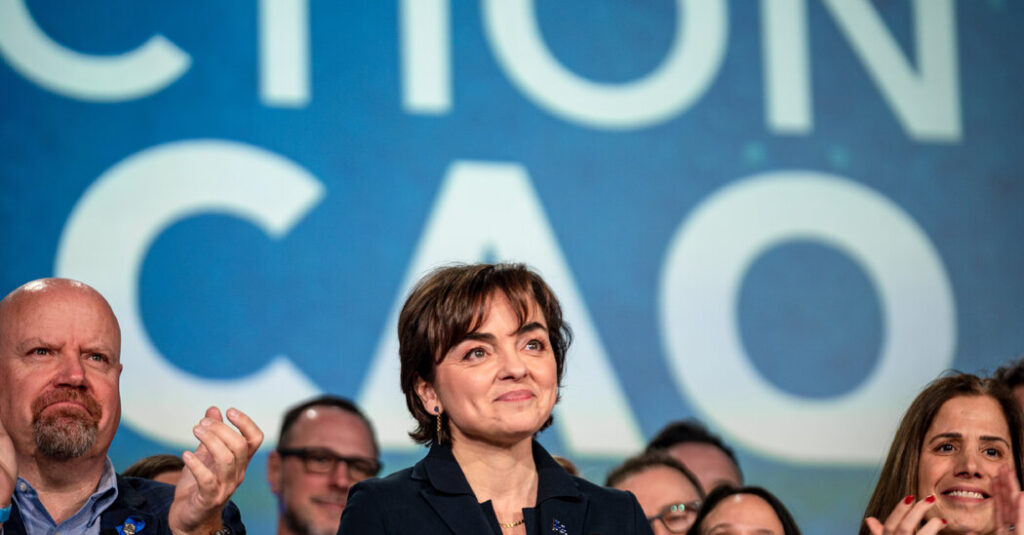
Christine Fréchette, Quebec’s former minister of economy, was selected as the new leader of the French-speaking province on Sunday after a vote by members of the governing party.
Ms. Fréchette, 55, succeeds François Legault, 68, who announced in January that he would resign as premier after seven years in power and a collapse in popularity.
With provincial elections scheduled in October, Ms. Fréchette, a former business executive who was first elected to office only four years ago, now faces the difficult task of turning around her party, the Coalition Avenir Québec, which is trailing in the polls by a wide margin.
Ms. Fréchette, who became the second woman to lead Quebec, focused on economic issues during her victory speech, vowing to improve affordability for Quebec’s families and to strengthen the province’s economy.
She described her victory as “opening the windows” and letting in “fresh air,” clearly hoping that voters will now take another look at her party.
“The change I’m proposing is an important one,” Ms. Fréchette said. “It’s a change of style — mine. I’ll listen, and you can count on me. I’ll act with rigor and humanity.”
Members of the Coalition Avenir Québec, a center-right party, gave Ms. Fréchette 58 percent of the votes, against 42 percent for the other candidate, Bernard Drainville, a former provincial minister of education. Turnout among the party’s 20,500 members was 77 percent.
The matchup was widely described in the Quebec news media as a battle between the party’s two main wings, pitting pro-business members like Ms. Fréchette against more nationalist-leaning ones like Mr. Drainville, who emphasized the importance of the French Québecois identity and took a hard line against immigration.
Ms. Fréchette, who was criticized in Quebec’s news media as running a low-energy campaign, appeared to address that point shortly before voting ended Sunday afternoon.
“People don’t want big speeches,” Ms. Fréchette told party members gathered at a convention center in Drummondville, a city between Montreal and Quebec City. “They want something quite simple: predictability, ambition and results.’’
By contrast, Mr. Drainville made a final emotional appeal.
“Vote with your heart, vote for your values, vote with conviction,” Mr. Drainville said.
Mr. Legault, who established a budget airline before entering politics, co-founded the Coalition Avenir Québec, or Coalition for Quebec’s Future, in 2011 as a third way in the province’s politics: a nationalist party that did not espouse Quebec’s independence from Canada.
Mr. Legault’s brand of nationalism, which tapped into the ethnic identity of the French Québecois, resonated especially among older and rural voters. Mr. Legault’s easygoing manner and avuncular persona reassured many voters during the pandemic and helped him win re-election in a landslide in 2022. Once ranked as the most popular premier in Canada, he became the most unpopular in recent years after a series of economic and policy failures.
Recent polls show that Quebec’s two traditional political parties — the separatist, social democratic Parti Québécois and the federalist, pro-business Quebec Liberal Party — are in a dead heat ahead of elections this fall.
The leader of the Parti Québécois, Paul St-Pierre Plamondon, has vowed to hold a referendum on Quebec independence if his party wins this fall despite the lack of widespread interest among voters. Quebec voted against separation from Canada in 1980 and 1995, and polls show that support for independence is at its lowest in decades, at 29 percent, according to a poll last month by Léger, a major firm based in Montreal.
Apprehension about a third referendum seemed to have fueled a recent surge in support for the Quebec Liberal Party, which had to change leaders abruptly early this year after reports of vote-buying inside the party. Though its new leader, Charles Milliard, a businessman who has never held office, still has low name recognition in Quebec, the Quebec Liberal Party enjoyed the support of 30 percent of decided voters in the recent Léger poll — behind 31 percent for the Parti Québécois.
Norimitsu Onishi reports on life, society and culture in Canada. He is based in Montreal.
The post Former Economy Minister Is Chosen as Quebec Premier Ahead of Elections appeared first on New York Times.