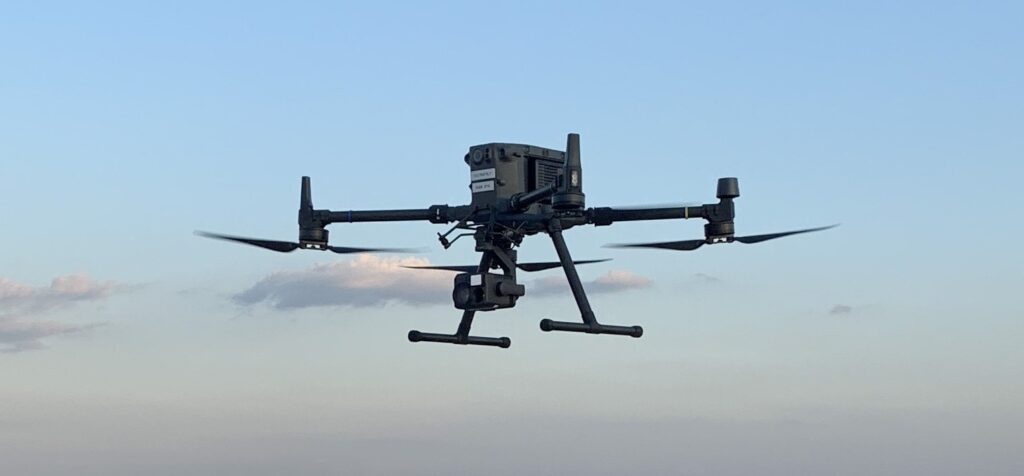
Watched from a drone flying above, a man pulled his silver SUV into a Delaware truck stop. He parked near a tractor-trailer and waited as another man stepped out carrying the first of two tan Home Depot boxes.
The exchange, as recorded by the drone’s video camera, was a key moment in what law enforcement officials said last week was the dismantling of a cocaine trafficking ring tied to a Mexican drug cartel that sold their product in Delaware, Maryland and Virginia.
“It was crystal clear,” Sheriff Mike Lewis of Wicomico County, Maryland, said of the footage.
A novel part of police work just 10 years ago, drones are now being flown by more than 1,000 large and small law enforcement agencies in multiple states, according to industry estimates. Their use is trending up for all manner of police work, from foot chases to crime-scene documentation to surveillance in complex drug cases. SWAT teams are sending them into buildings.
The devices, which can cost from $15,000 to $25,000, “are transforming policing,” said Charles Werner, director of Drone Responders, a trade group. “They are becoming a mainstream tool.”
The Wicomico County Sheriff’s Office, with nearly 100 sworn deputies, bought its first drone about five years ago and now has six. One of their most critical uses: looking for children or elderly residents who go missing in Wicomico County’s marshy areas.
In narcotics cases, so long as the targets stay outside, drones often record better court evidence — with no obstructions — than what police can do from the ground. And they’re safer than officers having to ease in close.
In the cocaine case, according to court filings, the overhead drone recorded the two Home Depot boxes being placed into the back seat of the SUV. Together they held 53 pounds of cocaine, officials said, part of the more than 93 pounds seized in the whole case, with a total value of over $4 million. Officers also seized 11 guns.
Lewis said the cocaine almost certainly originated in South America, passed through the Jalisco New Generation Cartel in Mexico and crossed into Southern California. It was then driven across the country in an 18-wheeler by two suspects.
The sheriff lauded investigators for halting the drugs from getting to users in and around his county but stressed that nationwide it was just a drop in the bucket.
Even though he works 1,800 miles from the U.S.-Mexico border, the Maryland sheriff said he understands the monumental task of stopping drugs from coming into the United States: “For every tractor-trailer that gets caught with drugs, there are 25 that get through loaded with cocaine.”
The investigation involving the drone-recorded truck stop began in late 2024, eventually leading investigators to monitor 19 cellphones, and so far has yielded charges against 13 suspects, with more arrests expected, according to Lewis.
One of the early busts, according to court filings, took place in October, after investigators followed two suspects’ cars through Talbot County, Maryland. One of the vehicles, a black Toyota minivan, was closely followed by what narcotics officers call the “bait car,” in this case a white Infiniti sedan, driven by a partner whose job was to keep the minivan from being pulled over, investigators alleged in court records.
The two vehicles pulled into a High’s Dairy Store in Trappe, Maryland, prompting a tactical assault team to move in. A search of the minivan, officers allege, yielded a sealed box on the passenger seat floorboard that contained six blocks of cocaine weighing 16 pounds.
Authorities charged the minivan driver, identified as Ricky Johnson Jr., 38, of Snow Hill, Maryland, under the state’s “drug kingpin” statute, according to court records. His attorney, Stephanie Shipley, declined to comment.
They also charged the alleged bait car driver, identified as Kavon Conquest, 25, of Salisbury, Maryland, with distribution of a “large amount” of cocaine, or more than the threshold of 448 grams. His attorney, Michael Beach, also declined to comment.
As investigators monitored the 19 phone lines, Lewis said, they could listen to calls and read text messages in real time. He described it this way: “You have no idea I’m getting the exact same text messages you’re getting. This is exactly the technology we deployed in this particular case, and it paid off.”
Lewis, a Republican, credited the office of Maryland Gov. Wes Moore (D) with helping fund the case. “When you’re manning a wiretap 24 hours a day, it takes manpower. It takes a lot of people to make this happen,” Lewis said.
That surveillance, he said, informed investigators where a suspect named Shakoor Stevenson, 43, of Salisbury, would be headed on Nov. 16: the Oasis Travel Plaza truck stop, 15 miles away, in Laurel, Delaware. They used unmarked cars to follow him there.
It’s not clear from court records exactly where and when the drone was launched. But because of one limiting factor in their use — typically about 45 minutes of battery life, Werner said — officers may have already set up with their drone near the truck stop and waited for the suspect to arrive before sending it airborne.
Lewis said he wasn’t worried about the drone being heard. “Tractor-trailers are inherently loud,” he said. “They’re inherently loud, and when you’ve got a truck stop, with truck tractors starting, stopping, starting, stopping, right along busy U.S. Route 13 — we weren’t worried about that drone being heard at all.”
After the two Home Depot boxes were loaded into Stevenson’s SUV, according to court filings, investigators tailed him as he headed south, paused in a hotel parking lot, and the SUV and a second car drove into a self-storage facility in Salisbury. By then, according to court records, investigators had come to conclude Stevenson was storing cocaine in Unit 434B. They moved in and took the second driver into custody as Stevenson ran toward a fence and climbed over it. He was eventually caught in a wooded area, authorities asserted.
Investigators seized the Home Depot boxes and charged Stevenson with a drug “kingpin” count, among others. His attorney, Josephine Schlick, declined to comment.
The driver of the second car, identified as Charnita Stephens, 51, was charged with distribution-related counts. A spokesperson for the Maryland public defender’s office, which represented Stephens in district court, declined to comment.
Three days after the storage facility bust, officers raided a two-story home in Pocomoke City, Maryland, and found an occupant in a downstairs bathroom. His hands were wet, they said in charging documents, “as if he was attempting to destroy evidence.”
They handcuffed the man, Desmond Roberts Jr., 31, and walked him to a patrol car. Inside the home, court records state, investigators found three clear baggies of white powder in the toilet. “I noted there was also a comb lying in the toilet submerged in the water,” an investigator stated in court filings. “It was evident that Roberts Jr. attempted to use the comb to force the three baggies down the toilet drainpipe.”
In a ceiling opening near the front door, investigators say, they found a cardboard box holding $5,800 in cash. Roberts was charged with possession of cocaine with intent to distribute.
James Britt, his attorney, said, “Mr. Roberts is looking forward to his day in court.”
Lewis, the Wicomico County sheriff, has long been a critic of President Joe Biden’s border policy, which he said allowed Mexican cartel members to enter the U.S. illegally to help set up smuggling routes around the country. Lewis is also a champion of setting up a 287(g) program in Wicomico County, designed to foster cooperation between local law enforcement and Immigration and Customs Enforcement officers.
Moore recently signed a law that prohibits local Maryland law enforcement agencies from entering into 287(g) agreements. He doesn’t want Maryland law enforcement officers working at the behest of the Trump administration’s ICE operations, according to a Moore spokesman.
The difference between the two men was evident Tuesday, when they came together with others to announce the results of the big drug case.
“Governor, sir, we might disagree politically on a number of issues,” Lewis said, “but, however, we share the same belief that partnerships on the local, state, and federal levels create safer communities for all Marylanders.”
The two men hugged before Moore spoke, with the seized evidence on display in clear plastic bags nearby.
Any future collaborations — and future police work of any kind — is likely to increasingly involve drones.
Werner said there are two main categories of use: One is tactical or event-by-event, such as drug deal surveillance. Drones can also be used for car pursuits, but current models generally top out at 60 mph, Werner said.
The other category of use is something called “drone as first responder,” in which agencies will launch drones based on 911 calls, leading them to often arrive at a scene to start recording before officers on the ground.
Werner said his group has worked with the Federal Aviation Administration to create a quicker approval process for police and fire departments — from what was once an 11-month turnaround to a one-week turnaround. Part of the agreement: Police agencies are buying drones with bright lights, parachutes in case they go down and devices that automatically detect planes and helicopters in their area.
The drones must generally fly below 400 feet. Agencies also must get clearance to fly drones out of their eyesight, Werner said. From 2018 to 2024, he said, 50 agencies were approved for “drone as first responder” programs. Since May 2025, when the streamlined approval process went into effect, more than 1,000 agencies have received approval, Werner said.
Werner said overhead surveillance of drug deals is a perfect use for a drone. When flying 300 feet, he said, they generally cannot be heard and they’re such small specks that they can’t be identified. “Most of the time,” he added, “people don’t look up.”
The post Bust of multi-state drug ring highlights increasing use of police drones appeared first on Washington Post.