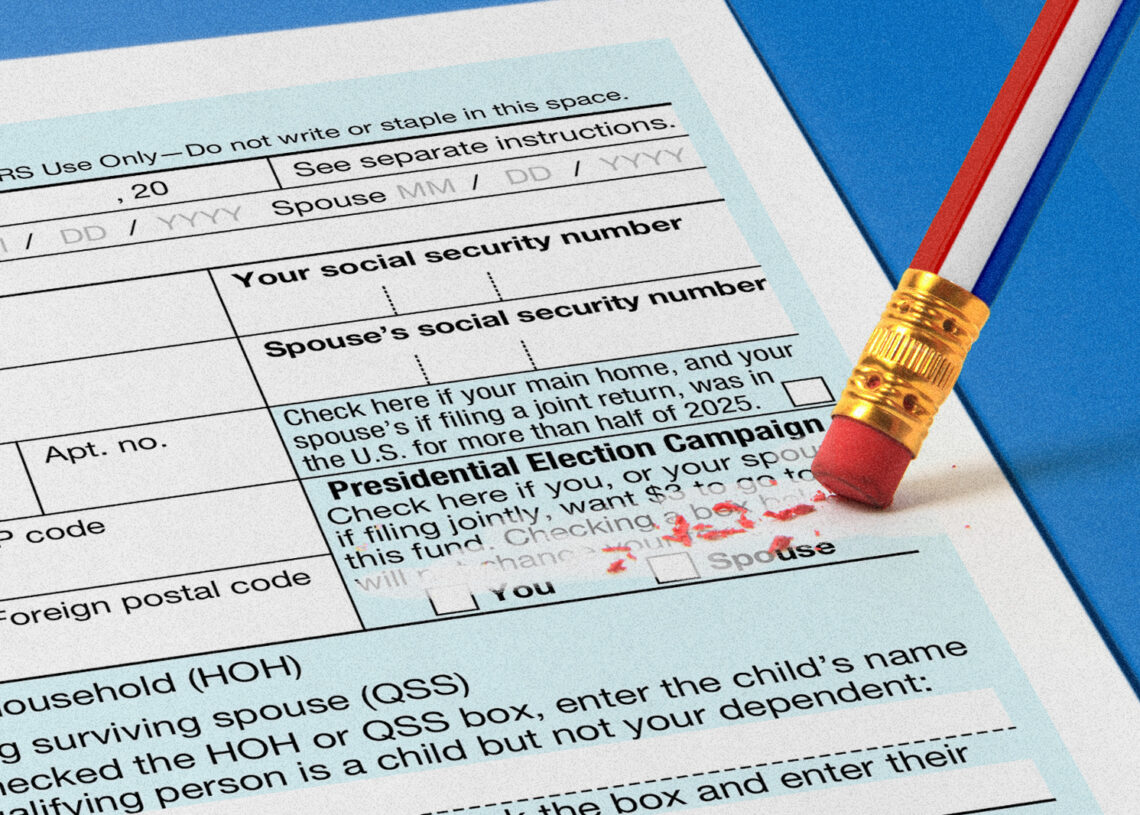
It seems quaint now, but there was a time when nearly a third of U.S. taxpayers checked that little box on their income-tax returns authorizing the Internal Revenue Service to allocate $3 of their taxes, $6 for married couples, to help pay for presidential campaigns. In 1976, two years after the Presidential Election Campaign Fund checkoff was created, 28 percent of filers opted into the program. That figure has dwindled to around 3 percent as fewer candidates avail themselves of the money and Congress raids the fund for other things.
Consider it one more sign of the decline in the democratic experiment: Americans are — quite rationally — unwilling to fork over the cost of a Snickers bar to help elect the leader of their country. That’s the case even though checking “no” has zero impact on the amount they pay in taxes.
Given the lack of appetite for campaign finance reform in an age of perpetual fundraising and ever-growing expenditures, Congress ought to simply junk the checkoff as the relic it is.
Perhaps, like me, you forgot about the $3 checkoff. An accountant prepares my taxes, so it has been years since I went line by line through a return. But this year I used TurboTax to prepare my college-student daughter’s return and was surprised to be reminded of the question: “Do you want $3 of your federal tax to go to the Presidential Election Campaign Fund?”
I can’t remember if I used to check “yes” when I did my own taxes. (I certainly did not this year on behalf of my daughter.) I have an even hazier memory of whether I fully understood the checkoff in the first place. I seem to recall that I thought the IRS was asking if I wanted to donate to the fund, which never appealed to me. If so, I was mistaken. The checkoff always gives taxpayers their one opportunity to say how they want a sliver of their taxes to be allocated — to the general treasury or to the Presidential Election Campaign Fund.
It was a good idea at its inception, intended as a good-government correction after the Watergate scandal. (The checkoff initially was for $1, or $2 for couples; it was bumped to its current level in 1994.) By matching primary campaign contributions up to a certain limit, federal funds would help candidates raise money for their campaigns. It would then fund nominees in the general election entirely, prohibiting most private contributions. The fund also helped political parties pay for their nominating conventions.
That worked for a while. Jimmy Carter credited federal financing and a level playing field for his victory against President Gerald Ford in 1976. Both candidates received the now laughably small amount of $20 million that year.
Seeing that the money kept rolling in, even at consistently lower participation rates, Congress began directing the revenue elsewhere. In 2014, it passed a law that canceled payments for political conventions and instead steered $12.6 million annually to the National Institutes of Health for pediatric medical research. Each year a little of the fund goes to pay down the federal deficit. A larger chunk funds the Election Assistance Commission, which oversees the administration of elections, including how voting machines operate. And in 2024, in an effort to boost spending on Secret Service protection for candidates, Congress effectively gutted the fund by withdrawing $320 million from it.
These all seem like worthy things to spend money on, but they are hardly in line with the spirit of the straightforward question taxpayers are being asked: Do you want some of your taxes to help fund presidential campaigns?
The upshot is that a fund that had more than $400 million as recently as 2023 ended February with just $23.5 million. More trickles in each month, but at ever-declining levels. Annual contributions peaked at $71 million in 1994, the year the checkoff tripled, and have steadily declined ever since. Not quite $20 million flowed into the Presidential Election Campaign Fund in 2025. If the trend holds, that number will dip further this year.
A small portion of the fund still goes to its intended uses, by the way. Former vice president Mike Pence claimed some money in the 2024 election cycle. So did Green Party candidate Jill Stein. That’s all good and fine, but the financing they received was a droplet in the ocean of private money raised by more successful candidates.
Public financing of political campaigns is a noble concept. Many countries do it to a far greater degree than the United States. Former president Carter advocated for it years after he left office, and policy experts like the Brennan Center for Justice at New York University School of Law continue to do so. But in the Citizens United environment of near-unlimited private contributions to political candidates, neither the politicians nor the campaign industry have any incentive to push for it.
The only thing I cannot figure out is why anyone still checks the box at all.
The post Hardly anyone checks this little box on their tax return. Why keep it? appeared first on Washington Post.