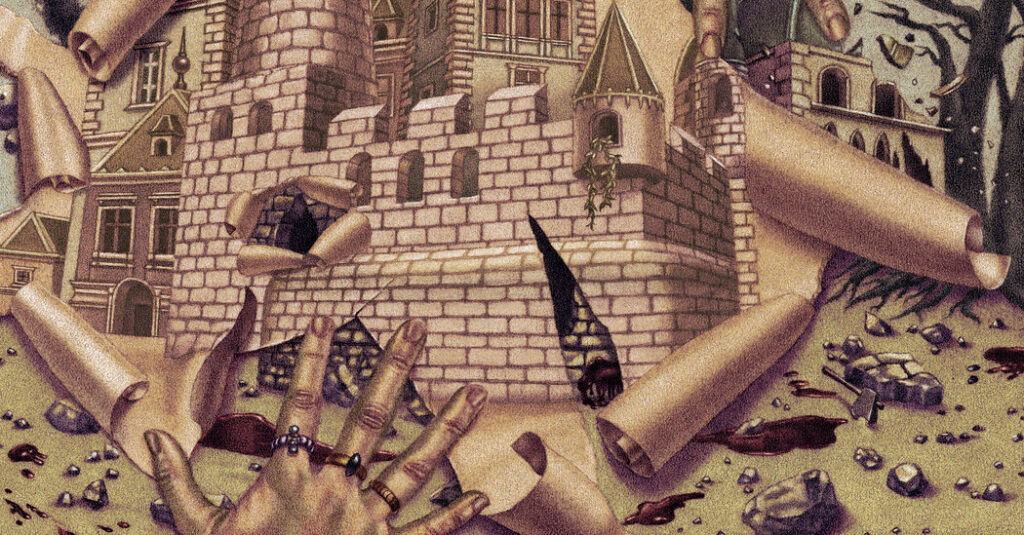
LÁZÁR, by Nelio Biedermann; translated by Jamie Bulloch
In the waning years of the Hapsburg Empire, a strange child with translucent skin is born into the Lázár family. His name is Lajos, and he will be the last baron in an aristocratic lineage about to plummet headlong into the “blood-red depths” of the 20th century.
Nelio Biedermann’s sweeping, unruly novel “Lázár” — artfully translated from the German by Jamie Bulloch — follows the family from the days of imperial grandeur, through the collapse of the monarchy, two world wars, Hungary’s Nazi collaboration and military loss, paranoid postwar life under Soviet occupation, up to the 1956 anti-communist revolution.
The novel, based loosely on Biedermann’s family history, begins as a gothic fable, rich with sensory description, gems of historical detail and surreal twists. Much of it is set on the lavish Lázár countryside estate, which anchors the family firmly to their past. Biedermann vividly evokes the atmosphere of a haunted manor at the edge of a sinister forest — through a narrative that hovers at the edge of realism. Family members are “swallowed” by the forest; letters and documents vanish into the house without a trace; paintings contain hidden messages; dreams invade waking life. Lajos’s uncle goes mad after a mysterious huntsman delivers him a copy of E.T.A. Hoffmann’s “Night Pieces.” Myth and memory collide.
The estate is run like a quasi-feudal fief, and the Lázárs take their wealth for granted. Even as the monarchy sinks “into the Danube swamp,” Lajos imagines he might still relive the “golden era of his grandmother, who had lived so extravagantly that she had her personal dairy cow transported by train to wherever she went.”
In the summer of 1948, while Lajos’s son is lying by the pool reading Thomas Mann, Soviet officers arrive and give the family one hour to vacate. Their land, home and possessions are expropriated by the state. They escape to Budapest, and are later sent to work on a state-run farm. Lajos’s son reflects on his father’s situation: “All his life he had been somebody without having to do anything to make this happen … and then, overnight, he was a broken man.”
Do we sympathize with these dispossessed nobles? Their allegiances are confused and typically self-serving. Lajos initially admires Hitler, but later turns to feeling “contempt and dark fear.” He watches thousands of Hungarian Jews marched toward Auschwitz, and tempers his guilt by sheltering an antifascist priest. His main concern is preserving the estate.
Later, in bombed-out Budapest, his children become marginally involved in revolutionary activity. But largely the Lázárs are caught between passivity and complicity. Discombobulated, Lajos and his ilk pine for their past, yet Biedermann presents the reordering of the old-world hierarchy with skillful ambivalence. There’s no neat moral reckoning.
The novel is consistently preoccupied with the question of whether literature itself can be complicit in violence. Facing the carnage of World War II, Lajos develops “an almost physical aversion to all fictional or beautiful prose,” as it distracts from brutal reality. His daughter, an avid reader, sees novelists as sadists who have “raped and pillaged people’s private lives,” creating a “power imbalance between perpetrator and victim.”
As if to drive the point to a literal extreme, Biedermann includes a blunt and shocking rape scene with a young novelist as its perpetrator. Throughout, rape is treated alternately as metaphor and event; the symbolic deployment risks dulling the horror. Yet its purpose is clear: to demonstrate that fiction has an active role in constructing the history it reimagines, and to ask what responsibility the author has toward the subjects he depicts.
Biedermann aims for a grand European saga in the mode of “The Leopard” or “Buddenbrooks,” and at its best, the novel achieves a powerful rhyming between daily life and the demise of an epoch. At other times, world-historical events are shoveled in with heavy hands (think: “Meanwhile …”). Lajos’s brief interests in, say, the Titanic, or Freudian psychoanalysis, read like dutiful flags in a timeline.
Overall, though, “Lázár” is thrillingly unburdened by conventional stylistic constraints. The story jumps in time, switches tenses and swaps point of view mid-paragraph. Nobody’s inner thoughts are off limits, even those of Stalin on his deathbed. Chapters might suddenly incorporate a list of possessions, a fragment of poetry, a sentence that runs two pages. The effect can be wildly freeing, even virtuosic. Sometimes it induces whiplash. On a few pages, the inconsistencies strain credulity.
Biedermann grasps at the edges of coherence, and some pieces flitter away in the wind. But he usually regains control by reining in the narrative, reinforcing core motifs and returning to the riveting scene-based storytelling that displays his true gifts. His formal risk-taking is clearly deliberate. It’s an audacious approach to portraying a chaotic era when any stable sense of past, present and future has fallen away and nothing can be taken for granted. As Lajos’s wife says: “There was no point in grappling with the future when the words ‘It’s war!’ were enough to turn apples into pears.”
LÁZÁR | By Nelio Biedermann | Translated by Jamie Bulloch | Summit Books | 258 pp. | $28
The post A Blue-Blooded Dynasty Falls to a ‘Blood-Red’ Century in This Novel appeared first on New York Times.