“Cheaters never lose, and losers never cheat.”
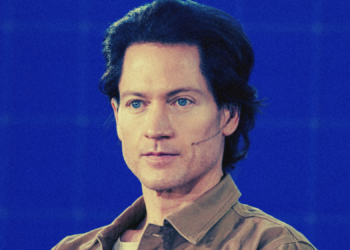
This is the demented advice that mega-rich tech CEO Duncan Park (Billy Magnussen) gives his teenage daughter at the end of the second episode of The Audacity, the lacerating new AMC series about the psychopaths of Silicon Valley, premiering April 12. It’s awful parenting, naturally, but the lesson also neatly encapsulates the rhetoric of Duncan’s particular bubble: It sounds counterintuitively clever but is wildly wrong—a bad idea pulled out of thin air by an overprivileged mediocrity who wants more than anything to be perceived as a genius.
In many ways, Duncan is a familiar archetype. By now you’ve seen plenty of movies and TV shows that skewer and punish the One Percent as they find ever more reprehensible ways to behave toward their peers and underlings. Jonathan Glatzer, creator of The Audacity, was a producer and writer for Succession, whose fans will get some of the same kicks here.
Likewise, you may be reminded of Mike Judge’s startup satire Silicon Valley when someone on the streets of Palo Alto calls Duncan an asshole for driving a Hummer and he yells back, “It’s an EV! I’m part of the solution! Bitch!”
But in Glatzer’s story, and with Magnussen’s ticking time-bomb performance, there is something perhaps new and different at play. Could this be television’s first true broligarch?
Duncan wears the puffer vest that has been the industry standard for years, though his Zoomer haircut brings to mind the youngsters of Elon Musk’s DOGE. When the crucial sale of his company Hypergnosis to an Apple-like behemoth falls through, he books a session with an on-demand ayahuasca shaman. He gets offended when a diagnostic evaluation reveals that he is neurotypical—he’d always assumed he was on the spectrum. In his petulance and boundary-crossing, his belief that market manipulation is the only sensible way to do business, and his growing suspicion that it was his dead former partner who carried him to the top, Duncan evokes the masculinity-in-crisis that has become a dominant theme of American billionaire culture.
And, contrary to some of its predecessors, The Audacity foregrounds the human wreckage that results from this explosive combination of emotional illiteracy and immense power.
At the center of the plot is a high-stakes entanglement between Duncan and his therapist, JoAnne Felder (Sarah Goldberg of Barry fame). You might expect something of a retread of Tony Soprano and Dr. Melfi in this relationship, the incurable narcissist offloading his woes on a woman who is paid to care. Instead, paranoid that JoAnne could leak damaging information regarding his business maneuvers, Duncan coerces an employee to use an AI surveillance platform to begin remotely stalking her and learns that she is making insider trades based on what she hears in sessions with her bigwig clients.
Both Duncan and JoAnne have plenty to worry about without the rapidly escalating blackmail scheme set off by this revelation. Their children, for instance. Duncan’s status-obsessed wife is grooming their daughter for Stanford despite her lack of merit while nagging whenever she takes a bite of food, and JoAnne is recently reunited with a painfully shy son who barely knows her. With the parents distracted by their game of cat and mouse, the kids are left adrift in the kind of cutthroat private school where suicide is an everyday topic.
This is one of the many ways in which The Audacity confronts the consequences of letting guys like Duncan run the world. It’s not all mergers and acquisitions here—in fact, the money is often secondary, except insofar as he thinks it gives him the right to destroy or manipulate whoever he wants. Lacking those resources, JoAnne quickly secures a handgun, which barely overstates the desperation of someone with student loan debt going up against a Fortune 500 executive.
The show is still less a parable of wealth than an examination of the perverse incentives and attitudes imposed by it. Duncan’s plan to save his stock valuation comes to involve Carl Bardolph (Zach Galifianakis), an old-school Valley whale and patient of JoAnne’s who veers between abject depression and violent rage—and is nonetheless a role model for younger male founders. Duncan yearns to join that lineage even as he keeps step with his own fraternal cohort. At one point he tells a housekeeper that “crypto bros” are enamored of the type of tungsten cubes he displays on his desk. “It’s not virtual,” he explains. “It’s real.” Later, he requests that an AI bot generate a “song of triumph” about him and takes actual pleasure in the result.
His pathetic qualities may not absolve him of evil. They do, however, give him a tragic dimension absent in many tech villain caricatures. Magnussen plays him as a nasty, vindictive, and very scared little boy—the predictable product of the ecosystem he is meant to dominate. The most painful and accurate thing is that he can’t begin to understand why all his meanness comes back to him.
The post ‘The Audacity’ Is the Broligarchy Takedown You Were Waiting For appeared first on Wired.