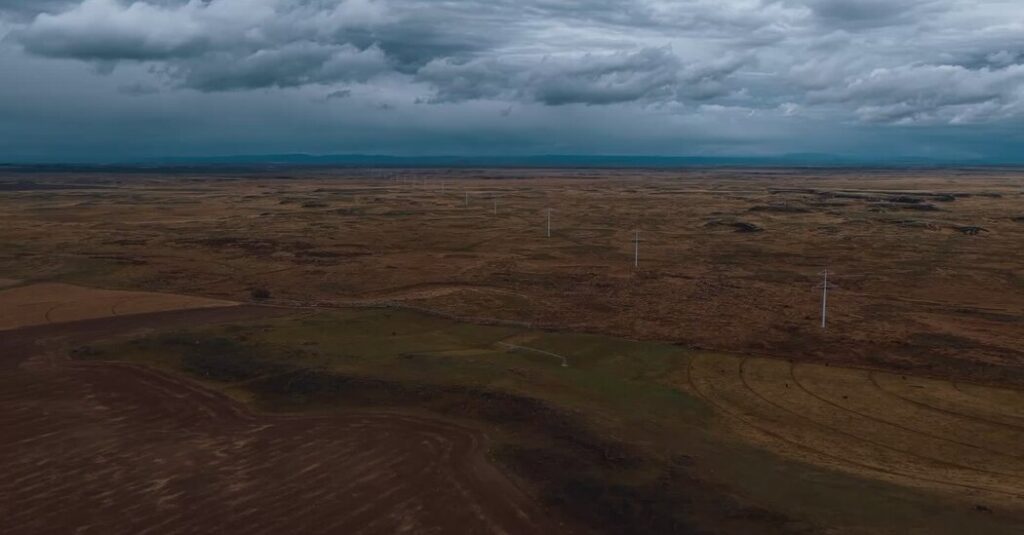
For decades, the fierce desert wind has been the only thing moving with any speed at the former Minidoka, Idaho, internment camp, other than an occasional car passing the site where more than 13,000 Japanese Americans were held behind barbed wire from 1942 through 1945.
Heavy breezes howl past a reconstructed guard tower and over the outlines of the camp’s baseball diamond.
Those winds were supposed to propel turbines — some twice as tall as the Statue of Liberty — at Lava Ridge, a wind energy project that would have stretched across tens of thousands of acres of federal land. Instead, an unlikely coalition of internees’ descendants, ranchers, tribal leaders, environmentalists, Republican elected officials and conservative renewable energy opponents slowed the project long enough for President Trump to win election in 2024 — then kill it.
The death of Lava Ridge last August points to the complexity of meeting America’s growing hunger for energy in the artificial intelligence era, amid the conflicting demands of climate scientists and land conservationists, shifting rules on public-land development and the president’s personal foibles.
But in this case, there was an unusual variable: How — or whether — the country should remember the darkest parts of its past.
“If this was near a Gettysburg or Yellowstone or Yosemite, they would never have dared,” said Dan Sakura, a public-lands consultant and descendant of Minidoka internees.
Lava Ridge supporters said it would have helped meet the increasing demand for clean energy in the West, particularly California. Opponents saw an industrial project spoiling the horizon of what placards at Minidoka call “an American concentration camp.”
The history of the camp, one of 10 the federal government ran during World War II, had largely been lost from local memory before the fight over the wind project. The government erected the camp in just two months after President Franklin Delano Roosevelt’s 1942 executive order demanding the forced removal of Japanese Americans on the West Coast, then government tore it down just as quickly..
President Bill Clinton protected 73 of the camp’s original 33,000 acres in 2001.
Descendants of internees say the stillness around the site is the point. An empty landscape helps visitors imagine how jarring and scary it must have been for the thousands of Japanese Americans who were removed from their homes and lives and taken by train to a remote, inhospitable corner of Idaho.
But as the nation’s A.I. industry grows, so does the need for energy. The Lava Ridge wind project grew in part out of a broader push by President Joseph R. Biden Jr. to expand renewable energy production on public land. Much of it, like the property around Minidoka, owned by the Bureau of Land Management, is unused even for recreation.
Southern Idaho appeared to be prime territory. The state already generates about 10 percent of its electricity from wind on private land, turbines dot the landscape along Interstate 84 between Boise and nearby Twin Falls, and the Snake River Plain also houses the Midpoint Substation, a major Western energy hub.
In 2019, the New York-based investment company LS Power submitted a plan to build 400 turbines, some as tall as 740 feet, across nearly 200,000 acres owned by the Bureau of Land Management and connecting to a massive transmission line the company is already building. The closest turbines would have been within two miles of the Minidoka visitors’ center.
The superintendent at the Minidoka historic site contacted family members of former camp internees. They called local elected leaders and neighbors like Dean Dimond, who began farming in Jerome County after college in 1996 and mostly knew about the camp through discoveries like the marbles and shards of teacups that children found in his fields, or the concrete foundations of forgotten buildings that he and other farmers had to work around.
Public hearings drew hundreds of people and lines around the block.
Groups that rarely worked together — environmentalists and renewable energy skeptics, Idaho tribes and the state government — spoke together in opposition. Wyatt Petersen, energy director for the Shoshone-Bannock Tribes, said LS Power and even the B.L.M. may not have fully appreciated the history of the region, the internment camp or the forced removal in the 1800s of Indigenous communities that still consider the plain culturally important.
“Yes, we’re not there today,” he said. “But that was not our choice.”
LS Power reduced the scope of the project to fewer than 250 turbines, none taller than 660 feet, across about 38,000 acres. The nearest would have been about nine miles from the site. In December 2024, a month before Mr. Biden left office, the bureau approved the scaled-down project. The bureau’s director at the time, Tracy Stone-Manning, said the final design “balances clean energy development that the country needs and the protection of resources that are vital to the natural and cultural history of the West.”
Neighbors were not convinced.
“They were just so gung-ho to get this done while they could,” said Janet Keegan, an internee descendant. “They soured a lot of us out here on wind farms entirely.”
Then Mr. Trump, whose antipathy for wind energy stretches back more than a decade, to a fight with energy developers near his Scottish golf resort, killed the project. On the first day of his second term, he paused all wind projects on public land or requiring federal approval. Eight months later, the interior secretary, Doug Burgum, formally canceled the project. His team cited Lava Ridge as part of “the radical Green New Scam agenda.”
“We won,” Mr. Dimond said. “Yea?”
His hesitation reflects the uncertainty over what happens next.
With or without Lava Ridge, the West’s energy demands are already reshaping the landscape. Mr. Dimond will lose a slice of land to the Southwest Intertie Project, a billion-dollar addition to the Western power grid. Utilities are also planning battery storage projects across the region, designed to store power until demand peaks.
Meantime, the Trump administration has begun speeding project reviews on federal land. The hundreds of hours the B.L.M. spent listening to neighbors balk at Lava Ridge would not happen Mr. Trump’s new rules.
Minidoka descendants have asked Mr. Trump to declare the area off-limits to wind and solar projects for decades to come or even permanently, arguing that the next time a Democrat wins the White House, wind might be back in political style and back on the table for the region.
But, as Ms. Keegan noted, the Trump administration is racing to approve oil and gas exploration.
“The protections are gone,” Mr. Sakura said. “The next time, we’re not going to have the same tools we had to slow Lava Ridge.”
Anna Griffin is the Pacific Northwest bureau chief for The Times, leading coverage of Washington, Idaho, Alaska, Montana and Oregon.
The post At a World War II Internment Camp, History Blows Away Wind Energy appeared first on New York Times.