At a military parade in Beijing in September, President Xi Jinping and his special guests, President Vladimir V. Putin of Russia and the North Korean leader, Kim Jong-un, watched as Chinese forces showed off several models of drones that could autonomously fly alongside fighter jets into battle.
The demonstration of technological might immediately set off alarm bells in the United States. Pentagon officials concluded that America’s program for unmanned combat drones was lagging China’s, according to three U.S. defense and intelligence officials. Russia, too, was thought to be ahead in building facilities that could produce advanced drones, said the officials, who were not authorized to speak publicly on military capabilities.
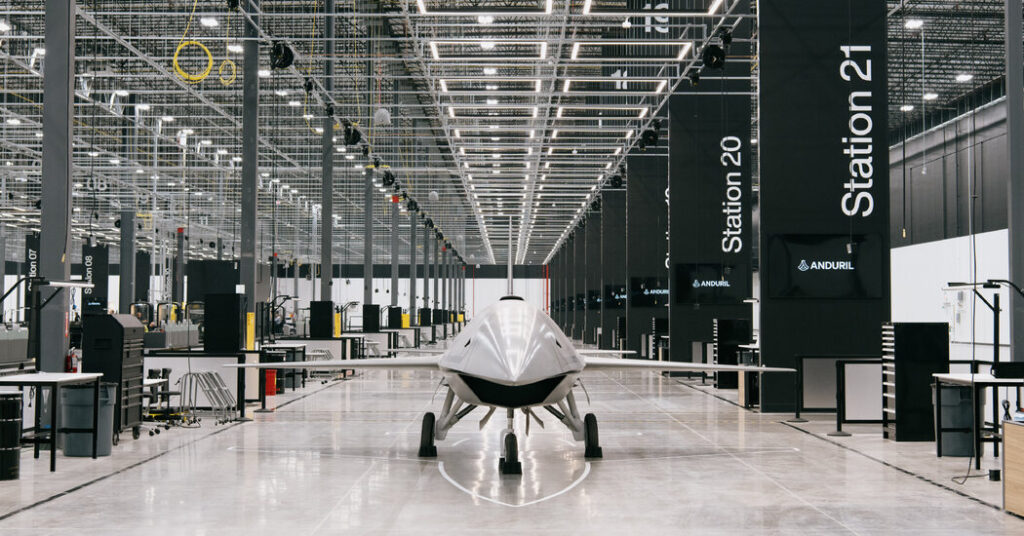
U.S. officials pushed domestic defense companies to step up. Last month, Anduril, a defense technology start-up in California, began manufacturing A.I.-backed, self-flying drones that appeared similar to the ones shown in China. Production at a factory outside Columbus, Ohio, started three months ahead of schedule, part of an effort to close the gap with China, one defense official said.
China’s military display and the U.S. countermove were part of an escalating global arms race over A.I.-backed autonomous weapons and defense systems. Designed to operate by themselves using A.I., the technology reduces the need for human intervention in decisions like when to hit a moving target or defend against an attack.
In recent years, many nations have quietly engaged in a contest of one-upmanship over these arsenals, including drones that identify and strike targets without human command, self-flying fighter jets that coordinate attacks at speeds and altitudes that few human pilots can reach, and central systems run by A.I. that analyze intelligence to recommend airstrike targets quickly.
The United States and China, the world’s largest military powers, are at the center of the competition. But the race has widened. Russia and Ukraine, now in their fifth year of war, are looking for every technological advantage. India, Israel, Iran and others are investing in military A.I., while France, Germany, Britain and Poland are rearming amid doubts about the Trump administration’s commitment to NATO.
Each nation is aiming to amass the most advanced technological stockpile in case they need to fight drone against drone and algorithm against algorithm in ways that people cannot match, defense and intelligence officials said.
Russia, China and the United States are all building A.I. arms as a deterrent and for “mutually assured destruction,” Palmer Luckey, Anduril’s founder, said in an interview in February.
The buildup has been compared to the dawn of the nuclear age in the 1940s, when the atomic bomb’s destructive power forced rival nations into an uneasy standoff, leading to more than four decades of nuclear weapons brinkmanship.
But while the implications of nuclear weapons are well understood, A.I.’s military capabilities are just beginning to be known. The technology — which does not need to pause, eat, drink or sleep — is set to upend warfare by making battles faster and more unpredictable, officials said.
Exactly which nation is furthest ahead is unclear. Many programs are in a research and development phase, and budgets are classified. Operatives from China, the United States and Russia watch one another’s factory lines, military displays and weapons deals to deduce what the other is doing, intelligence officials said.
China and Russia are experimenting with letting A.I. make battlefield decisions on its own, two U.S. officials said. China is developing systems for dozens of autonomous drones to coordinate attacks without human input, while Russia is building Lancet drones that can circle in the sky and autonomously pick targets, they said.
Even as the specifics of the technologies remain veiled, the intentions are clear. In 2017, Mr. Putin declared that whoever leads in A.I. “will become the ruler of the world.” Mr. Xi said in 2024 that technology would be the “main battleground” of geopolitical competition. In January, Defense Secretary Pete Hegseth directed all branches of the U.S. military to adopt A.I., saying they needed to “accelerate like hell.”
Billions of dollars are being poured into the efforts. The Pentagon requested more than $13 billion for autonomous systems in its latest budget, and has spent billions more over the past decade, though the total is difficult to track because A.I. funding has been spread across many programs.
China, which some researchers said was spending amounts comparable to those of the United States, has used financial incentives to spur private industry to build A.I. capabilities. Russia has invested in drone and autonomy-related programs, analysts said, using the war in Ukraine to test and refine them on the battlefield.
Liu Pengyu, a spokesman for the Chinese Embassy in Washington, said China had proposed international frameworks for governing military A.I. and called for “a prudent and responsible attitude” toward its development.
The Pentagon and Russia’s Ministry of Defense did not respond to requests for comment.
The dynamics may resemble the Cold War, but experts cautioned that the A.I. era was different. Start-ups and investors now play a role in the military and are as critical as universities and governments. A.I. technology is becoming widely available, opening the door for countries from Turkey to Pakistan to develop new capabilities. What’s emerging is a grinding innovation race without any obvious endpoint.
Ethical questions about ceding life-or-death choices to machines are being overtaken by the rush to build. The only major accord on A.I. weaponry between China and the United States was reached in 2024, a nonbinding pledge to maintain human control over the decision to use nuclear weapons. Other countries, like Russia, have made no commitments.
Some argued that A.I.’s impact would be bigger than any arms race.
“A.I. is a general-purpose technology like electricity. And we don’t talk about an electricity arms race,” said Michael Horowitz, a former Pentagon official involved in autonomous weapons development. “To the extent A.I. is transforming our military, it’s the way that electricity or computers or the airplane did.”
The Buildup Begins
In 2016 at an air show in the southern Chinese city of Zhuhai, a Chinese supplier flew 67 drones in unison. An animated film separately showed the drones destroying a missile launcher, a demonstration of their capabilities.
Russia, too, was building its drone arsenal. In 2014, its military planners set a goal of making 30 percent of its combat power autonomous by 2025. By 2018, the Russian military was testing an unmanned armed vehicle in Syria. While the tank failed, losing its signal and missing targets, it underscored Moscow’s ambitions.
In Washington, Lt. Gen. Jack Shanahan, who had previously worked in intelligence at the Defense Department, was assessing whether A.I. could solve a more immediate problem. The U.S. military was collecting so much data — drone footage, satellite imagery, intercepted signals — that nobody could make sense of it all.
“There was nothing in any of the research labs in the military that were capable of generating results in less than a couple of years,” General Shanahan said. “We had a problem we could not solve without A.I.”
In 2017, General Shanahan helped create Project Maven, a Defense Department effort for the military to incorporate A.I. into its systems. One aim was to work with Silicon Valley to build software to swiftly process images like drone footage for intelligence purposes. Google was tapped to help.
But the project quickly ran into hurdles. The Pentagon’s procurement system, built around legacy contractors and long timelines, slowed things down.
When word spread inside Google about Project Maven, employees also protested, saying a company that had once pledged “Don’t be evil” should not help identify targets for drone strikes. Google eventually backed away from the project.
In 2019, Palantir, a data analytics company co-founded by the tech investor Peter Thiel, took over Maven. New defense tech start-ups like Anduril also emerged, supplying the federal government with A.I.-backed sensor towers along the southern U.S. border.
In China, Beijing pushed commercial tech companies toward defense partnerships in a strategy called “civil-military fusion.” Private firms were drawn into military procurement, joint research and other work with defense institutions. Companies working on drones and unmanned boats found growing military demand for their technologies.
Russia’s invasion of Ukraine in 2022 turned theory into reality.
Outgunned, outspent and outnumbered, Ukraine held off Russia with an improvised arsenal of cheap technology. Hobbyist racing drones were used to attack Russian positions on the front lines, eventually becoming more lethal than artillery and, in some cases, gaining autonomous capabilities. Remote-controlled boats kept Russia’s Black Sea fleet pinned down.
Russia adapted as well. Its Lancet drone, which was initially piloted by humans, has incorporated autonomous targeting features.
“The four years of brutality on the battlefield in Ukraine has served as a laboratory for the world,” said Mr. Horowitz, the former Pentagon official.
In recent months, Ukraine began sharing its troves of battlefield data with Palantir and other firms so A.I. systems can better learn to fight wars.
Across Europe, where governments are aiming to diminish their reliance on the American military, the lessons from Ukraine resounded. In February, Germany, France, Italy, Britain and Poland said they would develop a joint air defense system to guard against drones.
China also advanced. At the 2024 Zhuhai Airshow, Norinco, one of the country’s main defense manufacturers, revealed multiple weapons with A.I. capabilities. One of its systems showed an entire brigade, including armored vehicles and drones, which were controlled and operated by A.I.
Another craft, unveiled by the state-run Aviation Industry Corporation of China, was a 16-ton jet-powered drone designed to serve as a flying aircraft carrier that could deploy dozens of smaller drones midflight.
‘Left Click, Right Click’
A week after American and Israeli forces struck Iran in February, a senior Pentagon official gave a glimpse into what computerized warfare now looks like at a conference livestreamed by Palantir.
A satellite feed showed a warehouse. With the click of a mouse, an officer selected a row of white trucks parked outside to target in real time. In seconds, the A.I. software suggested a weapon, calculated fuel and ammunition needs, weighed the cost and generated a strike plan.
It was the present-day version of Project Maven, which General Shanahan had started and was now run by Palantir and powered by commercial A.I. The system analyzed intelligence from various sources, generated target lists ranked by priority and recommended weapons, all but eliminating the lag between identifying a target and destroying it.
Embedded with a military version of Claude, the chatbot made by the A.I. firm Anthropic, Maven helped generate thousands of targets in the opening weeks of the Iran campaign, a pace that Adm. Brad Cooper, the head of U.S. Central Command, attributed in part to “advanced A.I. tools.”
Cameron Stanley, the Defense Department’s chief digital and artificial intelligence officer, who spoke at Palantir’s conference, said that what Maven was doing was “revolutionary.” Human involvement amounted to “left click, right click, left click,” he said.
The claims about Maven’s abilities might be overstated and much of the American advantage came from the scale of data flowing in and the skills of the people using it, said Emelia Probasco, a senior fellow at Georgetown University’s Center for Security and Emerging Technology.
“It’s not rocket science,” she said. “I suspect that China already has something like it.”
In a recent report analyzing thousands of People’s Liberation Army procurement documents, Ms. Probasco found that China was building systems that mirrored American ones. In one case, China was trying to replicate the Joint Fires Network, an American program set up to link sensors and weapons globally so a drone on one side of the world could cue a strike from the other.
In some areas, China clearly leads. Its manufacturing dominance means it can produce autonomous weapons at a scale the Pentagon cannot match.
Inside the Trump administration, the push for A.I. weapons has taken on an almost evangelical fervor. Last month, the Pentagon labeled Anthropic a security risk, partly because the company wanted to limit its technology’s use for automated weapons.
“We will win the A.I. race,” Jacob Helberg, the under secretary of state for economic affairs, said last month at the Hill & Valley Forum, an annual conference in Washington, which he co-founded to bridge Silicon Valley and the government.
At the conference, tech executives, investors and government officials cheered speakers who called for tech companies to give the military unfettered access to A.I.
Anduril’s Mr. Luckey argued that the A.I. arms buildup might prevent major wars. The logic mirrored the Cold War: If both sides knew what the machines could do, neither would risk finding out.
“Conflicts between superpowers will similarly deteriorate if you can build the things that deter warfare effectively enough,” he said.
Yet deterrence assumes rationality, while A.I. weapons are designed to move faster than human reason. In exercises dating to 2020, researchers explored how autonomous systems could accelerate escalation and erode human control — with some alarming results.
In one scenario, a system operated by the United States and Japan responded to a missile launch from North Korea by autonomously firing an unexpected counterattack.
“The speed of autonomous systems led to inadvertent escalation,” said the report by analysts at RAND Corporation, a nonprofit research organization that works with the military.
General Shanahan, who retired from the military in 2020 and is now a fellow at the Center for a New American Security, a think tank, said the race he had helped start kept him up at night. Governments must set clear boundaries before the technology outruns their control, he said.
“There is a risk of an escalatory spiral where we’re in danger of fielding untested, unsafe and unproven systems if we’re not careful, because we each feel like the other side is hiding something from us,” he said.
Sheera Frenkel is a reporter based in the San Francisco Bay Area, covering the ways technology affects everyday lives with a focus on social media companies, including Facebook, Instagram, Twitter, TikTok, YouTube, Telegram and WhatsApp.
The post Mutually Automated Destruction: The Escalating Global A.I. Arms Race appeared first on New York Times.