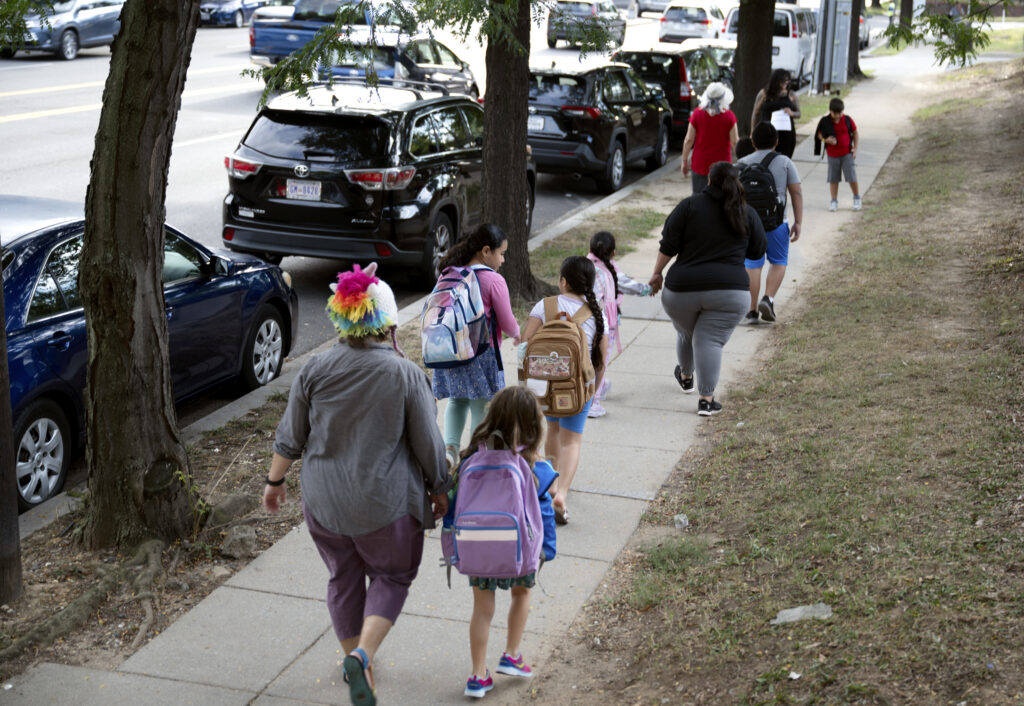
Prekindergarten applications in D.C. have plunged this year, particularly at schools in immigrant neighborhoods and those with bilingual programs, a sign of how federal layoffs and the Trump administration’s immigration crackdown have affected families who once competed fiercely for lottery seats.
There were about 32,800 pre-K applications through D.C.’s public school lottery for the 2026-27 school year, a 14 percent decline from last year, according to newly released data from the D.C. Office of the State Superintendent of Education. The drops were even steeper — nearly 25 percent — at Spanish-dominant dual-language programs and in neighborhoods with large immigrant populations, a Washington Post analysis of school-level lottery data found. Across all grades, the total number of applicants fell 6.5 percent.
The decline comes as the District absorbs blows to its population base: federal workforce reductions that have unsettled thousands of families, a sharp slowdown in immigration to the city and growing fear among immigrant communities over enforcement actions — all on top of a decade-long decrease in birth rates. Together, they appear to be thinning the pipeline of young children hoping to enter classrooms in the nation’s capital — a trend with direct consequences for a school system whose funding is based on how many students walk through the door.
That anxiety is reshaping how families navigate the lottery. Mariel Vallano, a middle school English-language teacher and community organizer who helps Spanish-speaking families submit lottery applications, said some undocumented immigrants are forgoing better academic options in favor of schools closer to home that don’t require a lottery application, a choice that offers less exposure to a potential Immigration and Customs Enforcement arrest.
“More distance means more risk, and a lot of parents are not comfortable … accompanying their kids to school anymore,” Vallano said.
A spokeswoman for the state superintendent’s office said the agency does not share information with ICE. D.C. Public Schools Chancellor Lewis Ferebee said at the beginning of the school year that the district shares student information with law enforcement officers only when they have a lawful court order, and principals have been directed to contact the district’s lawyers when that happens.
On Friday, DCPS spokesman Evan Lambert said the district does not ask for nor collect information about families’ immigration status.
“As we observe trends throughout enrollment season, our teams remain focused on supporting families and enrolling students so they can access the rigorous instruction, programming, and services DCPS offers to District residents,” Lambert said in a statement.
Since 2014, families seeking a spot at a D.C. public or public charter school have applied through My School DC, a common lottery system that covers more than 200 schools across the city. Parents submit a ranked list of up to 12 schools, and students are matched based on available seats and a random lottery number, with preferences given to siblings of current students, residents within the school’s neighborhood boundaries, and other groups. The lottery is used most heavily for pre-K, where there is no guaranteed seat within the neighborhood. In later grades, families can attend their designated neighborhood school without applying.
About 21,000 students applied through D.C.’s common lottery for the 2026-27 school year, some whose families submitted applications to multiple schools, a 6.5 percent decline from the previous year, the state superintendent’s data shows. The number of students on wait lists fell to roughly 28,900, from 31,760 last year, the lowest level in more than a decade. Nearly half of all school programs failed to fill their available seats on lottery results day.
Across all grades, applications from families who listed Spanish as their preferred language fell 22 percent over the past two years, more than twice the 9 percent decline among English-speaking families.
“We’re starting to see signs of increased stress in English learner family communities experiencing more risks of deportation or being hassled on the way to school,” Chelsea Coffin, who leads education research at the D.C. Policy Center, said.
Families at the CentroNía day care facility in the city’s heavily immigrant Columbia Heights neighborhood have experienced that firsthand. The private day care that emphasizes bilingual education but does not participate in the city’s lottery welcomed two girls of an immigrant family to its pre-K program last summer, said Lisa Rivera, the organization’s family and community services senior director who oversees admissions. But within a week, the 3- and 4-year-old sisters stopped coming.
Federal immigration officers had detained their father, and although their mother initially hoped to send them back to CentroNía, that didn’t happen, Rivera said. She hasn’t heard from her in months; calls to the mother and knocks on the door of the family’s home have gone unanswered, she said.
The girls’ withdrawal is part of a sharp drop in CentroNía’s pre-K enrollment to its lowest level since Rivera started working there more than a decade ago. Last year, the organization filled 92 of its 104 pre-K spots; this year, there are 69 students enrolled, a 25 percent decrease at its headquarters in Columbia Heights, which Rivera said has had a heavy ICE presence since August, when President Donald Trump declared a “crime emergency” in the city and ramped up enforcement.
“They were on the corner in the block. They were in the alley. They parked [in a lot] behind CentroNía,” Rivera said. “It was really a menace to our families.”
After a dramatic spike shortly after, the rate of ICE arrests in the city has sharply declined since December, according to recently released federal data.
Counter to the drop in pre-K demand, enrollment in subsidized child care has climbed from about 5,573 children in 2024 to 7,156 this year, according to a state superintendent’s office report. Coffin says this is a sign that families may be opting to stay in community-based settings, which can feel smaller or less risky.
Vallano, the middle school English-language teacher, pointed to another source of the declines in immigrant neighborhoods. After Republican governors in Texas and Arizona began sending migrants from the border to D.C. on buses in 2022, enrollment spiked in some of the city’s schools. But the buses stopped arriving to the city in 2023 and that pipeline of families has since dried up. Many of the predominantly Latin American families who enrolled children in D.C. schools, have since relocated to nearby suburbs, such as Prince George’s County in Maryland.
“Those students have been trickling out,” Vallano said.
At the city’s largest bilingual school by enrollment, Bancroft Elementary in the Mount Pleasant neighborhood, which has spots for both Spanish-dominant and English-dominant speakers, applications for PK3 classes meant for 3-year-olds fell by 39 percent this year.
The drop in demand was sharp enough that 18 children were admitted to Spanish-dominant classrooms without any of the criteria that traditionally went into securing a spot, such as having a sibling at the school or living in the neighborhood. In the previous three years, every seat had gone to families who held one of those advantages. The wait list at Bancroft, which stood at 60 last year, shrank to 10.
At the nearby Marie Reed Elementary School, PK3 applications submitted on behalf of children who primarily speak Spanish fell by more than a third this year. Oyster-Adams Bilingual School, in the city’s Adams Morgan area, D.C.’s second-largest bilingual program, saw 83 fewer applications from families with 4-year-olds who primarily speak English.
The declines were not limited to bilingual schools: Eaton, Janney and Hearst elementary schools each had 100 fewer 4-year-olds applying this year. Hyde-Addison Elementary School, in Georgetown, had 80 fewer applications submitted by families with 4-year-olds and another 80 less for classes targeting 3-year-olds.
But for some of the city’s more highly sought-after schools, the drop signals a cooling in demand but not a crisis. For smaller schools where applications have fallen below available seats, the consequences are more immediate: under D.C.’s per-pupil funding formula, fewer students means less money.
Several charter networks were left with hundreds of unfilled slots.
Lambert, the DCPS spokesman, cautioned that lottery applications do not always reflect where families ultimately enroll their children. The official enrollment count will not take place until October, the state superintendent’s office said.
Applications to Equitable Access programs, which reserve seats for students from underserved communities, held up better overall, declining by 6.3 percent. But at some schools, Equitable Access slots went unfilled. At Dorothy I. Height Elementary, in the Petworth neighborhood, no families applied for the Equitable Access program catering to 4-year-olds, down from 17 last year.
The decline also comes against a backdrop of demographic shifts that have been building for years. Births to D.C. residents have fallen between 2 and 3 percent annually since 2016, according to research from the D.C. Policy Center, with fewer children now reaching prekindergarten age. The D.C. Policy Center projects that pre-K enrollment will decline by about 1,700 students over the next five years.
Irene Holtzman, vice president of operations at KIPP D.C. Public Schools, which has eight charter schools in the city, saw a nearly 17 percent drop in applications for its six pre-K programs. Because their students are about 99 percent African American, the immigration crackdown is likely not a factor in the decrease, Holtzman said. Instead, it appears to be related to the continuing decline in the city’s birth rate.
“There’s a little bit of a demographic bubble that burst,” she said.
Coffin said she expects the number of pre-K and elementary student population to shrink by about 3,000 over the next five years, about 6 percent of the roughly 53,000 now enrolled in the network’s D.C. schools. That could result in funding cuts that hit campuses equally or result in the closure of about seven elementary schools.
“It’s not this exodus. It’s just fewer kids,” she said, “and it’s been coming for a while.”
Etai Mizrav, a professor of education policy at Northeastern University, said the systemwide decline “tells us that families across the District, not just in one neighborhood or one type of school, are making different choices about public education than they were a year ago.”
Given the city’s heavy investment in universal pre-K, Mizrav said, “we should understand why, and to make sure the city is doing everything it can to regain families’ trust.”
Rivera, at CentroNía’s, said the anxiety over immigration enforcement in the city is still driving people underground. In past years, she would typically have about 150 families waiting for a pre-K spot by this point in the spring, Rivera said.
As of Thursday, there were 35.
Families are “scared,” she said, before choosing a stronger characterization. “They are terrified.”
The post D.C. school applications fall amid deportation fears and federal layoffs appeared first on Washington Post.