Fifty-eight years ago, he went to jail for singing about love in times of war.
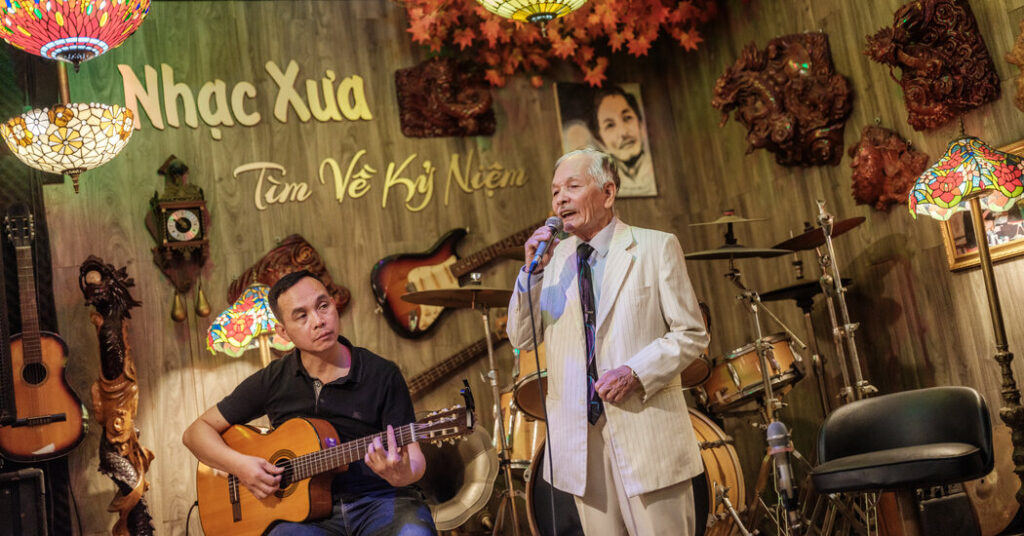
On a recent Wednesday night in the back room of a modest Hanoi home fashioned into a music club, Nguyen Van Loc returned to the same songs, smiling, wearing white, tapping a microphone to get the attention of a dozen friends drinking ginger tea.
“Good evening,” he said in Vietnamese.
Backed by a guitar, his opening ballad echoed through speakers built for a bigger space. Black-and-white photos of his favorite composers covered the wood-paneled walls. Lamps of colored glass, hanging upside down like drying flowers, brightened a stage adorned with phrases in gold.
“In Search of Bygone Memories.”
“In Remembrance of Days Gone By.”
Mr. Loc, 81, is Vietnam’s last, most steadfast singer of the heartfelt music that defined Hanoi before and soon after the country split in 1954. With a wispy sadness that he compares with soft breezes over rice fields, they are songs by Vietnamese artists (including many of his late friends) that draw from both Eastern and Western musical heritage. And like his life story, they carry waves of nostalgia, pain, longing and the lessons of connections lost when societies divide and leaders demand cultural obedience.
Musicologists have described the genre as slow-tempo Vietnamese poetry, delivered with melodies adapted from places like Paris, Detroit, Honolulu and Havana. In Mr. Loc’s view, the music deserves praise for its apolitical inventiveness and emotional depth.
“It’s about human beings and love, love between men and women, love for your hometown, for the countryside,” said Mr. Loc, a compact man with intense eyes that soften when he sings. “I just love that romantic music with its power of love that’s silky smooth.”
During the Vietnam War, North Vietnam’s Communist authorities feared that such music would lull people away from fighting. They labeled any music that wasn’t revolutionary Nhac vang, or “yellow music,” borrowing from a Chinese term for the love songs of 1930s Shanghai. As the war intensified, Hanoi’s leaders tried to eradicate the scene.
“Word went out on the street,” said Jason Gibbs, a longtime researcher of Vietnamese popular song. “If you keep doing this, you’ll get in trouble.”
Mr. Loc simply moved further into the shadows.
“Every night, we’d gather together around a pot of tea, have a few cigarettes, and we’d sing for each other in a small group,” he said.
Then the police came.
***
Born to a middle-class family in 1945 in Hanoi, to a father who had worked in construction for the French, Vietnam’s colonial ruler, Mr. Loc fell in love with prewar music as a boy.
His family fell from favor as the Communists rose. He quit school after seventh grade to work.
Music held his Hanoian social circle together, for a while. By the mid-1960s, Vietnam’s revolutionaries began to crack down even on home concerts.
They arrested Mr. Loc in March 1968. It was two months after the Tet offensive failed to give the North its desired, decisive victory, despite coordinated surprise attacks on major cities and U.S. military bases. He and his two bandmates, along with a few other musicians (including a wedding singer), were interrogated then detained.
State-run media accounts from the time suggest they fell afoul of a new law that was made public only after their arrests, insisting on long prison sentences for crimes like “spreading the enemy’s psywar propaganda,” and encouraging “the depraved culture of imperialism.”
Mr. Loc, talking in mid-March over green tea in his tiny alleyway home, described the case as a farce.
“They didn’t have evidence,” he said. “All they had were rumors.”
The musicians were sent to Hoa Lo prison, a notorious detention center that American soldiers nicknamed “the Hanoi Hilton.” Six months later, the authorities asked them to play at Hanoi’s grand Opera House, so that government-sanctioned composers of “red,” or revolutionary, music could learn what made yellow music so popular.
The group performed roughly 10 songs, which the authorities recorded with care.
“We thought we were right about the music, because now they wanted to listen to it,” Mr. Loc said. “We were so happy.”
They figured they were about to be released.
After three more years in jail — at their trial in 1971 — the recordings became evidence.
Mr. Loc said the prosecutor played their songs at low volume and distorted speed, then blared propaganda music loudly through a high-fidelity system, to show why yellow music was weak and socialist songs were strong.
“I could feel the heat rising, in my ears and my face, because they were so deceitful,” he said. “They trapped us. They tricked us. I felt so much hatred.”
He poured more tea. A woodcut portrait of Nguyen Van Cao, a poet, painter and composer who wrote Vietnam’s national anthem in 1944 and was blacklisted after seeking freedom of expression in the ’50s, hung on the wall.
“I got the lengthiest sentence,” Mr. Loc told us. “Ten years because the court said the musicians only played the notes, but I sang the songs.”
***
Guards called him the stubborn one. At labor camps deep in the jungle, they told prisoners to sing revolutionary music in exchange for lighter work and better food. Some agreed. Mr. Loc kept lugging bricks and eating gruel.
“I could never sing that music, the songs that encourage people to kill,” he said. “The music just wouldn’t stick in my head.”
When no one was around, he sang for his sanity. He would dig a hole in the ground with his hands and pour the songs he loved into the earth, voicing them secretly and briefly. Then he would cover the hole back up with dirt.
After the 1973 Paris Peace Accords wound down fighting with the United States, Mr. Loc’s sentence was reduced. He was released on March 27, 1976, after spending eight years as a political prisoner.
Music continued to shape his life. He kept his mustache and hair picture perfect, always ready for a spontaneous gig. He married a woman who had heard him sing in the early 1960s, and they had two children.
Their son, Nguyen Quoc Linh, 44, a jazz musician and teacher, said the family’s home sound system, with reel to reel tapes and tall speakers, felt like an extra relative, ever-present and vocal. One of his first memories: facing the speakers, losing himself in the music, and accidentally peeing.
“I got away with it because I was so small,” he said.
In the late 1980s, Vietnam’s economic liberalization opened up a bit more room for expression, and yellow music took on a life of its own in the Vietnamese diaspora. But Mr. Loc was still unable to perform freely.
He tried singing in bars, but the police denied him permits. He set up his own cafe in the mid-1990s, only to be told the police would arrest him if he tried to sing there.
Eventually, in 2008, he opened a cafe where he could take the stage. He had told the authorities back in 1971 that he had always wanted to advance musical development with the rest of the world. Instead, he became a preservationist for songs from his youth, opening a number of cafes, one after another. Each closed. His last one couldn’t survive the pandemic.
Along the way, the music he loved experienced a mild revival. In 2017, a cultural group invited Mr. Loc back to Hanoi’s Opera House for a concert honoring yellow music.
Accompanied by his son on guitar, he sang two songs that had been used against him. He told his son afterward about his appearance in 1968, and why returning prompted tears.
“For me,” Mr. Loc said, “it was a bit of personal revenge — to reclaim my pride.”
***
At his friend’s place in Hanoi last month, Mr. Loc sang a few songs at a time, taking turns with other performers. He moved about the room like a proud patriarch at a family wedding.
At one point, between sets, he waved to a fan stuck in Dubai, who was joining via video call because of the U.S.-Israeli war with Iran.
Many see the regularity of such shows as a triumph — they happen weekly, without police intervention.
But for Mr. Loc, sadness lingers. Justice, he said, would mean an apology from the government — for his years in prison, and the harassment that followed. In 2017, he was invited to sing at a lounge in Ho Chi Minh City, but when a large crowd appeared, the police refused to let him perform and unplugged his microphone when he tried to talk.
It was a sign, he said, that Vietnam pretends it’s more open-minded than it is.
But the music persists. As his performance stretched on, his voice strengthened. Enchanted (that’s how he describes performing), he closed his eyes at each crescendo, his voice powering lyrics that would hurt more if the notes didn’t sound so sweet.
“My heart knows that to love is, one day, to suffer,” he sang. “Yet why do I keep on loving, keep on remembering?”
Damien Cave leads The Times’s new bureau in Ho Chi Minh City, Vietnam, covering shifts in power across Asia and the wider world.
The post Jailed for Love Songs? Yes, and Still Singing. appeared first on New York Times.