Voters in Hungary will choose a new Parliament on Sunday, in an election with consequences that stretch far beyond a small corner of Central Europe.
It could have implications for the future of the European Union’s version of liberal democracy, and for that of the global populist movement that opposes it — promoted most famously by President Trump, but also by Viktor Orban, Hungary’s imperiled prime minister of 16 years.
The election is being followed anxiously by the Trump administration and the Kremlin, both of which want Mr. Orban to win, and by European leaders who hope to see the back of him.
Both Mr. Trump and Vice President JD Vance jumped into the campaign last week in a last-ditch effort to lift what seem to be the sagging prospects of Mr. Orban’s governing Fidesz party.
“I love Viktor,” Mr. Trump, speaking by telephone from Washington, told thousands of cheering Fidesz supporters in a Budapest arena. Mr. Vance, on a two-day visit to the Hungarian capital, offered his effusive praise in person.
Most independent polls show Fidesz far behind Tisza, an upstart party led by a conservative former Orban loyalist, Peter Magyar. Fidesz insists that its own polls show it winning.
Mr. Orban is a lodestar — or, as one analyst put it, the Fidel Castro — for “anti-woke” crusaders, including many within Mr. Trump’s MAGA movement and like-minded Europeans like Nigel Farage of Britain. They admire and hope to replicate his long string of electoral victories — four in a row, since 2010 — and his crackdowns on migrants and progressive social causes. Mr. Orban, who has bent many Hungarian institutions to his will, calls his project “illiberal democracy.”
Liberals loathe him, as do those who see the European Union as a necessary barrier against nationalist passions and Russian interference. A singularly disruptive force, he has blocked European assistance to Ukraine, worked to water down sanctions on Moscow and presented Ukraine, not Russia, as the principal threat to Europe’s security.
“If I had been Mephistopheles and I wanted to design an agent to show up all the structural weaknesses of the E.U., I would have designed Orban’s Fidesz,” said Timothy Garton Ash, a British historian and expert on Eastern and Central Europe.
Those weaknesses — including an endlessly cumbersome decision-making process and the veto power each member state has over key policies — will still exist if Mr. Orban’s party loses on Sunday, Mr. Garton Ash noted. But Europe, he said, will be rid of a thorn in its side and a leader widely seen as a stalking horse for Russian interests.
If Tisza wins a hefty majority in Parliament, he said, there will be “a real chance that Central Europe becomes not just a regional but a global trendsetter in showing how you can recover from quite far-reaching state capture and effectively move back from electoral authoritarianism to some credible version of liberal democracy.”
Many traps and uncertainties lie ahead. A big question is not only which side wins, but by how much.
The system
More important than the share of the vote won by each party is how, under a convoluted electoral system repeatedly revised under Mr. Orban, the votes translate into seats in Hungary’s 199-member Parliament.
Most pollsters predict that Tisza will win more votes overall than Fidesz. But even if it does, the extreme complexity of the electoral system, along with years of gerrymandering, means the outcome in Parliament might not quite reflect that.
The system’s complications have deepened longstanding distrust in the electoral process. A recent Gallup survey found that 57 percent of adult Hungarians lack confidence in elections. Many Fidesz supporters believe the polls showing their party losing are rigged and wrong.
Tisza, founded just two years ago, has become a vessel for the hopes of many Hungarians — including some who voted for Fidesz in the past — that change is possible.
A crude Hungarian saying daubed on an opposition banner near an Orban rally last month gave an earthy precis of Mr. Magyar’s basic message: “Even a horse’s penis comes to an end.”
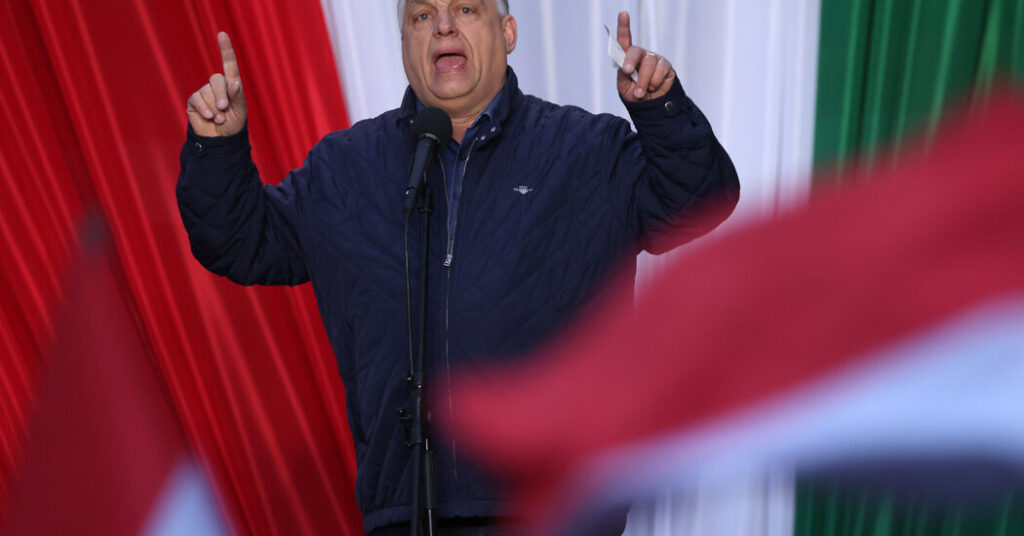
That is certainly the hope of Adam Stucs, 33, a Budapest resident who showed up on Saturday evening to hear Mr. Orban give the final speech of the campaign, and possibly of his career as prime minister.
“It’s a historic moment, at least we hope so — the end of an era,” he said. “I’m not a fan of Tisza, I’m a fan of a change.”
Most people in the crowd, however, came to cheer on Mr. Orban. Istvan Palyi, a Fidesz supporter wearing a Make Europe Great Again hat, said he was sure Mr. Orban would win, adding, “It doesn’t matter what the polls say.”
Scenarios
The main question is likely to be whether disenchantment with Mr. Orban is strong enough to give Mr. Magyar and Tisza a big majority in Parliament. A narrow win would lead to a shaky government backed by his own legislators or a coalition with smaller parties.
That, according to Mr. Garton Ash, would put Hungary in much the same position as Poland, where a center-left alliance won a parliamentary election in 2023 but found its scope for action crimped by the election of a hard-right president last year.
“Central Europe’s condition,” he said, “will then become one of incomplete democracy and incomplete authoritarianism — a semi-permanent hybrid state.”
If neither Fidesz nor Tisza wins big, an important thing to watch for will be whether the far-right Our Homeland Movement, the leftist Democratic Coalition or the Hungarian Two-Tailed Dog Party, a spoof outfit, gets enough votes to meet a 5 percent threshold and enter Parliament. They could then help shape the government if the final result is close.
Even Fidesz fans concede the party has almost no chance of repeating its landslide of 2022. But it could do well enough to hang onto power by forming a coalition government of its own.
What drove the campaign?
Though closely watched abroad, Hungary’s race was driven largely by domestic issues, particularly the faltering economy, a dilapidated health care system and widespread corruption linked to relatives, friends and allies of Mr. Orban.
Mr. Magyar hammered away at corruption at every campaign stop, reaching beyond die-hard Orban foes like Budapest liberals with the populist message that he would punish well-connected crooks and raise living standards for ordinary people.
Mr. Orban, vulnerable on the economy and corruption, tried to draw attention to foreign affairs. He reveled in the praise of Mr. Trump, Mr. Vance and many of Europe’s right-wing populist leaders, and he cast President Volodymyr Zelensky of Ukraine as an existential threat, a role previously assigned to the Hungarian-born American financier George Soros.
With Mr. Soros now 95 and retired in New York, Mr. Orban seems to have decided that he needed a more plausible enemy. Fidesz plastered sinister-looking photos of Mr. Zelensky on billboards across Hungary, blaming him and the European Union for rising unemployment and stagnant growth.
Mr. Vance, while in Budapest, took up the same cudgel against the E.U. and Ukraine, casting Mr. Orban as a warrior defending “Western civilization” and national sovereignty.
When will we know who won?
Polls close at 7 p.m. Hungary does not bother much with exit polls, which are hard to conduct because pollsters are not allowed within 150 yards of voting sites. Also, the complexity of the electoral system sharply reduces the polls’ predictive power.
For first-past-the-post races in Hungary’s 106 electoral districts, each of which elects a member of Parliament, the first official results should start coming in within an hour or so.
But counting in a parallel election for 93 members of Parliament — chosen from national party lists, under a proportional system — could take much longer. That count involves transferring some of the votes cast in electoral districts to party lists, under a complicated formula known as the d’Hondt-matrix.
If either Tisza or, less likely, Fidesz wins by a big margin, the final outcome should be reasonably clear by late Sunday or early Monday. But if the election is very close, it could take days to know the result, as postal ballots are laboriously counted.
Lili Rutai contributed reporting.
Andrew Higgins is the East and Central Europe bureau chief for The Times based in Warsaw, on temporary assignment in Shanghai.
The post What to Know as Hungary Votes in Elections Watched by the World appeared first on New York Times.