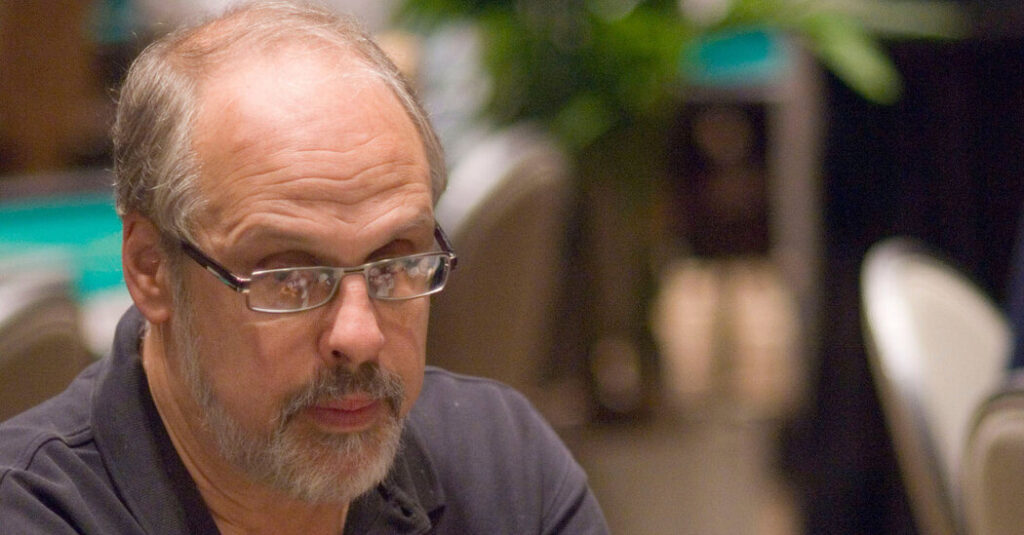
David Sklansky, a professional poker player and influential author who brought mathematical rigor to a card game that was once guided by gut feeling, died on March 23 in Las Vegas. He was 78.
His death, in a hospital, was caused by congestive heart failure, his son, Mathew Sklansky, said.
The website PokerNews called Mr. Sklansky’s book “The Theory of Poker,” first published in 1978 as “Sklansky on Poker Theory,” the most important text ever written on poker strategy. It was credited with creating the theoretical underpinnings of the modern approach to the game.
When Mr. Sklansky arrived on the Las Vegas scene in the 1970s, poker culture relied largely on seat-of-the pants instinct instead of game-theory analysis to make strategic decisions.
“It was more of a hustler-type game,” Mason Malmuth, who worked with Mr. Sklansky for 40 years as a frequent co-author and his publisher, said in an interview. “You were looking for bad players and having them join your game.”
Bored with academia as an undergraduate at the University of Pennsylvania’s Wharton School, and suffering from insomnia, Mr. Sklansky dropped out after a year in 1967 and worked briefly as an actuary before turning to poker and other forms of gambling.
Starting as a preteen in Teaneck, N.J., he had solved math problems and logic puzzles given to him almost every day by his father, a math professor. When he realized that his analytical background might provide a good living in Las Vegas, his classroom became poker tables, where he was known as the Mathematician.
“He was the first nerd to enter poker,” Chad Holloway, who interviewed Mr. Sklansky for PokerNews, said in an interview.
He wrote or collaborated on 19 books about poker and gambling, 17 for Mr. Malmuth’s Two Plus Two Publishing, which also created popular internet forums for serious players. Mr. Malmuth said that Mr. Sklansky’s books had sold 1.5 million copies, including 340,000 for “The Theory of Poker.”
In that seminal book, Mr. Sklansky expressed what he called the Fundamental Theorem of Poker: “Every time you play a hand differently from the way you would have played it if you could see all your opponents’ cards, they gain; and every time you play your hand the same way you would have played it if you could see all their cards, they lose.”
In essence, in a game of incomplete information, you want your opponent to make mistakes while avoiding them yourself.
“Suppose your hand is not as good as your opponent’s when you bet,” Mr. Sklansky explained. “Your opponent calls your bet, and you lose. But in fact, you have not lost, you have gained! Because obviously your opponent’s correct play, if he knew what you had, would be to raise. Therefore, you have gained when he doesn’t raise, and if he folds, you have gained a tremendous amount.”
“The Theory of Poker” quantified esoteric concepts like expected value (the amount a certain play is expected to win or lose on average), implied odds (the possibility of winning more in later betting rounds) and reverse implied odds (the possibility of losing more in later betting rounds). He noted that they helped elevate modern strategy beyond mere hunches and “looking into the other guy’s eyes and figuring out what he has.”
Math, though, is only part of poker logic, Mr. Sklansky wrote. It must be augmented by learning to “read” opponents’ hands, using psychology to analyze how they think and employing techniques of deception like slow-playing, or opening weakly with a strong hand to induce opponents to keep betting and increasing the pot.
“In most games, the bets you save are as important as the bets you win, because your real goal is to maximize your wins and minimize your losses,” he wrote. “Ideally, you want the pots you win to be as big as possible and the pots you lose to contain nothing more than your ante.”
David Bruce Sklansky was born on Dec. 22, 1947, in Teaneck. His father, Irving Sklansky, was a math professor at Columbia University, City College of New York and Fairleigh Dickinson University. His mother, Mae (Miller) Sklansky, was a legal secretary and ran the household.
In a 2005 interview with The Record, of northern New Jersey, Professor Sklansky said he began teaching his son calculus at the dining room table by the sixth grade.
“My wife didn’t like it,” he said. “She wanted to raise my Jewish son to be a doctor.”
David Sklansky played poker in high school and then at Wharton became intrigued by theoretical discussions that followed hands played with fellow students. Poker as a career seemed to perfectly suit both his competitive nature and the way he wanted to organize (or not organize) his life.
“He didn’t want a real job,” his son, Mathew, said in an interview. “He refused to wear a tie and could not stand the idea of a regimented schedule.”
When he emerged in the gambling world, high-stakes poker was altogether different from what it has become. Poker had grown popular in New Orleans and the Mississippi River Valley in the 1800s and had gained a reputation as “the cheating game.” Between the mid-1950s and the early ’70s, it still carried a whiff of backwoods chicanery, James McManus, a writer and poker historian, said in an interview.
“To play high-stakes poker in those days, you had to be a badass,” Mr. McManus said. “You had to beat the local players, you had to beat the cops who were raiding the quasi-legal games and you had to beat the outlaws who would come after you after you won the money.”
That culture began to change as Mr. Sklansky and others who viewed poker as a quantitative exercise prevailed, a shift Mr. McManus called “quants over cowboys.” Mr. Sklansky won $1,410,664 in lifetime tournament earnings and three bracelets — the distant equivalent of Super Bowl rings — at tournaments on the World Series of Poker circuit in the early 1980s.
Mr. Sklansky was married and divorced four times to three women. In addition to his son, from his marriage to Deborah Hakam, Mr. Sklansky is survived by his longtime partner, Sue Woods, and a sister, Ellen Sklansky. His other marriages were to Brenda Sklansky and twice to Robbie Lynn Sklansky.
He described himself as having a “mega IQ” and could be a polarizing figure. In 2006, Mr. Sklansky offered a public wager of $50,000 that he could beat any Christian of faith in a standardized math test. His stipulation was that his opponent would first have to pass a lie detector exam attesting to a belief in Jesus’s resurrection and also to a belief that those who disagreed with that cardinal tenet of the New Testament were destined for hell.
According to The Dallas Morning News, Ken Jennings, now the host of “Jeopardy!” as well as one of that game show’s greatest champions and a member of the Church of Jesus Christ of Latter-day Saints, responded on his blog that Mr. Sklansky’s provocation, while perhaps common to the world of poker, was an “insult” to people of faith and made Mr. Sklansky sound like “an arrogant jackass.”
But when it came to poker, Mr. Malmuth said that virtually all successful players today “owe David a debt of gratitude. He was the one who first put them on the right path toward strong, winning strategies.”
Jeré Longman is a Times reporter on the Obituaries desk who writes the occasional sports-related story.
The post David Sklansky, ‘Mathematician’ of High-Stakes Poker, Dies at 78 appeared first on New York Times.