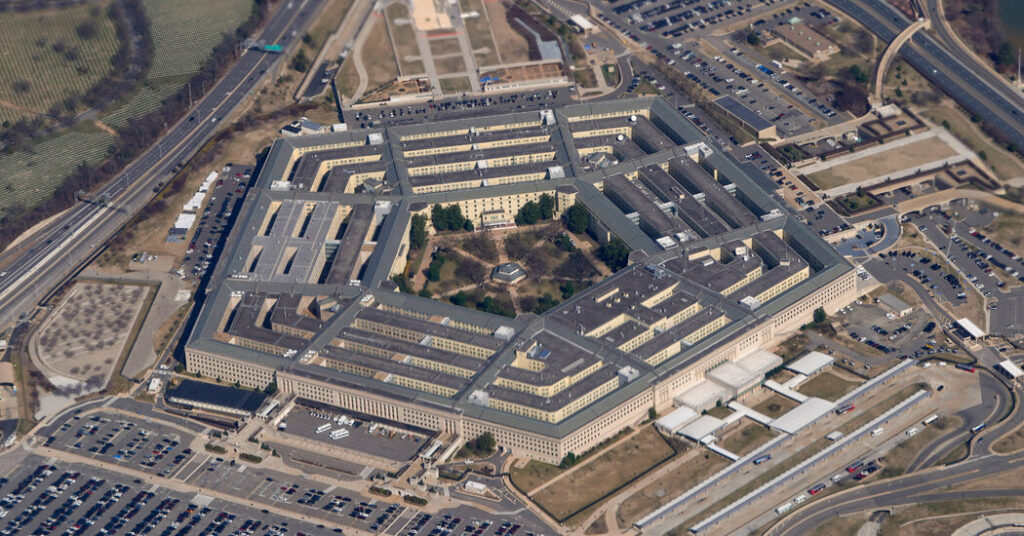
The Pentagon on Friday asked a federal judge to allow it to continue requiring escorts whenever journalists enter the military complex, a restriction that it argues is essential to guarding against national security leaks.
Judge Paul Friedman of the U.S. District Court for the District of Columbia has twice tossed out major parts of the department’s restrictions on reporters, saying they were unconstitutional, after The New York Times challenged them in a lawsuit.
The Pentagon has vowed to appeal those decisions, and it asked the court on Friday to keep in place the escort policy while it pursues its case.
“Allowing members of the public unfettered access to the Pentagon poses unique and acute dangers,” the filing said.
Since taking office in early 2025, Pete Hegseth, the defense secretary, has repeatedly moved to limit journalists’ access to the Defense Department. He previously proposed denying access to the Pentagon to a reporter from NBC News, then removed several news organizations from their on-site workstations.
The Defense Department’s petition is the latest development in case that dates back to October, when the Pentagon adopted a new set of restrictions for credentialed journalists who cover the military. Those restrictions allowed the department to declare journalists “security risks” and revoke their press passes. Journalists at many traditional media outlets surrendered their credentials instead of signing the policy. In December, The Times sued, arguing that the rules violated the First and Fifth Amendments.
Judge Friedman sided with The Times last month, tossing out major parts of the Pentagon’s rules.
Three days later, the Pentagon issued a revised policy that it said complied with the court ruling. At the time, it also closed the work space used for years by journalists with credentials to cover the military and added the requirement that all journalists visiting the Pentagon be accompanied by an official escort.
Judge Friedman on Thursday rejected the revised policy as well, and ordered that the Pentagon return to access policies like those in place at the time of his first ruling.
In a declaration issued alongside the Pentagon motion on Friday, Kingsley Wilson, the Pentagon press secretary, argued that credentialed reporters had capitalized on a loosely regulated environment.
“Unescorted access allowed journalists to maintain a persistent physical presence near sensitive spaces within the Pentagon,” she said. “This presence enabled journalists to observe activity patterns — such as which officials were meeting, when, and in what configuration — that could be used to identify individuals with access to specific sensitive information and to time inquiries accordingly.”
In a statement, a spokesman for The Times said, “It is telling that Ms. Wilson provides not a single example or any evidence of any kind to support her claims.” An attorney for The Times argued in a March hearing that it was “undisputed” that “there has never been a physical breach of security at the Pentagon involving journalists.”
The Pentagon conferred with The Times about its request to continue requiring escorts, and The Times opposes it, according to a footnote in the department’s filing.
The post Pentagon Asks Court to Keep Its Restrictions on Journalists appeared first on New York Times.