Pearl Fryar, a charismatic factory worker and self-taught topiary artist who turned a former cornfield in South Carolina into a world-famous garden featuring shrubs and trees that he coaxed into towering Seussian swirls, enticing Cubist forms and other uncanny shapes, drawing pilgrims from around the globe and raising the fortunes of his small community, died on April 4 at his home in Bishopville, S.C. He was 86.
His death was confirmed by his wife, Metra Fryar.
What drove Mr. Fryar initially was a prize. In 1980, the Fryars, high-school sweethearts who had lived in apartments, bought a double lot in Lee County, S.C., and built a sturdy brick ranch house. Then Mr. Fryar began to embellish the property.
Newly house-proud, he was determined to win the Yard of the Month award from the local garden club. He began modestly, creating a decorative driveway with bricks and pebbles and then planting comely bushes, delicate ornamental trees and traditional flower beds.
But the garden club said he wasn’t eligible for its prize because the house was outside the city limits of Bishopville, the county seat.
“I decided then and there,” he told Charleston Magazine in 2007, “that I’d come up with something so much better than all the other yards that they’d have to make an exception.”
He began to rescue plants that had been thrown out by a nearby nursery, scouting the compost pile every week like a lobsterman checking his pots. One day, he noticed a shrub on display that had been trimmed like a pompom, got a three-minute tutorial from the proprietor on how shape plants with a pair of shears and went home with a $2 holly bush to practice on.
Topiary was not in his vocabulary — the son of sharecroppers, he had grown up on a farm — but it sparked something in him. “I really had no idea what I was doing,” he later said, “but at some level it was satisfying to me. Once I got started, I couldn’t stop.”
He was indefatigable. “Jet-fueled” is how Bill Noble, the former director of preservation at the Garden Conservancy in Garrison, N.Y., put it in an interview.
After his shift as a production engineer at a can factory, Mr. Fryar would work past midnight, his garden illuminated by floodlights as he sculpted a Hollywood juniper or a Norway spruce.
More Pablo Picasso than Capability Brown, Mr. Fryar was an artist at heart rather than a horticulturist. But he had a gardener’s patience. He envisioned forms in his head — he never sketched, saying that it flattened out his perspective and that his drawings were illegible anyway — and was willing to wait a decade for those forms to be realized.
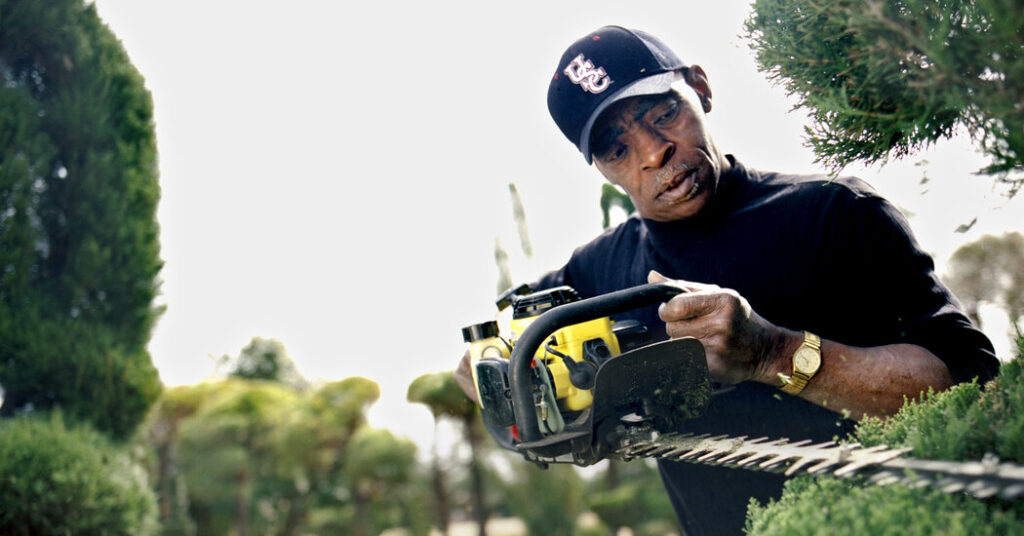
He did win the local garden award, in January 1986. That was the first of many accolades. Year after year, using gas-powered hedge clippers, pruning shears and a chain saw, he continued to plant and sculpt.
His techniques were his own. He used PVC pipes to create arches between a pair of holly trees, for example, attaching the new growth to the pipes with zip-lock ties and slicing off the rest of the limbs. He did impossible things with dogwood, turning one tree into something resembling a giant snowball. He shaped the top of a 20-foot Leyland cypress — that suburban stalwart and neighbor screen — to resemble a fish bone. Junipers were sheared into animated mounds that seemed to embrace one another, dancing.
“I wasn’t sure if he was really his losing his mind or what,” his wife said in “A Man Named Pearl,” a 2006 documentary directed by Scott Galloway and Brent Pierson. “Because he was just clipping up everything.”
He carved the words “love,” “peace” and “goodwill” into the lawn in eight-foot letters, a 40-foot-wide message that he planted with annuals in the spring and summer and filled with straw in the colder months.
His bemused neighbors started asking for tips as they, too, began pruning and shaping their shrubs. “It’s hard to keep up with the Fryars,” one told the filmmakers.
Before long, Mr. Fryar was welcoming visitors from all over the country, and then the world. Garden clubs arrived by the vanload, and school and church groups came in flotillas of buses. In the documentary, Ronnie Williams, the director of the Lee County Chamber of Commerce, declared Mr. Fryar an economic driver for the town.
“I didn’t even know how to spell topiaries,” he joked, describing how he began fielding calls about the garden.
Mr. Fryar had an open admission policy — no appointments needed — and greeted every pilgrim personally. There was a donation box for those who wanted to contribute. One visitor left $5,000.
By 2002, he had retired from the can factory because, as he said, “my job was interfering with my hobby.”
The garden was only part of the draw for visitors, said Lindsey Kerr, a horticulturist who cataloged the nearly 400 plants there from 2009 to 2010.
“They wanted to meet Pearl,” Ms. Kerr said. “They wanted to shake his hand.”
He had found his mission, he told the documentary filmmakers. “I didn’t want to create a garden,” he said. “I wanted to create a feeling, that you felt differently when you walked through than when you started.”
Mr. Noble’s role at the Garden Conservancy involved finding and preserving outstanding American gardens, and he was part of an early effort to support Mr. Fryar’s.
“There was nothing like it, and there was no one like Pearl,” he said. “There is a tradition of outsider art in the rural South and of African American outsider art, and plants may play a role, but not always. If Pearl’s garden is not the only example, it is by far the most outstanding example. There is nothing close.”
Pearl Faison Fryar, who was named for an uncle, was born on Dec. 4, 1939, in Clinton, S.C., one of three children of Gertie Mae (Faison) Fryar and Rufus Fryar.
After being drafted into the U.S. Army and serving in Korea as a chemical weapons specialist, he studied math and chemistry at North Carolina College (now North Carolina Central University) in Durham. In the mid-1960s, he moved to New York, where Metra Raynor, his girlfriend since high school, was working as a seamstress. They married and Mr. Fryar went to work for the American Can Company.
Several years later, he was transferred to Atlanta and then to Bishopville, where the Fryars began looking for a house. They were discouraged from buying in one neighborhood, the broker told them later, because the sellers didn’t think they could keep the yard up, a coded racist trope. Instead, they found a property in a predominately Black neighborhood nearby, where there was land to stretch out on — more than three acres.
Mr. Fryar wasn’t particularly bitter about the bigotry; he was a child of the South and a realist. “There are always going to be those obstacles,” he told the filmmakers. “The thing about it is, you don’t let those obstacles determine where you’re going to go.”
In addition to Ms. Fryar, he is survived by their son, Patrick; and two siblings, Ada Fryar Randolph and Norwood Randolph.
Like a landscape designed by Frederick Law Olmsted, Mr. Fryar’s garden is a significant American landmark. And it is just as vulnerable — a living work of art that requires constant, skilled attention. In Mr. Fryar’s case, that meant hundreds of hours of backbreaking work every month.
As he aged, the work took a toll. In recent years, the community rallied around him with donations and volunteers. The garden is now managed by a nonprofit organization.
In 2021, Michael Gibson, a Black topiary artist, became the garden’s first artist in residence, helping to maintain the garden as Mr. Fryar’s health declined.
“I’d never seen a Black man doing topiary, especially at this scale,” Mr. Gibson told The New York Times.
Polly Laffitte, a curator who included Mr. Fryar in a 1997 exhibition of self-taught artists at the South Carolina State Museum in Columbia, said that he hoped his legacy would be more than horticultural.
“Pearl saw his garden as a living statement about the power of creative individuals doing extraordinary things to make a difference in one’s community,” Ms. Laffitte said.
She added: “It’s always been my fear — losing him and all he accomplished. But he once told me there’s no way people are going to forget a Black man that cut up bushes whose name was Pearl.”
Kirsten Noyes contributed research.
Penelope Green is a Times reporter on the Obituaries desk.
The post Pearl Fryar, a Picasso of Plants, Dies at 86 appeared first on New York Times.