This article is part of Overlooked, a series of obituaries about remarkable people whose deaths, beginning in 1851, went unreported in The Times.
As the former Yugoslavia was splitting apart in 1992, the Bosnian capital of Sarajevo came under attack in what has been described as the longest siege of a city in modern warfare.
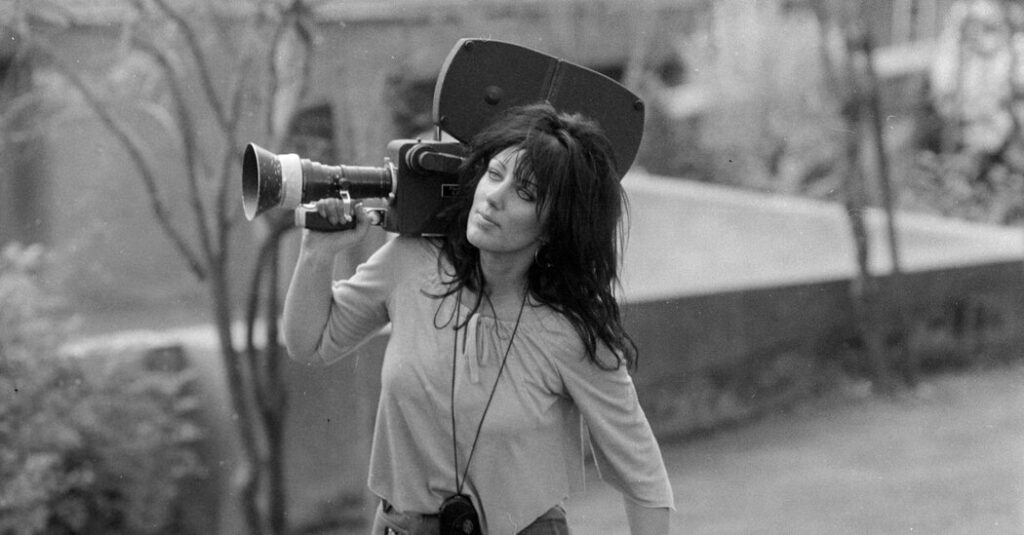
Margaret Gipsy Moth, a camera operator for CNN, was on the scene that July to cover the blockade formed by Bosnian Serb troops, who were encircling the city with the intention of taking a portion of it.
But as she and two other CNN journalists were riding in their white van on a stretch of road known as Sniper Alley, they came under fire.
Moth, who was sitting behind the driver, was hit by a bullet that shattered her jaw and tore through the base of her tongue — injuries that left her speech permanently slurred. She would ultimately have 25 surgeries.
Yet she was considered fortunate to still be alive. After she recovered, she returned to the conflict in Sarajevo, joking that she needed to find her missing teeth.
And for another 15 years at CNN, she continued to cover the cruelty that humans inflicted on one another in hostilities across the globe, including the Chechen war, the U.S. war in Afghanistan, the second Palestinian intifada and the civil war in Sierra Leone.
“People say, ‘People like you — you have a death wish,’” she said in “Fearless: The Margaret Moth Story,” a 2009 CNN documentary. “And it used to make me so angry. I don’t know anyone who’s enjoyed life more or values my life more.”
Moth, a raconteur who held court at parties, was known for taking younger journalists under her wing while covering the world’s hot spots.
She could also be mischievous. In a marketplace in Iraq after the Persian Gulf war, she smacked the cigarette out of the mouth of a man after he pushed her camera into her nose.
In 1991, as militiamen began firing on protesters in Tbilisi, Georgia, some photojournalists took cover behind vehicles. Moth stood up and filmed the gunmen. And in 2002, as Israeli troops encircled Yasir Arafat’s headquarters after a Palestinian suicide bombing, Moth scored an exclusive interview with Mr. Arafat by walking into his compound with a group of medical professionals.
Through it all, she felt lucky to have a job that satisfied her hunger to observe critical moments in human history.
“As dark and real as she would get, she didn’t indulge in the dark side of human behavior,” said Jeff Russi, her companion in the 1980s. “That’s what gave her the strength to witness the atrocities she had to witness.”
Margaret Annette Wilson was born on Jan. 30, 1951, in Gisborne, New Zealand. Her mother, Nona (Cammock) Wilson, raised her and later worked in a factory; her father, Raymond, was a bricklayer and plasterer.
Little is known about her childhood, but it was clear she sought to distance herself from it, said the actress Lucy Lawless, who directed “Never Look Away,” a 2024 documentary about Moth.
“She had compartmentalized her life so thoroughly,” Lawless said in an interview, “that very few people knew all the pieces.”
An avid skydiver, she renamed herself after a series of de Havilland Moth light aircraft powered by Gipsy engines. She used a customized square black parachute, logging more than 800 jumps.
She also invented her own look, dying her naturally blonde hair jet black and wearing it spiky or teased. She dressed in black from head to toe; rarely, if ever, was seen without her signature black eyeliner; and slept in a pair of black combat boots to be ready for action. She smoked Cuban Montecristo No. 5 cigars and treasured Penguin Classics books. Her favorite author was Dostoyevsky.
While studying photography at the University of Canterbury’s fine arts school in Christchurch, New Zealand, she took a course on moving images and was drawn to film. She came to relish Fellini’s “Satyricon” (1969) and Wim Wenders’s “Wings of Desire” (1987) in particular.
She considered her gender a hindrance to securing many of the jobs she applied for, but eventually became one of the first female television camera operators in Australasia.
She moved to the United States around 1980 and worked in the media department of the University of Texas MD Anderson Cancer Center in Houston. She also painted houses and interned at KPRC-TV before joining KHOU, a CBS affiliate, in 1984.
She was hired by the Dallas bureau of CNN in 1990. Around the same time, dozens of staffers were being deployed to cover the gulf war, and the international desk would often rotate camera operators in from other parts of the network.
Moth volunteered to capture the drive to push Saddam Hussein’s army from Kuwait.
War “was sort of her vibration,” Lawless said, adding: “She was calmest in the chaos. She was a bloody ferocious character.”
Moth’s assignment in Sarajevo, the capital of Bosnia and Herzegovina, began in the spring of 1992. Eason Jordan, who was CNN’s chief news executive at the time, said in an email that Moth was “the best-qualified and most impressive prospect for the job.”
The attack that nearly took her life was one of many against journalists that highlighted the indiscriminate nature of the nightmarish conflict, and it accelerated efforts by CNN to protect its employees.
“Everybody was a little more careless in the beginning,” Stefano Kotsonis, a correspondent who was in the van with Moth, said in an interview. At CNN, he added, “everything changed.”
Within hours of the shooting, the network began ramping up security for journalists in war zones, ultimately providing armored vehicles; making bulletproof vests and helmets standard equipment; sending staffers to predeployment risk training; and frequently paying security advisers to accompany news teams.
When asked what she would do if she met the sniper who shot her, Moth said she would be interested to know his intentions.
“I would not feel any anger or anything because when you are in a war zone, both sides are fighting each other,” she said in “Fearless,” the CNN documentary. “If you’re on one side, you’re sort of ‘with’ that side, and you have to take what comes with it.”
Moth learned she had colon cancer around 2006 and moved back to the U.S. She died on March 21, 2010, in Rochester, Minn. She was 59.
“I would have liked to have gone out with a bit more flair, but I feel like if I can die with dignity, then that’s the main thing,” she said in the documentary. “I don’t think it matters how long you live, as long as you can say that ‘I’ve gotten everything out of life.’”
Throughout her career, Moth was known for being cynical, pragmatic almost to the point of coldbloodedness and devastatingly harsh toward anyone who showed signs of machismo.
But she earned a reputation for her unshakable sense of morality, rugged individualism and single-minded focus. In 1992, Moth received the International Women’s Media Foundation’s Courage in Journalism Award, which recognizes female journalists who have demonstrated extraordinary courage in their careers.
“There’s so much interest in her story,” Joe Duran, her friend and former colleague at CNN, said in an interview. “I think her story will only grow.”
Moth compared her own life to a game of tennis.
“You have no choice over how that ball comes to you,” she said in “Fearless.” “But it’s how you hit it back that counts.”
Amisha Padnani contributed reporting. A version of this obituary appeared in “Overlooked: A Celebration of Remarkable, Underappreciated People Who Broke the Rules and Changed the World” (2023).
The post Overlooked No More: Margaret Gipsy Moth, Fearless CNN Camera Operator appeared first on New York Times.