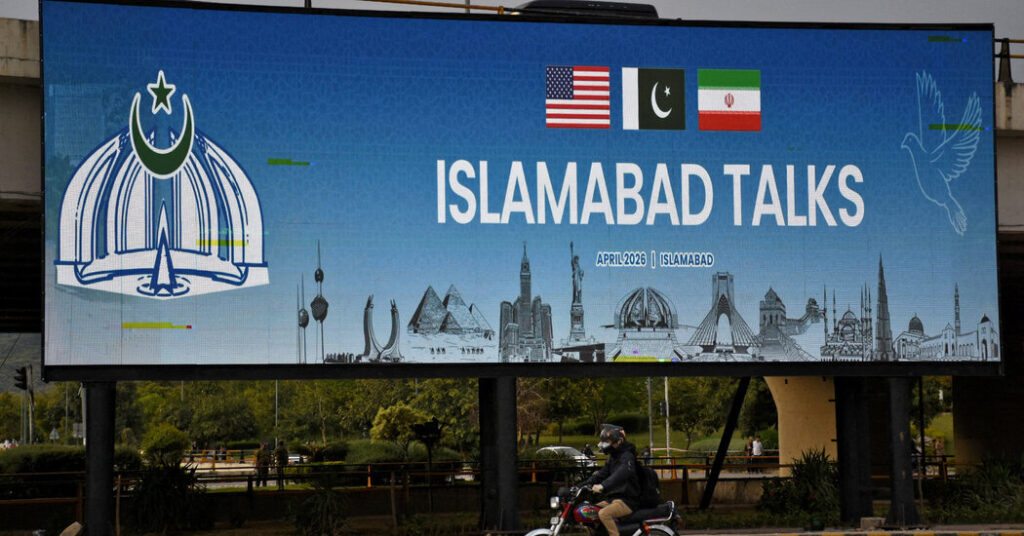
An American delegation led by Vice President JD Vance met on Saturday with senior Iranian negotiators in Pakistan, officials from Iran and the White House said.
It was a historic encounter between top officials from the United States and Iran, adversaries with a strained diplomatic history that stretches back almost half a century. Here is a look at key moments from past negotiations.
The Hostage Crisis and the 1980s
On Nov. 4, 1979, Iranian students seized the U.S. Embassy in Tehran and took dozens of Americans hostage, igniting a 444-day crisis that defined the final year of Jimmy Carter’s presidency.
The hostages were not freed until the start of President Ronald Reagan’s first term in 1981, through an agreement brokered by Algeria. In exchange for the hostages’ freedom, the United States agreed to lift sanctions on Iran and stay out of Iranian politics.
In the 1980s, American officials began secretly facilitating the sale of weapons to Iran in exchange for its help in securing the release of American hostages held by Hezbollah, the Lebanese armed group backed by Iran. The U.S. government then used the money from those weapons sales to fund a right-wing insurgency in Nicaragua.
The scandal, known as the Iran-Contra affair, broke with U.S. policy of not negotiating with terrorist groups and not aiding Iran. It also revealed that, despite the frequently heard chants of “Death to America” in Iran, senior Iranian officials were willing to deal with the United States if they saw it as being in their interest.
The Late ’90s and Early 2000s
This period saw increased public engagement between the United States and Iran. Talks between senior American and Iranian officials took place at the United Nations General Assembly in 1998.
After the Sept. 11 terrorist attacks, the United States and Iran developed back channels to coordinate the American military campaign in Afghanistan against the Taliban, who were harboring Osama bin Laden, the Al Qaeda leader who directed the attacks.
But relations deteriorated sharply after President George W. Bush described Iran as being part of an “axis of evil,” and the U.S. invasion of Iraq in 2003 saw Iran-allied militias fighting American troops there.
There was also growing U.S. concern over Iran’s nuclear program, which the Iranians said was for peaceful scientific purposes.
The Short-Lived Nuclear Deal
President Barack Obama came into office in 2009 emphasizing his desire for diplomacy with Iran. But attempts to foster better relations were scuttled after Mahmoud Ahmadinejad, then Iran’s hard-line president, ordered a crackdown on domestic protests and the expansion of the nuclear program.
The Obama administration then placed far-reaching, devastating sanctions on Iran to persuade it to abandon its nuclear ambitions.
In 2013, the election in Iran of Hassan Rouhani, a more moderate president, offered an opening to reset the relationship, as exemplified by a historic phone call between Mr. Obama and Mr. Rouhani that same year.
In 2015, after months of painstaking negotiations, Iran, the United States and other countries reached a nuclear deal known as the Joint Comprehensive Plan of Action. The deal limited Tehran’s nuclear program in exchange for the lifting of some American and international economic sanctions.
Three years later, President Trump pulled out of the deal and reimposed stringent sanctions. Since then, various diplomatic efforts to curb Iran’s nuclear program have largely been unsuccessful.
The 12-Day War
In April 2025, the Trump administration began new nuclear negotiations with Iran. Indirect meetings were held in Oman, led by Steve Witkoff, the president’s special envoy, who is involved in the current negotiations in Pakistan. Oman mediated further talks in Rome and Muscat, the Omani capital, but the sides struggled to reach an agreement.
The talks were derailed in June when Israel launched a military campaign that decimated Iran’s military chain of command. A week later, the United States joined with Israel to attack sites they said were used to enrich uranium, dealing significant damage to Iran’s nuclear program.
2026 Nuclear Talks
In February, amid escalating threats by Mr. Trump to attack Iran over its nuclear program, American and Iranian officials took part in indirect talks in Switzerland but did not find a breakthrough.
On Feb. 28, the United States and Israel launched strikes across Iran, igniting a war that lasted for more than a month, with a cease-fire agreed this week.
Mr. Vance, who is leading the American delegation in Pakistan, said ahead of the talks that he believed the negotiations were “going to be positive,” but he also had a warning for Iran.
“If they’re going to try to play us, then they’re going to find that the negotiating team is not that receptive,” he said.
Yeganeh Torbati contributed reporting.
Pranav Baskar is an international reporter and a member of the 2025-26 Times Fellowship class, a program for journalists early in their careers.
The post U.S.-Iran Talks Timeline: Key Moments Between Two Adversaries appeared first on New York Times.