They were making their way through the formalities of “just war” theory, which for centuries has tried to tame a seemingly impossible question — Is war moral? — into something of a practical checklist: Are the war’s goals clear? Was there an explicit, grave threat? Is victory likely? Will good clearly outweigh destruction?
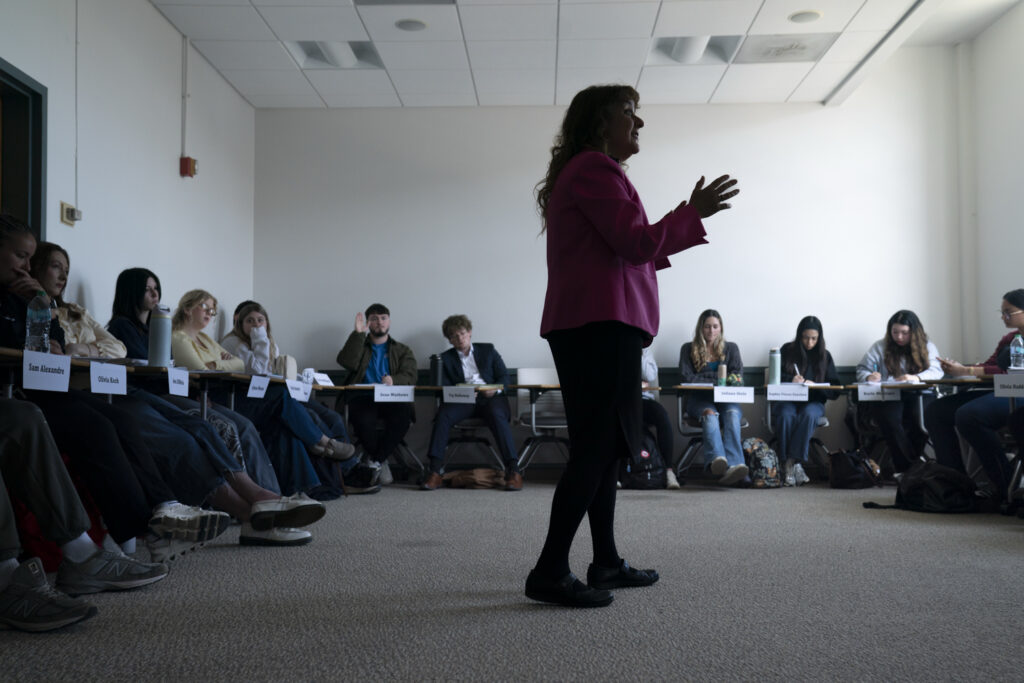
The air conditioner hummed. Sitting in a horseshoe shape on the Washington, D.C., campus of the Catholic University of America, the 26 students enrolled in Politics 226, a 90-minute long course on peace and the morality of war, took notes and politely raised their hands.
Then a slide appeared: Does the U.S. intervention in Iran meet “just war” criteria? A few minutes later, a student mentioned President Donald Trump’s recent social media post threatening to wipe out Iranian civilization.
“Yes, what about that tweet?” asked the professor, Maryann Cusimano Love, chair of Catholic’s Politics Department and a consultant for the Vatican on issues of nuclear and artificial intelligence weapons, among other things.
Hands shot up around the room.
For Politics 226: Introduction to Peace Studies, this was a week when treaties, rules and theories slammed into the reality of a U.S. president who says he “doesn’t need” international law, doesn’t ask God for forgiveness and is limited solely by his own ideas about morality. Even for Trump, his Tuesday post casually threatening to level Iran, in a way that seemed to suggest the use of nuclear weapons, lit up classes around the country where young Americans are studying morality and war.
“A whole civilization will die tonight, never to be brought back again,” Trump posted on Truth Social at 8:06 a.m. “I don’t want that to happen, but it probably will.”
Against this backdrop, the Catholic University students looked to answer: In a war such as the United States’ in Iran, what does morality look like?
Students said the riotous nature of social media, digitally gamified war, Trump’s penchant for shock and the oft-changing U.S. goals in Iran can sometimes leave them numb. But, they said, studying ancient systems that insist on bringing morality to war have made them more hopeful that it can and must be done.
Love, for her part, kept steering conversation back to the theory and norms.
“On the tweet, it’s like teetering on a point of no discrimination,” said Sophia Flores Sanchez, 21, a politics major from Silver Spring, Maryland, referring to just war theory’s ban on attacks that are indiscriminate. “He generalizes and says ‘We’re going to destroy civilization’ — that’s genocide. It’s very dehumanizing.”
“Sophia says that’s genocide. How does [Trump’s post] compare with our lessons on genocide?” Love asked.
“Another professor said we’ve ‘been at war’ for 70 years with Iran,” said sophomore Kevin McElligott, 21, a political and history major from Simsbury, Connecticut.
Remember, Love said, that there are legal definitions and norms. “What is the definition of war?” she asked, before several students noted a mainstream international definition that 1,000 battle-related deaths must happen in a year in order for a conflict to be a “war.”
The class talked about the line between urgent self-defense and preemption. They discussed how the local archbishop, Cardinal Robert McElroy, said Trump had not met just war’s requirement of “just intention” — a clear objective.
“It would be different if he said they were trying to end the regime,” said Sean Matthews, 20, a student of politics and global studies from Massachusetts. “But [what Trump said] doesn’t meet the criteria.”
Classes at colleges and universities around the country this week tackled how Trump’s approach fit into the major schools of thought around war, which include pacifism, just war theory and realism, which sees war as rational and emphasizes hard power and security concerns over morality. Just war’s roots are thousands of years old and include Persian and Indigenous traditions. It’s often associated with the Catholic Church because the church codified it, Love said.
Aidan Connors, 22, sat Thursday in a class on philosophy and war at Tufts University outside Boston. Trump’s attack on Iran, bellicose threats and what Connors said was a “disregard for rules of engagement” can make the philosophical frameworks she’s studying feel almost irrelevant.
“We are engaging with philosophical discussions that are on the edge of the conversation, and what’s happening is something that was meant to be sort of morally inconceivable,” said the philosophy and theatrical performance double major, who will graduate this spring and plans to go to law school.
A recent class, she said, wrestled with philosophical questions about civilian casualties. Meanwhile, she pointed out, the Trump administration has killed dozens by bombing suspected drug dealers off the coast of Venezuela.
“Under all of the theories that we’re reading, that would under no circumstance ever be morally permissible,” she said. “But it’s happening in real time.”
Bracy Bersnak, a political theorist at Christendom College in Front Royal, Virginia, led a class of sophomores on just war theory Wednesday. Students at the Catholic school felt there are just war arguments to be made about aspects of the Iran war, including that the destructive nature of nuclear weapons means the U.S. can’t wait until an attack is imminent for war to be defensive.
However, he said, the class agreed that Trump’s threatening post violated just war theory.
“No one had sympathy for the post,” Bersnak said of the class of 20. “You can’t threaten to do something like that under just war. You can’t threaten to commit a war crime as a negotiating tactic, even if you didn’t mean it.”
Threatening indiscriminate attacks on Iranian civilization is immoral, he said.
At Catholic, Love discussed Trump’s post in the context of what the class had studied about the Rwandan genocide in the 1990s. There, political leaders from one side used radio waves and hate speech to dehumanize the other and publicly incite people to kill their neighbors.
“To get people to violate these deeply held moral norms that are deeply internalized, you have to take these actions,” she said. “This is a real challenge, the way new technologies and AI can generate the language of violence and disinformation.”
Outside of class, some students said their generation is hungry for both moral structure and activism, but at the same time apathetic. Several described exactly where they were when they read Trump’s post. They felt terrified, sickened, shocked — but also, in a way, numb. One student showed a text thread on his phone that quickly shifted from Trump’s post to a conversation about an upcoming coffee date.
“We’re constantly hearing the world is doomed, global warming, etc.,” Matthews said before class. But, “there is a want for morality and for a structure to people’s lives,” he added. “It’s a very interesting time to be involved in studying morality.”
At 12:30, students squeezed out of their chairs, grabbed their backpacks and water bottles and headed out — to internships on Capitol Hill, to lunch in the sunshine, to lacrosse practice, to work on petitions and letter-writing campaigns. A fragile U.S.-Iran ceasefire was in place, but it was clear that questions of morality and war wouldn’t be going anywhere. Which was fine: Class meets again Tuesday.
The post How college students who study war view Trump’s Iran taunts appeared first on Washington Post.