Homes near a former battery recycler in Southeast Los Angeles County still have excessive lead in their soil, even after the state spent hundreds of millions of dollars over a decade to remove it, according to a new study.
The former Exide Technologies plant in Vernon melted down pallets of lead-acid car batteries in blast furnaces for nearly a century, blanketing up to 10,000 nearby properties with toxic dust, according to state officials. They say the cleanup is the largest of its kind in the country.
The Exide plant was permanently closed in 2015 and later abandoned by the company. The California Department of Toxic Substances Control hired contractors to remove and replace heavily contaminated soil at nearby homes, schools and parks in seven communities, including Boyle Heights and unincorporated East L.A.
Now in a review of the state’s work, a team of university researchers and a local environmental health organization have tested more than 1,100 soil samples from 370 homes within and just outside the state-designated cleanup area. They found nearly three quarters of remediated homes still had lead levels above California’s standard for residential properties in at least one sample. Their study is published in Environmental Science & Technology.
Jill Johnston, lead author and associate professor of environmental and occupational health at UC Irvine, said the results suggest there were deep flaws with the cleanup. This leftover lead has the potential to stunt brain development in young children, leaving them with lifelong deficits if they inhale dust or ingest it playing in their yards.
“The state cleanup plan [said] surface soil was going to be removed or covered,” Johnston said. Instead, there is “potentially ongoing exposures to folks living there now, but also future generations.”
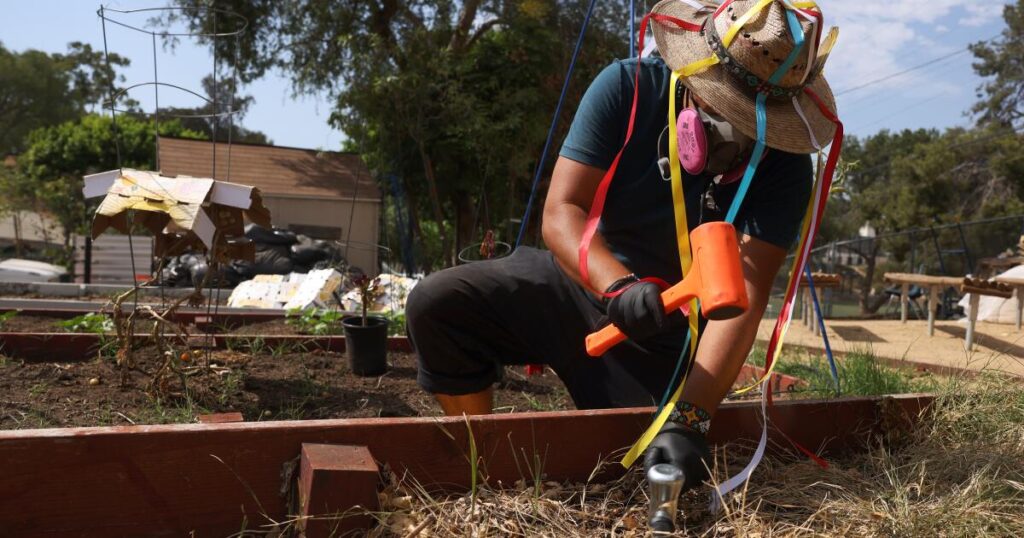
The cleanup started in 2016 and is ongoing. It aimed to excavate up to 18 inches of contaminated soil from each home and backfill with clean topsoil. So far, more than 6,100 properties have been remediated in Southeast L.A. County. The state has dedicated more than $700 million to the effort.
A 2023 Los Angeles Times investigation, which cited preliminary soil testing results, found that state-hired cleanup crews often did not remove contaminated soil from next to buildings, walkways and trees, where backhoes and other excavators can’t get in — areas that require a shovel.
In some cases, workers mishandled contaminated soil, spreading it onto neighboring properties. The state did not offer soil testing to confirm the properties met state standards after the cleanup, leaving many skeptical their homes were actually clean.
Mark! Lopez, a community organizer with East Yard Communities for Environmental Justice and a co-author of the study, had long heard complaints from residents and raised concerns about the cleanup. The findings, he said, substantiated many of those claims.
“The results are worse than we feared,” said Lopez, who led teams in collecting soil samples from 2021 to 2024.
When they released initial data, he said, “DTSC was trying to deny its validity … Now that can’t be denied.”
A DTSC spokesperson said the agency could not accept the study’s findings without more information.
“It is impossible to evaluate the conclusion of the UC Irvine study without the underlying data and methodology,” the agency spokesperson said. “That information has not been shared after multiple requests.”
No cleanup ever replaces every particle of soil, the agency said. “That said, DTSC has carried out an unprecedented cleanup near the former Exide facility, completing work at more than 6,000 homes, the largest residential cleanup of its kind in the nation. This work confirms DTSC’s commitment to protecting the health of residents.”
After the team shared results with state officials, DTSC committed to perform soil testing at 100 homes that had their work done early in the process, before procedures underwent an overhaul. The agency also has paid for post-cleanup testing at the most recently cleaned homes. None of that data has been published, and it’s unclear if DTSC intends to order crews to return to homes that have lead contamination above state standards.
In addition, DTSC now has third-party supervisors monitoring cleanup work.
Johnston and fellow researchers also tested more than 620 samples from 200 homes outside the official 1.7-mile cleanup area. Almost all, 89%, had lead levels above state standards, suggesting Exide’s pollution may have traveled farther than the cleanup zone designated by the state.
Some level of lead blankets many urban areas, because of lead paint, leaded jet fuel and tailpipe exhaust from leaded gasoline. But the researchers believe much of this pollution was attributable to Exide.
That’s because at the direction of state regulators, Exide sampled homes in Long Beach, about 14 miles south, in a similar neighborhood close to freeways, a rail yard and older homes — but without a lead smelter. Lead concentrations were far lower than in Southeast L.A. County.
“We essentially saw lead level patterns that mimicked lead levels in the community — before cleanup,” Johnston said. “So the vast majority of homes exceeded state thresholds.”
DTSC officials have said lead contamination also could have been from older homes with lead paint or leaded gasoline in cars.
Community leaders have pushed for extending the cleanup area to remove hidden threats in those areas, even as many still worry about residents whose properties already have been cleared. They don’t want residents to have a false sense of security that their property is clean when many still are laced with lead.
Johnston said some of the risks could’ve been avoided if the state committed to proper safeguards, such as post-cleanup sampling, sooner.
“If that process started early on and is done in a way where residents and the broader community had transparency to that data, we could have addressed” hot spots of contamination and other neighborhood concerns, she said.
The post Lead still haunts yards in Exide battery recycler cleanup zone appeared first on Los Angeles Times.