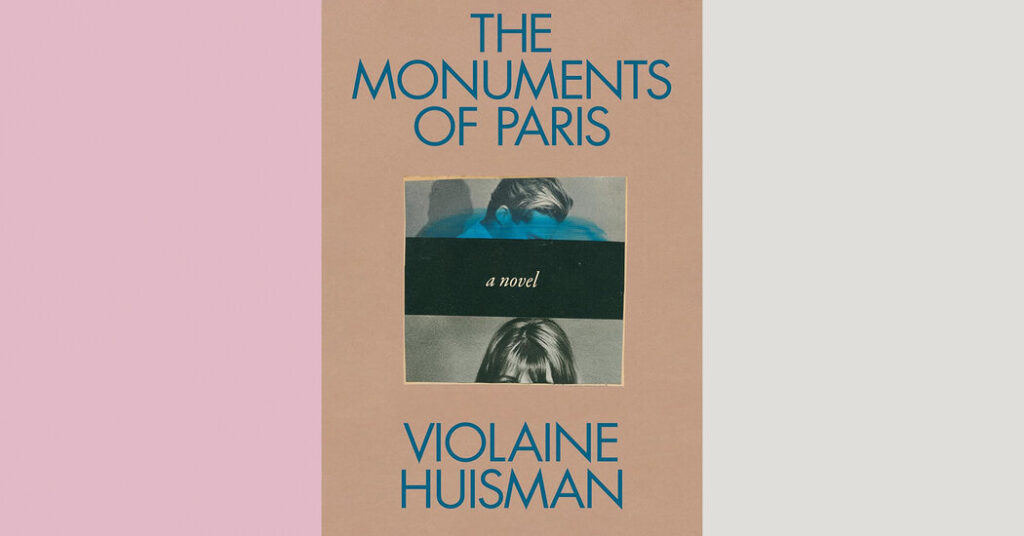
THE MONUMENTS OF PARIS, By Violaine Huisman
“The Book of Mother,” the 2021 debut novel by the French writer Violaine Huisman, draws heavily from Huisman’s own life, forming an intimate portrait of the narrator’s late mother through memories and poignant digressions into the dramas and minutiae that shape her legacy.
Huisman lends her first name to her narrator, Violaine, who is also a writer, and reveals her mother in shades: a mistress and a wife who was strikingly beautiful and ingloriously vain, proud and implacably self-pitying, and who suffered from bipolar disorder. Imperfect, as mothers always are.
Violaine wants to make sense of her mother, and cites Maman’s abusive childhood, as well as the indignity of her impoverished upbringing and her ultimately unhappy marriage to her wealthy second husband, Violaine’s father, whom she divorced after discovering his affair with another woman. Sympathetic and probing, “The Book of Mother” is a record of hard-won understanding by a daughter who has aged into seeing the past more clearly.
Stories of mothers and daughters seem to beget stories of fathers and daughters. In Huisman’s new novel, “The Monuments of Paris,” she returns to her family’s stories, shifting her gaze to the paternal side of her family, to her father, Denis, and his father, Georges — men who managed, through their own suffering, aspirations, love affairs and exile, and with help from their family name, to imprint themselves onto history. (Huisman translated this novel herself.)
The novel begins in the summer of 2020, when Violaine moves her husband and two daughters from Brooklyn to a village outside Paris to be near her ailing father. She spends weeks of the pandemic at her father’s bedside, listening as he chatters with her daughters and regales them with tall tales.
Even through her grief, Violaine views her father with a degree of mistrust. She refers to him as “a man of another generation,” acknowledging the phrase as one that some might invoke as a means of explaining away his arrogance, countless affairs and ostentatious behavior. As Denis recites the family stories — such as their fleeing to Bordeaux in June 1940, during the first days of the German occupation, cramped and unnerved inside a car that included Georges; his wife, Marcelle; Denis and his two brothers; Georges’ mistress, Choute; and Choute’s cat; and how Georges, who served as jury president for the Cannes Film Festival, never received credit for coming up with the idea of the festival in the first place.
About Choute, whom Georges met when she was 19 and he 41: Their relationship never made sense to Violaine. After all, Georges had been mayor of a village in northern France and was later selected to be the director of the French Beaux-Arts (a post equivalent to minister of culture today). He was an upstanding man who had taken seriously his government appointments. Had Violaine’s father exaggerated the affair to soften, or even to account for, his own philandering? Following Denis’s death, with the help of a French scholar, Violaine pores over the family’s archive for answers.
Like “The Book of Mother,” “The Monuments of Paris” is a painstaking work of family history sense-making. Violaine’s unflagging dedication to her research reveals a moving adoration of her late father and grandfather. Yet her insistence on sharing irrelevant details is exhausting, dragging the book’s pace. We learn that a novel by Georges’ friend Roland Dorgelès is still “taught in schools all over France as an exemplary account of World War I.”
This, among other asides, provokes questions about Huisman’s chosen form: Is a novel really suited to such meticulous personal storytelling? “The Monuments of Paris” is perplexingly reportorial, and would be significantly improved by the invention typically mandated by fiction.
THE MONUMENTS OF PARIS | By Violaine Huisman | Penguin Press | 226 pp. | $28
The post A Daughter’s Loving Homage to Her Large-Living French Dad appeared first on New York Times.