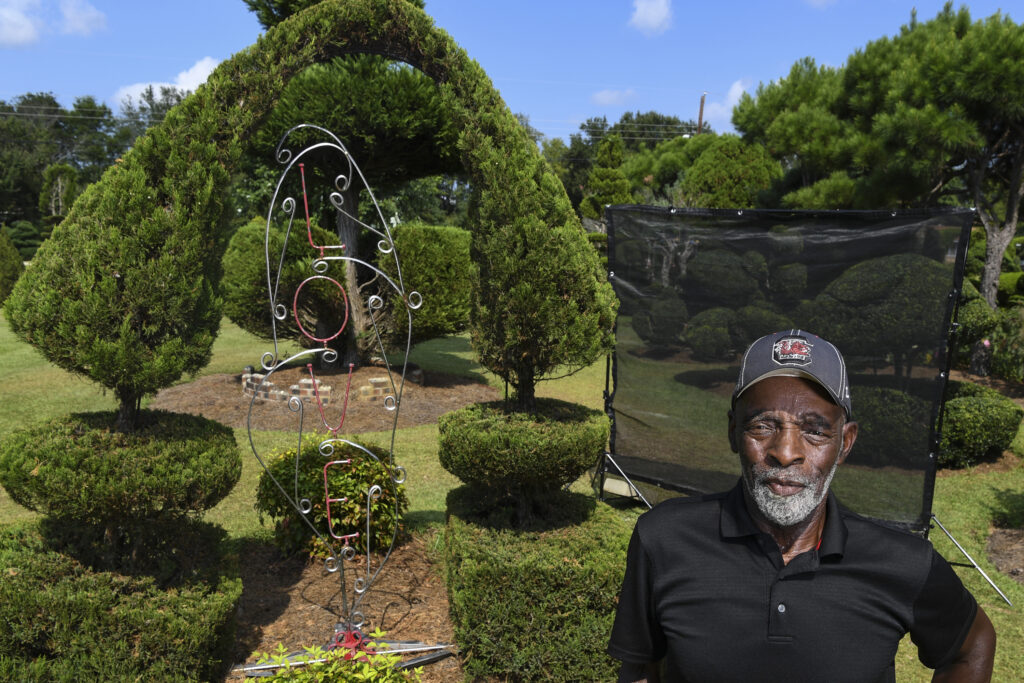
For years, he would work his 12-hour shift at a can factory, then come home to tend to his carefully trimmed oaks, pines, boxwoods and junipers. Floodlights helped him keep gardening after dark. And a bevy of makeshift tools — PVC pipes, coat hangers, even pantyhose — helped him turn his once-ordinary trees and bushes into internationally acclaimed topiaries, living sculptures that established his three-acre garden as the botanical jewel of tiny Bishopville, South Carolina.
Pearl Fryar, who died April 4 at 86, was a Picasso of the garden, a self-taught artist who turned the soil into his canvas and wielded hedge trimmers in lieu of a brush. His work attracted thousands of visitors each year, who flocked to his garden — free and open to all — to see topiaries that were featured on Oprah Winfrey’s talk show, photographed for Southern Living magazine and showcased on CBS’s “Sunday Morning.”
Mr. Fryar, the eldest son of North Carolina sharecroppers, sometimes downplayed his achievement.
“I’m just a man who cuts up bushes,” he would say with a grin.
But in interviews and a 2006 documentary, “A Man Named Pearl,” he described his garden as a ministry of sorts, a way to spread a message of “Love, Peace + Goodwill,” words that he cut into his lawn in tall block letters.
Touring Mr. Fryar’s garden, one visitor says in the documentary, “you feel different than you did at the start.”
Shrubs along the driveway were shaped into the letters L-O-V-E. Live oaks were transformed into whimsical cubes and voluptuous mushrooms. Junipers were trimmed into sailboats, adrift in a sea of green. One of his most technically demanding topiaries, a Leyland cypress that took no less than seven years to complete, resembled a set of eye-catching fishbones.
“Pearl carved out his own road of what it means to be a topiary artist,” said Michael P. Gibson, a fellow topiary creator whose interest in the craft was ignited by a meeting with Mr. Fryar, who began making topiaries in his early 40s.
“He was just making topiaries out of his imagination,” said Gibson, who spent a year helping maintain and preserve the garden as its artist-in-residence during the pandemic. “He was opening up the structure and almost exposing the inner beauty within. Horticulturalists would visit his garden and say, ‘This is impossible.’ But to Pearl there were no rules — he was rewriting the rules of topiary and being free.”
Amid the trees and bushes, Mr. Fryar erected pieces of his “junk art,” sculptures he assembled out of found metal and emblazoned with phrases like “Hate Hurts.”
It was a message informed by experience. Born in Clinton, North Carolina, on Dec. 4, 1939, Pearl Faison Fryar said he witnessed lynchings as a boy in the 1940s, and was taught by his parents to stay safe by avoiding the attention of Whites. He helped out on the farm “from about the time I could stand up,” tending to cotton and tobacco and working in his family’s vegetable garden.
While the Fryars were far from wealthy, he was able to enroll at North Carolina College (now North Carolina Central University), a historically Black institution in Durham, where he participated in civil rights demonstrations and joined a picket line in the early 1960s.
“People was saying to me, ‘You better get out of there, man, you’ll get yourself killed,’” he said in an interview with William Arnett, a writer and art collector. “And I said to them (and to myself), ‘If this is all I got to live for, I’ll give my life to change it. I am not going back home to pick cotton.’”
Mr. Fryar went on to serve in the Army in South Korea, where he encountered bonsai trees and botanical gardens that informed his later work, before moving to New York City to reunite with his childhood sweetheart, Metra Raynor, whom he soon married.
Living in Queens expanded his creative horizons — “I would never have made my garden had it not been for living in New York,” he said — and allowed him to launch his career at American National Can Company, where he worked for 36 years, manufacturing cans out of steel and then aluminum.
By the late 1970s, Mr. Fryar had moved to Bishopville, an hour’s drive from Columbia, where he hoped to become a plant manager for the can company. But he soon concluded that as a Black employee, he would never get the promotion, telling the New York Times years later that “the situation” in the South “had not changed that much” since he was boy.
Gardening offered a new avenue for his ambition. As he put it, “You tell me I couldn’t do one thing, I’m going to prove to you I can do another thing.”
A racist comment also provided fuel. Mr. Fryar said that when he went looking for a home in Bishopville, one of the community’s White residents told his real estate agent that he didn’t want Mr. Fryar as a neighbor, because “Blacks don’t keep up their yards.”
Mr. Fryar set about proving the naysayers wrong, with an early aim of winning Bishopville’s Yard of the Month award. His gardening plans grew more elaborate after he encountered a topiary for the first time at a local nursery, where the owner offered him a three-minute lesson on the art of pruning.
It was all he needed to get started.
Mr. Fryar began by cutting up a bush in his front yard. “I thought he had lost it,” his wife said. Before long, he was cutting up most everything else on the lawn, at times working with throwaway plants that he salvaged from the nursery. He won his Yard of the Month prize and much more, with some of his topiaries moving to the South Carolina State Museum in Columbia as part of a 1990s exhibition on self-taught artists.
“Real satisfaction,” he told The Washington Post, “comes from doing what no one else can do.”
Mr. Fryar eventually installed a donation box in his garden, with some of the proceeds going toward a scholarship fund he created for high school students. The garden is now maintained by a nonprofitthat bears his name, and will remain open as a living memorial to Mr. Fryar, who died at home. He had been in recovery from brain cancer, said the organization’s president, Linda Fuller, but was still supervising the garden’s upkeep in recent years, offering direction to workers while crisscrossing the grounds in his John Deere Gator.
In addition to his wife, Metra, Mr. Fryar is survived by a son, Patrick, and a brother and sister. As a result of his influence, about half the homes in his neighborhood now have topiaries in their gardens, according to Fuller.
“When I did my first plant, and I saw that I could do it, it just gave me the greatest feeling,” Mr. Fryar once said. “Everybody needs to get that feeling out of something. To some other person it might not mean nothing, but to you, no matter how small it is, it becomes your life.”
The post Pearl Fryar dies at 86. The self-taught topiary artist spread a message of love. appeared first on Washington Post.