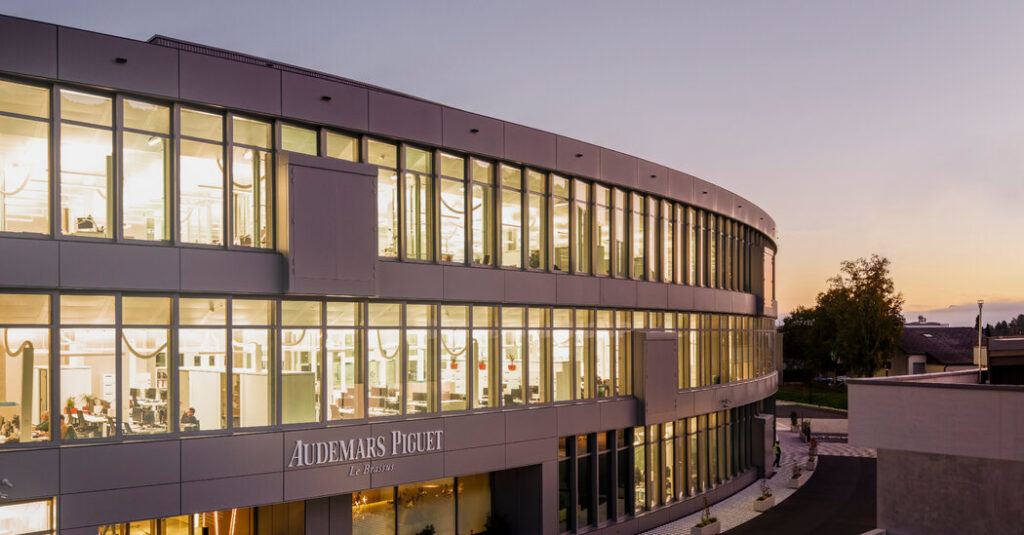
For an industry that places such value on where its products are made, it is perhaps not surprising that Audemars Piguet’s most talked about novelty is not a watch, but a building.
Opened in January in Le Brassus, Switzerland, and named the Arc, the structure curves into the surrounding valley and accommodates around 700 employees. It is the brand’s new production facility — or “manufacture,” as people in the industry call integrated watchmakers.
But beyond making timepieces, it has been designed as a vehicle for storytelling, following a trend that has defined the watch world for recent years.
“This new facility is a milestone for Audemars Piguet and reflects how we are investing in our future by rethinking the way we work,” Ilaria Resta, the company’s chief executive, said in an interview.
By bringing the workshops that were once scattered across the Swiss watchmaking region of the Vallée de Joux under one roof, Ms. Resta said, the brand had created a new production flow that mirrored the journey of a watch through its various ateliers and was designed to enhance the exchange of ideas and, ultimately, the quality of the timepiece.
Crucially, the new 23,700-square-meter (255,000-square-foot) building highlights the company’s focus on developing mechanical watch functions, known as complications. To achieve this, it has integrated a specialized workshop previously based in Le Locle, Switzerland, 110 kilometers (68 miles) away, and introduced spaces equipped with dedicated tools and machines where watchmakers can experiment and develop new ideas, products and prototypes.
“We are providing an ecosystem where innovation can advance more rapidly,” Ms. Resta said. “Together, these strategic choices aim to reinforce our long-term goals.”
According to a report by Morgan Stanley in February, Audemars Piguet’s turnover grew by 9 percent last year to 2.6 billion Swiss francs, about $3.25 billion, positioning the brand third in terms of sales after Rolex and Cartier.
Audemars Piguet is not alone in focusing on its manufacturing facilities. Across Switzerland, a construction boom is underway as watchmakers race to vertically integrate their operations.
In Le Noirmont, Hermès is developing a new 11,000-square-meter production site that will bring together the development and manufacture of key components. The expansion follows the growth of the brand’s watch division, where revenue has more than doubled in six years to 549 million euros in 2025 from €193 million in 2019. That lifted Hermès to 14th place in the top 20 watch brands by turnover, according to Morgan Stanley.
Further south, closer to Lake Geneva, Hublot is preparing to move this summer into H3, a new 13,650-square-meter facility, more than double the combined size of its two previous buildings, known as H1 and H2.
Scheduled to officially open in early 2027, it will eventually consolidate production and offices alongside the existing H2 building. Designed to blend with the surrounding landscape, H3 will also feature a reorganized supply chain and automated stock systems.
But what Julien Tornare, the chief executive, is most focused on is less technical: the client experience.
“We don’t just want clients to see watchmaking, our technical expertise, the fact that we produce sapphire and ceramic in-house, we want them to experience the brand,” Mr. Tornare said, adding: “I want to deliver the most unique experience.”
A client showroom will expand to approximately 400 square meters from 80 square meters in the current H1 facility. Equipped with a private kitchen, it will be adaptable for multiple uses, from private events for clients to gatherings with brand ambassadors. Mr. Tornare explained that the site would better highlight the brand’s connection with contemporary art and feature outdoor sports facilities to involve clients in activities with the brand’s ambassadors from the sports field.
“When visits are done well, the level of emotion is very high — and so is the conversion rate,” Mr. Tornare said. “But most importantly, clients develop a stronger connection to the brand.”
It is a sentiment shared across the industry. In November 2024, Bulgari — which turned over 405 million Swiss francs last year according to Morgan Stanley’s estimate — inaugurated its redesigned production facility in Saignelégier, expanding the site by 1,000 square meters to a total of 4,400 square meters.
“When clients visit a manufacture, they realize that behind each watch there are dozens of people, specialized crafts and years of accumulated expertise,” said Jean-Christophe Babin, the chief executive of LVMH Watches and the chief executive of Bulgari, in an email interview. “The object suddenly becomes much more human.”
Twenty years ago, he added, clients were drawn primarily by design or brand name. Today, there is a deeper curiosity about process. “Visiting a manufacture transforms the relationship from a purely commercial interaction into something closer to a cultural or intellectual experience,” he said
Few stories illustrate the point more vividly than one told at Zenith. During the quartz crisis of the 1970s, when the introduction of quartz watches led to a decline in mechanical movements across Switzerland, a watchmaker hid the plans and tools for the El Primero movement in the manufacture’s attic, as he was convinced it would be a mistake to abandon it. Years later, the discovery of that hidden material enabled the brand to bring the mechanical watch back into production.
“Many collectors know that story before they arrive,” Sarah Zaouk, Zenith’s chief marketing officer, said in a phone interview. “And when they finally see that space for themselves, it can be a very emotional moment.”
Chopard also understood the power of such narratives early. The brand was among the first to vertically integrate its operations, doing so in 1996, and a decade later it opened the L.U.CEUM — Traces of Time Museum within its manufacture.
“Becoming a manufacture repositioned Chopard in the men’s watch market and within the very select circle of high-end traditional watchmakers,” Karl-Friedrich Scheufele, the brand’s co-president, said in an email interview.
Nevertheless, Oliver R. Müller, the founder of the luxury consultancy LuxeConsult, described fully integrated production facilities as a “historical anomaly” in contrast to the traditionally fragmented network of specialized suppliers that characterized watchmaking before the 1970s.
He noted, however, that the shift — which began with the revival of mechanical watchmaking in the late 1980s after the quartz crisis — aligned with the broader direction of the luxury industry toward what he calls “premiumization,” a greater emphasis on craftsmanship, coupled with lower volumes and higher prices.
“Telling your client that you’re a manufacture is a very powerful narrative to communicate expertise and legitimacy, especially at the high end,” he said. “It follows that manufactures now are becoming marketing tools.”
The post Factories That Do More Than Make Watches; They Sell Stories appeared first on New York Times.