Masood Masjoody’s warnings over the years seemed unsettling, even sometimes outlandish: He was not safe in Vancouver. His university was protecting agents of Iran’s regime. His fellow Iranian activists wanted him dead.
After he was fired from a job teaching math at a university in British Columbia, Mr. Masjoody, 45, became preoccupied with Iranian pro-monarchy activists. He alleged they were plotting his demise because he had begun to oppose the group’s advocacy around restoring a shah, or “king” in Farsi, in their homeland.
Then, in February, Mr. Masjoody vanished. A few weeks later, on March 9, the police discovered his body.
The authorities have charged two people who are Iranian anti-regime activists with first-degree murder in Mr. Masjoody’s killing. Both had been sued by Mr. Masjoody, who claimed they had threatened his life after a clash over political beliefs.
Lawyers for the defendants, Mehdi Ahmadzadeh Razavi, 48, and Arezou Soltani, 45, declined requests for comment.
Investigators have not said how Mr. Masjoody was killed or provided a motive.
But that has not stopped chatter within the Iranian diaspora in Vancouver and beyond about whether his death was a consequence of his activism.
“He was right,” Nik Kowsar, a cartoonist who fled Iran in 2003 for Canada, said of Mr. Masjoody. Mr. Kowsar, now a water security analyst in Washington, D.C., said he had met with Mr. Masjoody two years ago in Vancouver to discuss online threats made against them after falling out with the pro-monarchy movement.
The killing has put a spotlight on years of divisions within the Iranian diaspora that have escalated since the 1979 revolution that toppled Iran’s shah, Mohammed Reza Pahlavi, and ushered in the Islamic Republic under Ayatollah Ruhollah Khomeini.
“There is little trust among many activists,” Mr. Kowsar said. “That’s why we haven’t had a united front in the last 47 years.”
The war in Iran and the possibility, however remote, that it could threaten the regime’s survival has intensified debate among the diaspora about their homeland’s fate.
On one side are those who support re-establishing a monarchy, led by Reza Pahlavi, the son of Iran’s deposed shah, who from exile in the United States has long promoted himself as the country’s future leader.
On another side are Iranians who support democracy and remember the shah’s rule for its authoritarianism, suppression of political dissent and corruption. Many contend that activists who defend the shah have targeted them with online harassment campaigns.
Mr. Masjoody documented those suspicions on social media and in lawsuits. So regularly did Mr. Masjoody make legal claims that, last year, a judge declared him a vexatious litigant, limiting new filings.
Still, he was in the middle of suing Mr. Pahlavi and local activists, accusing them of defamation and harassment. Mr. Pahlavi, in an affidavit responding to the suit, denied knowing Mr. Masjoody.
Mr. Pahlavi did not respond to requests for comment.
Some activists have blamed online harassment and misinformation for stoking disaccord that has left many Iranian-Canadians fearful of expressing their political views.
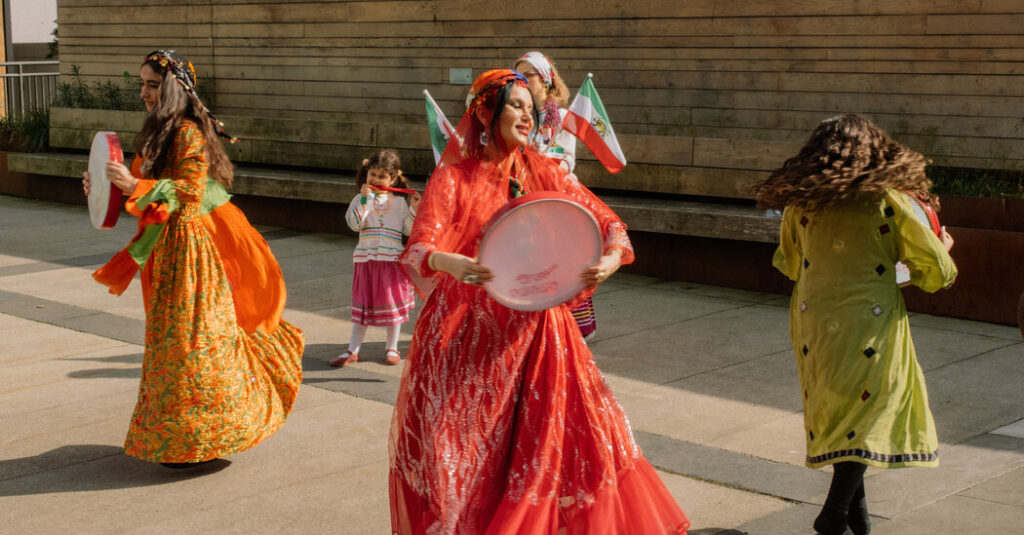
In the “Little Tehran” neighborhood of North Vancouver, dozens of businesses display Iran’s pre-revolution lion and sun flag, a symbol today of nostalgia for the secular, more tolerant society under the shah.
Masoud Nejati has the flags hanging outside his hair salon and a portrait of the exiled Mr. Pahlavi in the window.
Mr. Nejati, who said he knew Mr. Masjoody for a decade, brushed off the idea that the Iranian community is divided. But he and others severed ties with Mr. Masjoody when the activist began making accusations that monarchists were threatening his life.
Monarchy is the only ruling system that can unify Iranians of all political stripes, Mr. Nejati said. “It’s like a father that loves all the children,” he said.
While Mr. Nejati views the paternalism of the pro-monarchy movement as benevolent, others find it menacing.
Saba Ghassemi, a saleswoman at an interior design firm, said she was ejected from a recent rally in Vancouver against the Iran war for refusing to chant pro-monarchy slogans or Mr. Pahlavi’s name.
Ms. Ghassemi said she preferred a different slogan — “Women! Life! Freedom!” — popularized during anti-government marches after the 2022 death of Mahsa Amini, a young woman who died in police custody in Tehran after being accused of violating laws on wearing a hijab.
“I personally feel very lonely among the diaspora,” Ms. Ghassemi said from her home on a recent Friday as she prepared to ring in the Persian New Year, Nowruz, marking the start of spring. She was reluctant to celebrate this year because of the war.
On social media, arguments between Pahlavi supporters and pro-democracy activists have spiraled into insults and attacks, said Shirin Khayambashi, a sociology professor specializing in Iranian diaspora communities at Toronto Metropolitan University.
“We are a community that is grieving,” said Dr. Khayambashi, pointing to the death toll from protests in January brutally put down by the Iranian regime and, now, the war.
The relationship between Mr. Masjoody and the two people accused in his killing, Ms. Soltani and Mr. Razavi, began in rapport and focused on campaigning against the Islamic regime, according to accounts in court documents filed by Mr. Masjoody and other parties in his lawsuit.
They collected information about agents of the Islamic Revolutionary Guards Corps, the regime’s ideological security force, who Ms. Soltani believed were employed at Canadian universities, according to the court documents.
She and Mr. Masjoody, who had a doctorate in mathematics, were friendly enough that she supported him when he went on a hunger strike after he was dismissed by his employer, Simon Fraser University, for professional misconduct and claims he was harassing a female colleague.
Mr. Razavi, a stone worker, began to distance himself from Mr. Masjoody in February 2023 over their conflicting political beliefs, according to the court documents.
About two months before he disappeared, Mr. Masjoody wrote in an affidavit that he believed Ms. Soltani and Mr. Razavi had “sought a substance with which to murder me.”
Iranian activists on opposite sides of the monarchy debate clashed outside a courthouse after a bail hearing last month for Ms. Soltani and Mr. Razavi, and were dispersed by sheriffs. The defendants remain in custody.
Other recent violent acts have shaken Canada’s Iranian community. In Toronto, police are investigating shots fired at a boxing gym affiliated with the pro-monarchy movement. Canada’s intelligence agency has also warned of Iranian cyber threats and espionage against Canadian citizens.
Three months before he disappeared, Mr. Masjoody said in an interview on a Farsi YouTube channel that online harassment is an oppressive tactic.
“These actions,” he said, “are used as a strategy to silence pro-democracy voices.”
Farnaz Fassihi and Parin Behrooz contributed reporting from New York.
Vjosa Isai is a reporter for The Times based in Toronto, where she covers news from across Canada.
The post A Killing Exposes Deep Rifts in Canada’s Iranian Diaspora appeared first on New York Times.