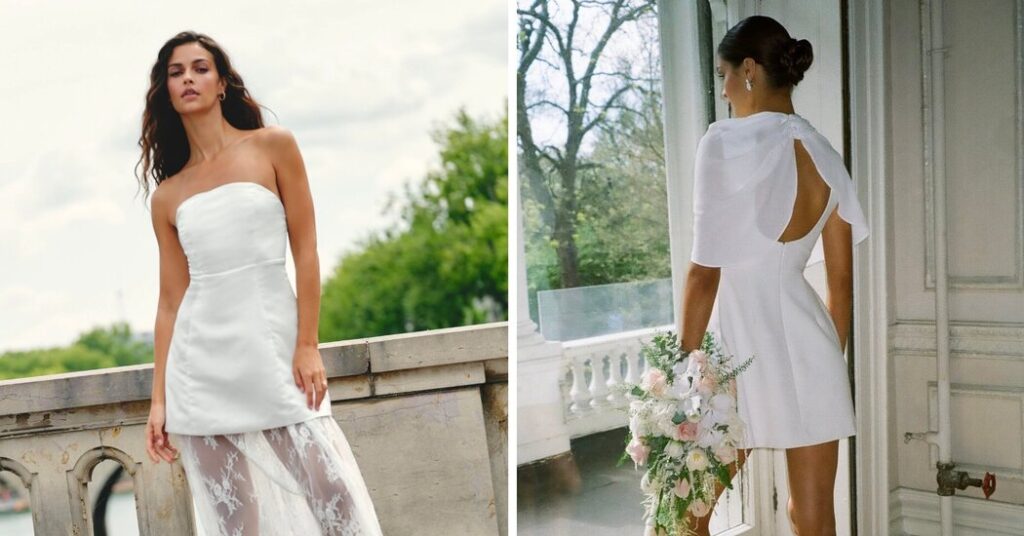
For her intimate wedding last September, Catherine Benge Ricci wore a white silk dress from the bridal line of the contemporary fashion brand Reformation. It was purchased just two weeks before her ceremony.
“I knew that was the dress I wanted from browsing their website, and when I tried it on in person at their store on Madison Avenue, it just felt right,” said Ms. Benge Ricci, 25, a fashion public relations manager at ODA in New York City.
Ms. Benge Ricci and her husband, Francisco Jorge Ricci, decided to get married soon after their engagement, and not have a large celebration, to avoid the stress of a long planning period, she said. “While we weren’t having a traditional wedding where a formal gown made sense, I still wanted a long dress — but nothing too fussy or with a train that would constrict me from moving around the city,” Ms. Benge Ricci said.
Typically, brides need to order their dress at least nine months before the wedding if they want a couture or custom-made gown, which requires time for production and fittings. Ready-to-wear dresses offer shorter turnaround times, sometimes with immediate off-the-rack availability.
Ms. Benge Ricci is one of many brides opting for ready-to-wear brands. They are largely being drawn to brands they already favor for everyday attire — Ms. Benge Ricci has been shopping at Reformation since 2018 — and are more open to dresses that are not traditionally bridal.
Reformation, which was founded in 2009, started its dedicated bridal line in 2014. And like almost every ready-to-wear brand that now sells wedding attire, it was in response to consumer demand. “Our customers were consistently asking us to offer bridal, both directly through our customer service channels and indirectly by wearing our existing white inventory to wedding occasions, like rehearsal dinners or more casual receptions,” said Hali Borenstein, the chief executive of Reformation.
Cult Gaia, founded in 2012, started its bridal line last year, “after years of seeing so many future brides gravitating to the brand,” said Jasmin Larian Hekmat, the brand’s founder and creative director. “Brides were turning to Cult Gaia for those once-in-a-lifetime moments like their engagement party, rehearsal dinner, after party and honeymoon,” she said. “I started the collection by reimagining some of our most-loved silhouettes in ivory and white, then expanded into a full narrative of bridal.”
The bridal market remains dominated by couture and custom-made designers, with dresses that can cost $20,000 or more, but ready-to-wear brands are becoming a significant part of the industry. In the last two years, many popular contemporary brands like Nadine Merabi, Odd Muse and De La Vali have started or expanded bridal lines. Meshki debuted its bridal collection during New York Bridal Fashion Week in April 2025.
“While the bridal boutique is still alive and well, as customer service is paramount for the wedding day, there is a nontraditional vibe that is a growing category,” said Rachel Leonard, the fashion director and a founder of the Bridal Council, which is made up of fashion designers, retailers and experts in the bridal industry. “There will always be brides who want the special experience of the custom dress in the bridal salon,” Ms. Leonard said. “However, not all women have the same sentiment or want to make the dress their number one priority.”
Many brides today are planning for their wedding closer to the day and need a quicker turnaround, or would rather spend their budget on photos or food, Ms. Leonard said. “It also has to do with how big the wedding will be, how formal and the venue,” she added.
Ready-to-wear bridal lines typically offer more affordable price ranges, inclusive sizes and diverse, nontraditional styles, especially for pre-wedding events. “These brands are making bridal fashion more accessible by offering convenient ways to discover, shop and style pieces online that feel special — without always requiring a traditional appointment or custom order for every look,” said Caroline Thorpe Goldberg, a Boston-based bridal stylist and the founder of the bridal fashion site Little White Looks. “They are also often based on styles that brides can wear over and over again after their bridal season.”
Online retail opens more access to international ready-to-wear brands, while social media provides a wide range of fashion ideas. According to The Knot 2026 Real Weddings Study, 30 percent of the 10,474 respondents had looked at wedding attire online before getting engaged. “Even ahead of Bridal Fashion Weeks and collection styles being released, we see that couples are sourcing styles across a variety of platforms — social media, digital and print content and the like — further fueling this fascination with bridal fashion,” said Esther Lee, the editorial director of The Knot.
Ella Crotty, for example, turned to Meshki for a dress to wear to her small pre-wedding event in England, as well as a second look for her black-tie wedding in March last year. Ms. Crotty, 28, a merchandise planner based in Sydney, Australia, who now works for the brand, said she has shopped and followed Meshki for years. “We had a lot of events around our wedding, so I was constantly on the lookout for bridal outfits,” she said. “I followed the brand on their social media accounts and saw them tease their newest bridal drop, which happened to be arriving a few weeks before our wedding.”
Most ready-to-wear brands have click-and-shop bridal options where you pick your standard size, which can also be altered by a tailor if needed. Prices typically start at around $100 for brands like Lulus and Petal & Pup. On the higher end, couture-like brands, such as Wiederhoeft and Markarian, also offer made-to-order looks at up to about $5,000 in addition to their more affordable styles online.
Shopping for bridal looks from ready-to-wear brands can give freedom to experiment without having to commit or make a decision too far in advance, said Ms. Thorpe Goldberg, the bridal stylist from Boston. “By waiting until you’re closer to the event, you often have a better sense of what you want and how you want to feel,” she said.
This also helps reduce dress regret. “I’ve had multiple brides purchase a custom-made gown 12-plus months out from their wedding and, unfortunately, change their mind,” Ms. Thorpe Goldberg said. “In this case, they’ve sold their dress and looked to websites such as Anthropologie, Mytheresa and Net-a-Porter for a quick replacement.”
The post Why Brides Are Saying Yes to the Off-the-Rack Dress appeared first on New York Times.