Riding in the back seat of Rickey Polidore’s metallic slime green truck offered a clear view of how much joy an art car could bring to Houston.
As Mr. Polidore, a Houston native, pulled up to a corner store on the city’s south side, a group of men drinking tallboys from paper bags cheered. “There he go!” one of them yelled. Mr. Polidore laughed and said, “The homies love an art car.”
On the stereo, Mr. Polidore was playing classics of Houston’s chopped-and-screwed rap genre. The bass rattled the countless aftermarket accessories he had welded and glued and Mod-Podged onto his vehicle, creating a jangling cacophony that matched the car’s festive exterior.
Soon, another truck pulled up alongside his. The driver rolled down his window. His young son was sitting on his lap, waving at everyone. Then, his eyes widened as he took in the sight of a creation that seemed to belong more to a dreamscape than to the street.
This was not just a car. It was an art car — a vehicle transformed into a kinetic sculpture, built from imagination and, often, from what others had thrown away.
“I can’t drive past trash without pulling over,” said Mr. Polidore, 50, a longtime elementary school art teacher who writes art curricula for the district. “When I’m stuck in that hellacious Houston traffic, I’m scanning the side of the road for any parts of cars that have gotten thrown off in wrecks and I’m grabbing them.”
On Saturday, April 11, two of Mr. Polidore’s cars will be among the over 250 art cars winding their way through Houston in the 39th annual Art Car Parade. After the rodeo, the parade may be the city’s signature event, with more than 300,000 spectators each year. Other cities — Baltimore; San Francisco; Seattle; Portland, Ore.; even Jaipur, India — have their own versions. But Houston, Texas’ largest city, remains the movement’s unofficial capital, the place where the idea first took hold and never quite let go.
Houston is, in many ways, the perfect setting. It is one of the most car-dependent cities in the United States. Roughly 95 percent of the greater Houston area’s 7.5 million residents have access to a vehicle. The city’s vast sprawl and punishing summer heat make driving less a choice than a necessity.
“So why not make it art?” Mr. Polidore said.
The parade traces its origins to the early 1980s, when a handful of Houston artists began embellishing their cars as personal projects — eccentric, often obsessive expressions that blurred the line between transportation and sculpture. In 1988, the Orange Show Center for Visionary Art, a local nonprofit dedicated to making art more accessible, organized the first parade to bring these creations into public view.
Throughout the city, art car artists have been rushing to pull off their visions and turn old cars into works of art. Some of these artists are adults; some aren’t from Houston, but migrate to the city for the parade in wacky caravans. Saturday’s parade is the capstone of a full weekend with events like a ball and a preview parade that visits hospitals and nursing homes. There are awards to be won for the best cars, and $15,000 in prizes. Grand marshals have included celebrities like the comic actor Dan Aykroyd, the musician George Clinton and the Olympic gold medalist Carl Lewis.
The rules remain minimal. “Whether it’s been painted, welded, sculpted, dropped, chopped, beaded, smashed, crashed, lit or lifted, art cars come in all shapes, sizes and forms,” read this year’s brochure. “The only rule is that it must roll!” And across the city, in garages, driveways and schoolyards, artists have been working for months to ensure that theirs will.
But what might make Houston’s art car parade so special is the fact that many of the artists are children.
On a recent Thursday afternoon, just after the dismissal bell rang at the Arabic Immersion Magnet School in the Montrose neighborhood of central Houston, a group of students, still wearing their backpacks, excitedly shuffled their way toward the back of the school, where their class’s art car awaited their attention.
The students rushed to grab cups of white paint and went to work. “Zainab,” said Justin Larson, the art teacher, “please watch your scarf.” Zainab Alaqili, a sixth grader, looked down at the end of her hijab and groaned when she discovered she had accidentally dipped it into paint, as so often happens. “It’s OK, if I notice it quickly I can wash it off,” explained the 12-year-old as she rinsed the hijab under a faucet. This is her third year working on an art car. “I love how people get really creative with our themes, and how we can incorporate Arabic into ours,” she said.
This elementary school is the United States’ first and only schoolwide public Arabic immersion program, and its project is an example of how art cars can also function to showcase Houston’s diversity. Considered by many measures to be one of the most diverse cities in the country, the art car parade has become a visual representation of the many cultural and ethnic backgrounds that comprise Houston.
Last year’s design reimagined alphabet soup, covering the vehicle in ceramic letters of Arabic script.
“There’s a lot that goes into it,” said Lujain Abdulhasan, 14, who is originally from Iraq. “We have to prime and paint and then prime again. It’s a lot more interactive than just drawing. I like it better.”
Over 50 of the cars that roll on Saturday will have been made in Houston classrooms, a striking fact at a time when arts funding in schools continues to shrink. The cars used in schools are donated — some junky, but operating well enough. For several years, many have been provided by a local car dealership, Gillman Automotive Group.
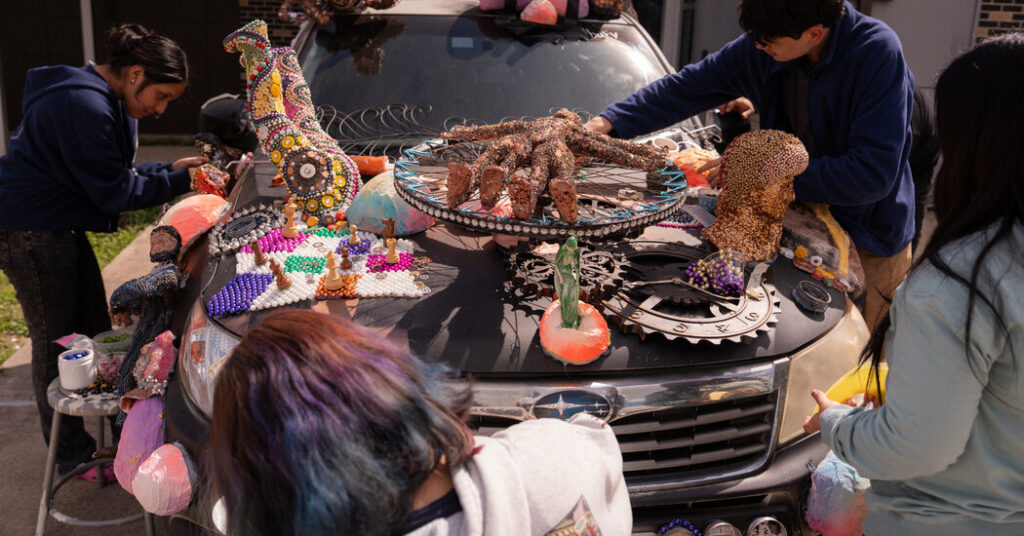
At Westbury High School in southwest Houston, Wendy Bejarano’s sculpture class has been at work since January. This year’s vehicle, a donated 2009 Subaru Forester S.U.V., came with an unexpected complication: a sunroof.
“We weren’t counting on that,” said Ms. Bejarano, 48, laughing. “We needed to attach things to the roof.”
Her solution was characteristically inventive: The class mounted a coffee table onto the top.
Their theme, “Renaissance on Wheels,” unfolds from there. A donated eight-foot-tall skeleton, the kind sold as gaudy Halloween lawn décor, has been remade with papier-mâché into a reclining figure reminiscent of something by Botticelli. Nearby sits a plaster cast inspired by Michelangelo’s Pietà, covered in pennies. Last year, Ms. Bejarano’s class project at her previous school — a dazzling bust of Salvador Dalí’s head, his pencil-thin mustache extending beyond the perimeter of the car, the hood and trunk festooned with surrealist elephants — won the grand prize, a trophy and a $2,000 purse. If there is pressure to repeat the feat, it is hard to detect among the students, many of whom seem more absorbed in the process than the outcome.
“It’s nice to get to be outside,” said Anderson Carreto, 18, as he glued broken strands of Mardi Gras beads onto the car. “I usually get bored at school, sitting inside just working with pencil and paper. But with this class, I get to choose what I want to do and how I am spending my time.”
For Angie Soto, 17, the class offers something more intangible.
“I have really strict parents,” she said. “So this is the class I look forward to the most. It feels like relief, like I’m getting something out of my system.” She paused, looking at the accumulating layers of work. “It’s a lot of different people with different mind-sets coming together,” she added. “You can see how everyone expresses themselves. It’s like we’re writing the same paper, but using different fonts.”
In Houston, where driving is nearly unavoidable, the art car offers a kind of inversion, a reminder that even the most ordinary object can be remade into something strange, expressive and communal.
Or, as Ms. Soto put it: “Art cars are chaos. Good chaos.”
The post In Houston, One Person’s Trashed Car Becomes Everyone’s Treasure appeared first on New York Times.