As the United States and Iran prepare for ceasefire talks Saturday, the two countries appear to have common ground on only one thing — their need to find an exit ramp from the war.
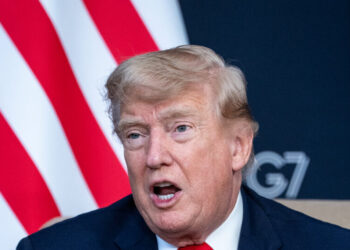
President Donald Trump is paying a growing political and economic price at home, with falling approval ratings and climbing gas prices undercutting his bluster and boasts about U.S. military might having already achieved a total victory over Tehran.
While Iran may see surviving thousands of pulverizing U.S. and Israeli air attacks as its own victory of sorts, its prewar problems — international isolation, a failing economy and a fed-up population — have only gotten exponentially worse.
But a mutual desire to end the conflict may not be enough, as the two sides come to the table with demands that leave little apparent room for compromise. Even before their negotiators arrived for talks in Islamabad, the Pakistani capital, they have accused each other of bad faith.
Trump on Friday claimed that the hard-line, 10-point proposal Iran publicly released this week was “a hoax” and said Tehran was being “dishonorable” in not allowing oil tankers to transit the Strait of Hormuz. White House spokeswoman Karoline Leavitt insisted Thursday that Iran had secretly sent much more reasonable demands that Trump said he could “work with.”
Meanwhile, Iran’s chief negotiator, Parliamentary Speaker Mohammad Ghalibaf, said the U.S. has violated what he claimed were pre-talk agreements on a ceasefire between Israel and Iran-backed Hezbollah in Lebanon and the release of blocked Iranian assets frozen under U.S. sanctions. “These two matters must be fulfilled before negotiations begin,” he wrote on social media.
That brought another social media outburst from Trump, who said: “The Iranians don’t seem to realize they have no cards. … The only reason they are alive today is to negotiate!”
As he boarded a plane for Islamabad on Friday morning, Vice President JD Vance, who is heading the U.S. delegation, tried to calm things down. “I think it’s going to be positive,” he told reporters. “If the Iranians are willing to negotiate in good faith, we’re certainly willing to extend an open hand.”
A former senior Egyptian official, who like several others interviewed for this article spoke on the condition of anonymity about the pending talks, cautioned against paying too much attention to public statements. “Each side is allowed to declare victory and adopt some hard-line rhetoric in the media to address its domestic audience.”
“The truce serves the interests of all parties,” he said. “Everyone needs it, otherwise it would not have been necessary in the first place.”
The U.S. and Iran “might both have an objective interest in finding a way out,” said Robert Malley, who played a senior role in Middle East policy and Iran negotiations during the last two Democratic administrations, but “there are also other factors that show how big the gap is.”
Iran has publicly rejected U.S. demands that it stop all uranium enrichment, hand over its stockpile of weapons-grade uranium, sharply curtail its ballistic missile program and end support for proxy militias in the region. The U.S. has said the retention of enrichment and missile capability, among other things on Iran’s wish list, is not even on the table. It has indicated that the removal of sanctions — something Iran’s beleaguered economy desperately needs — would come only at the end of a successful negotiation, not at the beginning of talks.
While Israel appears to be abiding by the ceasefire in Iran, its attacks in Lebanon have continued. Trump said Thursday that he “spoke with Bibi and he’s going to low-key it,” using Israeli Prime Minister Benjamin Netanyahu’s nickname.
As State Department officials worked Friday to try to manage the conflict in Lebanon, lest it interfere with the Iran negotiations, Secretary of State Marco Rubio’s director of policy planning, Mike Needham, held a phone call with the Lebanese and Israeli ambassadors to Washington and the U.S. ambassador to Lebanon to prepare for U.S.-arranged Israel-Lebanon talks set to begin Tuesday in Washington, said a senior U.S. official familiar with the matter.
The administration’s topmost concern in Islamabad is the Strait of Hormuz, the narrow passage through which roughly a fifth of global fuel supplies transit the Persian Gulf. The nearly complete halt of maritime traffic there has roiled global markets and caused oil prices to spike. Trump has called for the strait to be reopened as part of any deal, but Iran is intent on formalizing its expanded control over the waterway.
Iran never officially closed the strait but has mined parts of it, introduced a system in which tankers must get permission from Tehran to pass and begun collecting tolls. “We will definitely take the management of the Strait of Hormuz to a new phase,” Iran’s new supreme leader, Mojtaba Khamenei, said in a post on X on Thursday. Iran has said it will use the money for war reconstruction.
Rep. Jake Auchincloss (D-Massachusetts) said allowing Iran to remain in control would be a “strategic failure” for the United States and “make the Strait of Hormuz an Iranian river to stuff cash into the coffers of the ayatollah.”
“All the open-ended issues that were facing America a month ago,” when the war began, “are still facing America. Except that now the new ayatollah has a strategic deterrent … the Strait of Hormuz,” said Auchincloss, a Marine veteran who served in Afghanistan.
Rubio has said repeatedly that charging tolls is “illegal” and “unacceptable.”
On Wednesday, Trump appeared to propose some kind of U.S.-Iran joint venture, saying that the U.S. “will be helping with the traffic buildup. … There will be lots of positive action! Big money will be made. Iran can start the reconstruction process.” A day later, the president reversed himself, saying Iran would have no role in controlling the strait and there would be no tolls.
John Mearsheimer, a University of Chicago political scientist, warned that the administration’s leverage may be constrained and that Iran’s leaders would be “out of their minds” to surrender control over a strategic choke point that now gives them substantial economic and diplomatic advantage.
On the eve of the talks, it was unclear whether the two sides would meet face to face or, as in previous negotiations, sit in separate rooms while a mediator — in this case, Pakistan — carries messages back and forth.
Both the delegation heads, while near the top of the hierarchy of their respective governments, are untested as high-level international negotiators or technical masters of the intricate details of the issues before them.
The stakes for Vance are particularly high, said a person familiar with the matter who spoke on the condition of anonymity about sensitive internal administration deliberations.
A longtime skeptic of Middle East wars who reportedly advised Trump against starting this one, Vance “wants to show the president he’s capable of handling big things and now he’s got the ball. We will see if he can close,” the person said.
Sen. Lindsey Graham (South Carolina), a prominent GOP hawk whose soaring rhetoric about regime change in Iran has been chastened in recent days by Tehran’s resilience, put Vance on notice, calling him the “architect” of a still-secret U.S. negotiating document he called “troubling.”
“I look forward to the architects of this proposal, the Vice President and others, coming forward to Congress and explaining how a negotiated deal meets our national security objectives in Iran,” Graham said in a statement on social media Wednesday.
U.S. officials pushed back on the “architect” claims, saying most of the diplomatic spadework on the ceasefire was done by special envoy Steve Witkoff and Trump son-in-law Jared Kushner, who are joining Vance as part of the negotiating team. Both are highly distrusted by Iran after the U.S. and Israel twice launched surprise military attacks in the midst of previous negotiations they headed.
The Iranians “view Witkoff as two-faced and unreliable,” said a Middle East diplomat familiar with the matter.
A former U.S. official questioned whether any of the U.S. negotiators are up to the task. Trump has ridiculed previous administrations for spending months and years on intricate talks with Iran before reaching an agreement he labeled worthless.
Trump’s extremely small circle of trusted advisers and his belief in his “instincts” rather than in experts — many of whom have resigned, retired or been fired by the administration — leaves little backup. “There’s no team anymore” to delve deeply into the details of the U.S. negotiating position, “no State Department, no NSC,” or National Security Council, the former official said.
The negotiations will also be an early test of Iran’s new leadership. While U.S. and Israeli attacks culled Iran’s senior-most ranks, those who have been promoted to fill the positions are closely aligned with Iran’s military.
Foreign Minister Abbas Araghchi, who led previous rounds of talks with the United States, will be on the Iranian team with Ghalibaf, who has emerged from the war as one of the most powerful people in the country. The upcoming negotiations are also the first under Iran’s new supreme leader, Mojtaba Khamenei, who reportedly has even closer ties than his father had to the Islamic Revolutionary Guard Corps (IRGC), the primary element of the Iranian armed forces that reports directly him.
A European official briefed on the negotiations said Iran’s leadership wants to be able to use the ceasefire to “strengthen and reinvigorate itself.” But, he said, it’s unclear if the regime has been so badly damaged by the conflict that it eventually decays under domestic pressure. What is clear, the official said, is that more than a month of war and assassinations among the upper ranks of leaders have has left a more-militarized team in power in Tehran.
Previously, he said, the clergy, as well as Iran’s military and business elite, all had significant stakes in matters like negotiations with the United States. The supreme leader had to “constantly balance these guys who were always fighting each other.” Now, he said, there is only one center of power: the IRGC.
Heba Farouk Mahfouz in Cairo contributed to this report.
The post U.S., Iran prepare for peace talks with a gulf separating the two sides appeared first on Washington Post.