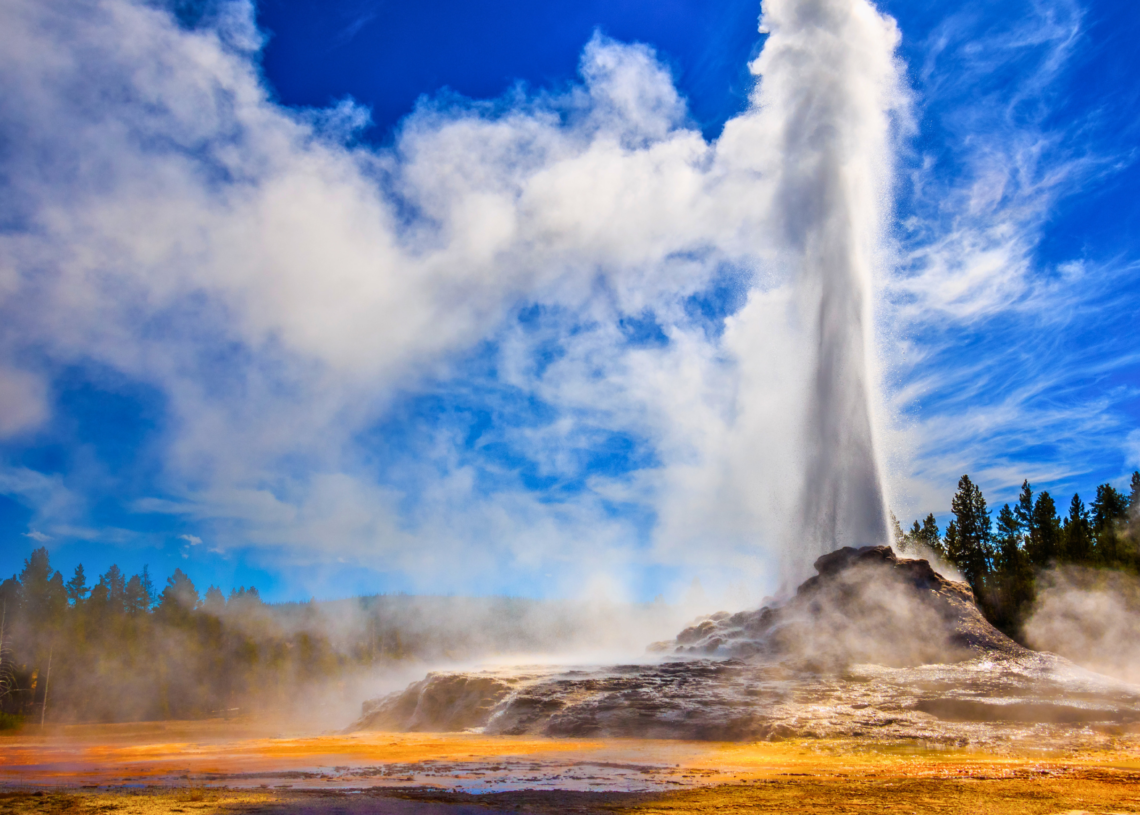
Beneath Yellowstone National Park, there is a massive supervolcano… and that’s kind of all we know about it. Scientists have never fully understood its mechanics and what, exactly, is powering it. The most prominent theory held that Yellowstone was fueled by a deep mantle plume, a kind of vertical column of superheated material rising from deep within the earth. There’s a logic to it. But didn’t fully explain how seemingly the entire park is one giant bubbling cauldron of heat.
New research published in Science, compiled by a team of researchers from the Chinese Academy of Sciences Headquarters, suggests Yellowstone’s heat may come from much shallower depth than previously thought, and is largely driven by tectonic movement that’s stretching and stretching the Earth’s outer shell.
The researchers believe that instead of a single upward blast of heat providing the volcanic system with its energy, the system is likely a tangled web of underground magma highways that distribute the heat across the park, powering its geysers and hot springs alike.
The Yellowstone Supervolcano Is Exceedingly Rare
Scientists built a 3D model of the region, including the Yellowstone Caldera and the nearby Eastern Snake River Plain, to simulate how magma forms and moves. If you imagined a giant underground bubbling cauldron with what essentially amounts to a series of straws sticking into it that lead to the surface, it’s not quite that. It’s actually closer to an ant farm’s winding network of tunnels.
Magma seems to originate in the upper mantle, in the asthenosphere, then migrates through cracks and reservoirs created by tectonic stress before eventually fueling volcanic activity at the surface.
As Yellowstone is one of about only 20 known and active supervolcanoes on Earth, researchers need to understand its deeper machinations so we can better predict an eruption. We already know that the Yellowstone supervolcano is capable of eruptions that can make even the most violent we’ve seen in our lifetimes look like a baby’s temper tantrum. It’s the last supereruption, the one that formed its massive 30-by-45-mile-wide Caldera, which happened around 630,000 years ago. Luckily, researchers don’t think we’re due for another one anytime soon.
The post A New Yellowstone Supervolcano Study Just Dropped. Should We Be Worried? appeared first on VICE.