Floating in the Pacific Ocean on Friday, the four astronauts of NASA’s Artemis II mission had achieved more than just a historic return to human spaceflight around the moon.
“From the pages of Jules Verne to a modern-day mission to the moon, a new chapter of the exploration of our celestial neighbor is complete,” Rob Navias, who provided NASA commentary during the re-entry, said after splashdown.
The successful conclusion of Artemis II sets NASA on a path to extend the agency’s achievements in space exploration, and, for now at least, the United States is ahead of China in a 21st century space race.
Reid Wiseman, Victor Glover, Christina Koch of NASA and Jeremy Hansen of the Canadian Space Agency were the first people to leave low-Earth orbit since 1972. Their journey captivated space enthusiasts and may have created new ones.
Along the beaches of Central Florida, spectators craned their necks as a giant NASA rocket roared to space on April 1. “Moon joy” became a catch phrase for the astronauts and mission control.
As their spacecraft slipped into Earth’s atmosphere at more than 24,000 miles per hour on Friday, the big three American TV networks — ABC, CBS and NBC — interrupted scheduled programming just as they had during the Apollo missions. Video of the capsule descending under parachutes also popped on the big screens at a couple of baseball stadiums: the New York Mets’ Citi Field in Queens and the Seattle Mariners’ T-Mobile Park.
As the astronauts swung around the moon’s far side on Monday, they passed through a point 252,756 miles from Earth, surpassing a distance record set by the crew of Apollo 13 in 1970. In all, they traveled 700,237 miles from Florida to the moon to the Pacific Ocean.
Along the way, the Artemis II astronauts studied parts of the lunar far side that human eyes had never seen. (Those regions of the surface were hidden in shadow during the Apollo missions.) They were also wowed by a 53-minute solar eclipse.
Most importantly, the mission demonstrated that their Orion spacecraft can handle transporting human beings to the moon.
That sets up the next steps in the Artemis program, which aims to put American back on the surface of the moon in 2028.
China, which is aiming to put its astronauts on the moon by 2030, is the competitor spurring NASA and the United States. But unlike the lunar contest with the Soviet Union in the 1960s, the goal for both countries is not just to get to the moon but establish a continuing presence there.
”It’s a huge moment for everybody,” Jared Isaacman, the NASA administrator, said from the deck of the U.S.S. John P. Murtha, waiting for the astronauts to be brought aboard. “We are going to get back into doing this with frequency, sending missions to the moon until we land on it in 2028 and start building our base.”
After splashdown, at 8:07 p.m. Eastern time, members of the recovery team took more than an hour to approach the bobbing capsule as they contended with currents in the waters off San Diego.
They soon helped the astronauts out of the spacecraft, hoisted them up for hovering helicopters to take them to the U.S.S. John P. Murtha. All four astronauts were able to walk across the ship’s flight deck to a medical bay for examinations.
At a news conference after splashdown, Rick Henfling, the NASA flight director who oversaw mission control during the re-entry, said the crew was “happy and healthy and ready to come home to Houston.”
For the astronauts, their last day in space began with a pair of wake-up songs. The first was “Run to the Water” by the rock group Live. That was the song that the crew had requested for the beginning of their last day in space. That was followed by “Free” by the Zac Brown Band and a recorded message.
“It takes courage, grit and freedom to chase the unknown,” Mr. Brown told the crew. “It’s the purest kind of American spirit.”
The spacecraft picked up speed as it fell like a rock toward the planet.
At 7:33 p.m. the Orion crew capsule — the cone-shaped section where the astronauts sat — detached from the cylindrical service module below it. The service module contained the power, propulsion and communications equipment used for most of the mission, but it was not needed for the last part of the journey. That discarded part burned up as it entered the atmosphere over the Pacific Ocean.
The crew capsule traveled farther to the east.
At 7:53 p.m., at an altitude of 400,000 feet, it hit what NASA calls the “entry interface,” where the Earth’s atmosphere was thick enough to start slowing down the spacecraft, which had reached a peak velocity of 24,664 miles per hour.
As expected, the heat enveloping the spacecraft created a blackout of radio communications for six minutes.
“Certainly, there’s anxiety,” Mr. Henfling said. “If you didn’t have anxiety bringing this spacecraft home, you probably didn’t have a pulse.”
Within the capsule, the astronauts felt forces up to four times that of gravity pushing them downward into their seats.
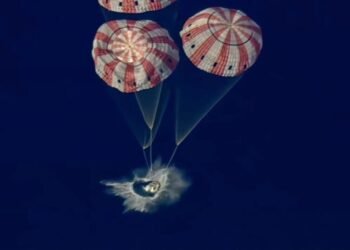
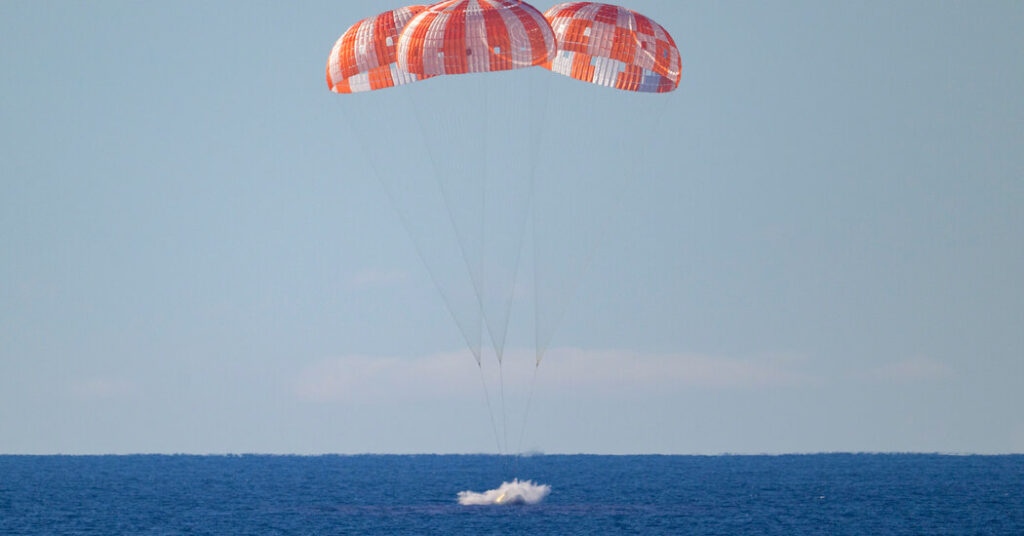
At an altitude of 22,000 feet, after the capsule slowed under the speed of sound, small parachutes known as drogues deployed. The main parachutes were released a minute later, providing a final descent to the ocean, hitting the waters at about 20 miles per hour.
Mr. Henfling said he and the flight controllers could finally breathe a sigh of relief when the side hatch of the capsule was opened.
At that point, the celebrations started.
“I made a call out to anybody who had worked the mission, no matter what shift or what room you were sitting in, to come into the room and just soak in the moment with the rest of the operations team,” he said. “They all deserved it.”
The main purpose of the mission was to check out key systems of Orion, especially life support that kept the astronauts alive and comfortable.
“This was an incredible test of an incredible machine,” said Amit Kshatriya, NASA’s associate administrator.
The mission also set a series of firsts. Mr. Glover was the first Black man to travel into deep space, Ms. Koch the first woman and Mr. Hansen the first Canadian.
Their observations during the lunar flyby illustrated how human beings can sometimes be better than robotic instruments, able to compare features many miles apart at a glance. Instruments on a spacecraft typically can measure only in one location at a time.
“That’s exactly what’s exciting about this mission,” said Jacob Richardson, a deputy lead on the Artemis II lunar science team.
The astronauts were also able to observe sites multiple times during the hourslong flyby, noting the appearances changed as the lighting conditions shifted.
For them, the moon was not just a dull gray seen in photographs.
“When they got to the moon, they described this fantastically colorful moon,” Dr. Richardson said. The color information “tells us about the materials at the surface,” he said.
With the conclusion of Artemis II, NASA will quickly pivot to the next mission, scheduled to launch in about a year.
Under a revamped moon program that Mr. Isaacman, announced in February, Artemis III will not head to the moon as previously planned. Instead, it will remain in orbit around Earth, allowing astronauts to practice docking with one or both of the spacecraft that are in development for future landings on the moon.
Pieces of the Space Launch System rocket and Orion spacecraft for Artemis III will soon arrive at the Kennedy Space Center in Florida. Less certain is when the landers, under development by SpaceX and Blue Origin, might be ready.
There may also be questions about the heat shield of the Orion capsule used on this mission and those used for future flights.
During Artemis I, an uncrewed flight to the moon in 2022, the heat shield suffered unexpected damage during re-entry. Artemis II’s heat shield used an identical design, but the re-entry trajectory was modified to reduce the heating.
While the Artemis II heat shield worked, engineers will want a close-up look to see how much damage did occur.
“We already have two of our heat shield experts on board the ship,” said Howard Hu, the program manager for Orion at NASA. Once the capsule is pulled out of the water, “we’ll do some inspections,” he said.
If Artemis III succeeds, Artemis IV and maybe Artemis V as well will attempt to land on the moon near the moon’s south pole in 2028.
Last March, NASA revealed plans to establish a base on the moon over the next decade at a cost of about $30 billion.
Kenneth Chang, a science reporter at The Times, covers NASA and the solar system, and research closer to Earth.
The post Artemis II Splashdown Gives NASA Momentum in Renewed Moon Race appeared first on New York Times.