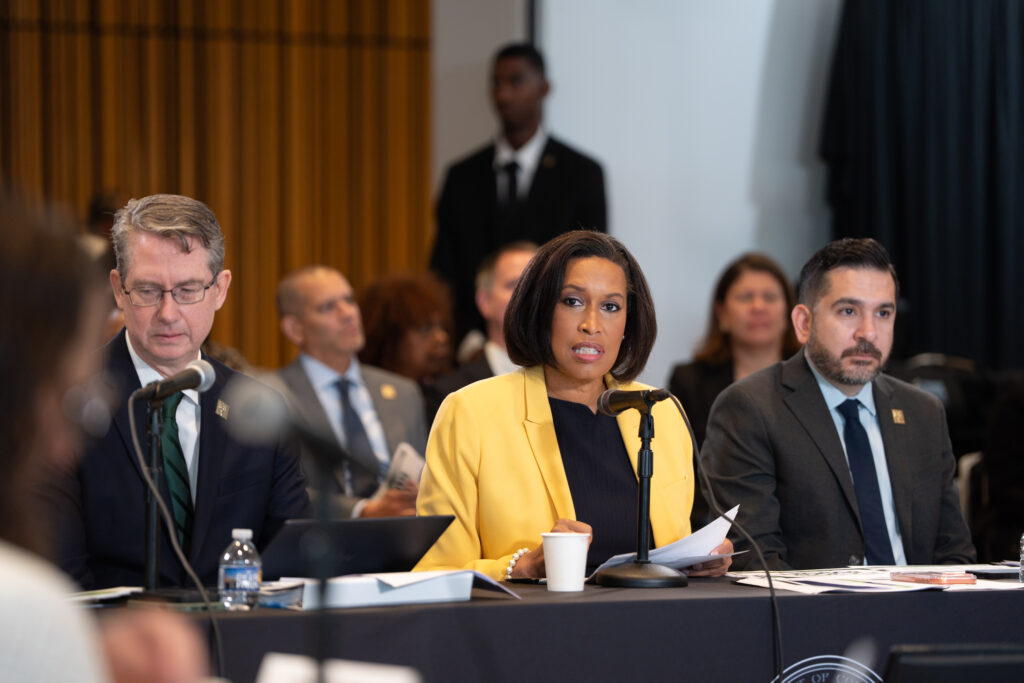
D.C. Mayor Muriel E. Bowser (D) proposed a budget Friday that will put off raises for firefighters, cut paid medical leave for workers and forgo boosts to early childhood educator pay as the city faces a double whammy of rising costs and flat revenue forecasts.
The $21.2 billion proposal is a last chance for Bowser to signal and enact her biggest policy priorities before she leaves office in early January after more than a decade as mayor.
It comes, however, as her ambitions were constrained by a significant budget shortfall. The Trump administration’s mass firings of federal workers cost the city more than 20,000 jobs and downtown office vacancies remain high, hits to the city’s coffers that came as the cost of delivering programs and services is on the rise. To keep the city’s programs running at current levels, it would take $1.1 billion more in revenue than D.C. officials have at their disposal, they say, meaning steep cuts were unavoidable.
The central question for Bowser and the D.C. Council is where those cuts will come from.
In her proposal, Bowser said her team aimed to preserve education funding and money for core services like libraries, parks and recreation and public works like road paving and street cleaning. They clawed back some cuts to the city’s health care programs for low-income people and immigrants and poured money into efforts she hopes will revitalize the city’s lagging economy.
But Bowser also proposed reductions to the tune of $469 million — not only to employee raises, paid medical leave and early childhood pay, but also to new affordable housing production and workforce programs her administration said were not producing results, as well as to a rapid rehousing program that provides limited-time housing assistance to families at risk of homelessness. The proposed reductions drew outcry from the firefighters union, early childhood educators and left-leaning advocates.
“Nobody is saying that the programs that have had to take a cut aren’t worthwhile programs,” Bowser said at a news conference Friday. “What we’re saying is our level of growth right now doesn’t support them.”
Bowser emphasized that the city still has resources. While the spending proposal marks a reduction of at least 3 percent from the current year — a rare occurrence after decades of steadily rising revenue — the city’s budget is significantly bigger than it was a decade ago. Revenue has grown 62 percent since fiscal year 2015, Bowser’s first year in office. And the city routinely outperforms the chief financial officer’s often conservative revenue projections, including last year, when the city brought in about $400 million more.
The budget proposal now moves to the council, where lawmakers have the power to swap Bowser’s proposed cuts with other reductions, all while maintaining the balanced budget required of the city each year. Council members, who will cast final votes on the budget in June, have in past years opposed and tried to reverse many of Bowser’s proposed cuts to child care and paid leave programs.
But those adjustments get more difficult as the economic picture becomes more dismal — a reality D.C. Council Chairman Phil Mendelson (D) and other lawmakers acknowledged Friday.
“You had some constraints that made your choices more difficult,” Mendelson said. “We really do have a strong city but have to work within these constraints.”
Lawmakers are also likely to debate whether to raise taxes — which Bowser has warned against. While the mayor’s budget proposes a tax on hotels, along with increases to taxes on medical marijuana sales and rental cars, it would not increase property or income taxes.
Bowser proposed a number of legislative ideas to make it easier to do business and attract investment. One such proposal would offer tax abatements to spur affordable housing around several Metro stations — including Takoma, Deanwood, Fort Totten and Friendship Heights. Another fund would offer tax incentives for developers in Southwest Washington, where massive federal buildings are up for sale. Bowser’s original presentation described it as a tax abatement, but an official later said taxes would be collected but could be redirected as a tax rebate.
Council member Charles Allen (D-Ward 6) called the federal buildings a “huge opportunity.”
“Big,” Bowser agreed.
“We have a whole part of our city that has been underutilized for some time and presents us with a great opportunity to get more people, more taxpayers, more housing to mix with the commercial development,” Bowser said.
The Bowser administration also said it will halt additional significant cuts that were expected to hit the city’s Healthcare Alliance program, which provides health insurance to people regardless of immigration status, and Medicaid eligibility.
“It was my No. 1 priority,” Bowser told reporters of the push to preserve the coverage, despite the rising costs.
As recently as two months ago administration officials framed the looming health care cuts as largely unavoidable.
The Alliance program was set to be zeroed out next year, causing about 24,000 people to lose health care — a prospect that outraged health care advocates who feared it could be life-threatening for lower-income residents and immigrants relying on it. Childless adults were also set to be kicked off Medicaid starting in 2028.
Instead, all who are in the programs right now will retain health coverage. At the same time, the administration is proposing to restore dental and vision benefits — which had also been cut last year — for Alliance recipients and those in another city-funded basic health care program.
Council member Christina Henderson (I-At Large) thanked Bowser for the health proposals. “Ensuring people have health care takes care of our hospitals,” she said. “I feel like I’ve been banging this drumbeat: Vision and dental care is super, super important for our residents.”
But the restoration of health coverage came at the expense of other programs, including two popular initiatives benefiting D.C. employees, namely child care workers.
Bowser proposed slashing a program that has boosted the wages of early child care educators, arguing that the Pay Equity Fund program, as well as a child care subsidy that helps lower-income residents, was growing in an unsustainable way.
The budget aims to prioritize direct aid to families through the child care subsidy. The $114 million program also will have new restrictions, including a waiting list for families to get in, that are intended to control costs.
“I think what I hear most from families is they want more opportunity for child care, more places, more spots, more quality spots, and they want it to be less expensive,” Bowser said. “We don’t think the Pay Equity Fund does that. … It’s more of an income support fund for child care workers.”
Child care workers will retain health care benefits that were part of the Pay Equity Fund.
The move drew swift pushback from child care center owners and other advocates. About 20 teachers gathered at a rally Friday at Loving Care Day Nursery in Northeast Washington, holding signs with messages such as “We’re not broke, the system is” and “If they can own yachts, they can pay taxes.”
Sharon Lemons, assistant director at Loving Care, said the pay equity program was a “lifeline” that allowed centers to better retain staff and serve children. “I just think it’s so unfortunate for the teachers,” Lemons said. “When pay equity started, I felt noticed as a child care professional. I felt whole.”
The city’s universal paid leave program will also face $95 million in hits. The city will not accept new medical leave claims by people employed at D.C. companies in the coming year, whether to deal with personal medical needs or to take care of a family member. Employees in D.C. will still be able to file prenatal and parental leave claims for the birth of a child.
One of the tougher choices, Bowser’s team said, was to propose putting off raises for union government workers. The move would save $127 million and represents a large share of budget reductions.
While police and teachers have already settled on raises with the city, Bowser’s proposal would mean that about 2,000 members of the D.C. firefighters union will not see cost-of-living increases and other raises until the city revisits the budget. School principals and other D.C. government office workers will also be affected, officials said.
City Administrator Kevin Donahue urged the council to prioritize raises should additional revenue become available. The council and mayor’s office have tussled with the chief financial officer forwithholding an estimated $180 million in revenue after pushback from Congress over local tax policy.
“Our employees work hard and put themselves in harm’s way, and they do deserve pay increases,” Donahue said.
Dave Hoagland, president of the firefighters union, called the proposal “deeply concerning.” “A strong city depends on strong public safety services,” he wrote in a statement. “Keeping those services fully staffed, experienced and ready must be a priority — not an afterthought.”
Bowser also proposed less money to help increase affordable housing. After pouring about $100 million a year into the city’s Housing Production Trust Fund, the new budget would allocate $50 million. The city would also stop accepting new applicants to a rapid rehousing program offering temporary support to people at risk of homelessness. The budget plan also does not fund new housing vouchers, officials said, though it would build a new non-congregate shelter to help people transition from homelessness.
In public safety, Bowser’s proposal increases spending for the police department, largely for overtime costs that the city does not typically account for on the front end. It also sets aside funding to replace D.C.’s crumbling jail, through a public-private partnership model the administration said will save the city money while maintaining government control over the facility.
The budget plan will be formally sent to the council next week. Mayoral candidate Janeese Lewis George (D-Ward 4) was the only lawmaker who did not attend Friday’s presentation. Her council office spokesman said she had a personal appointment she could not move but watched remotely.
Omari Daniels contributed to this report.
The post Bowser’s final D.C. budget includes $469M in cuts amid tough fiscal picture appeared first on Washington Post.