Even as Air Force Two carried Vice President JD Vance toward Pakistan for weekend talks with Iran, President Trump’s shaky cease-fire with Tehran was in growing jeopardy as world leaders hastened efforts to prevent a return to all-out war.
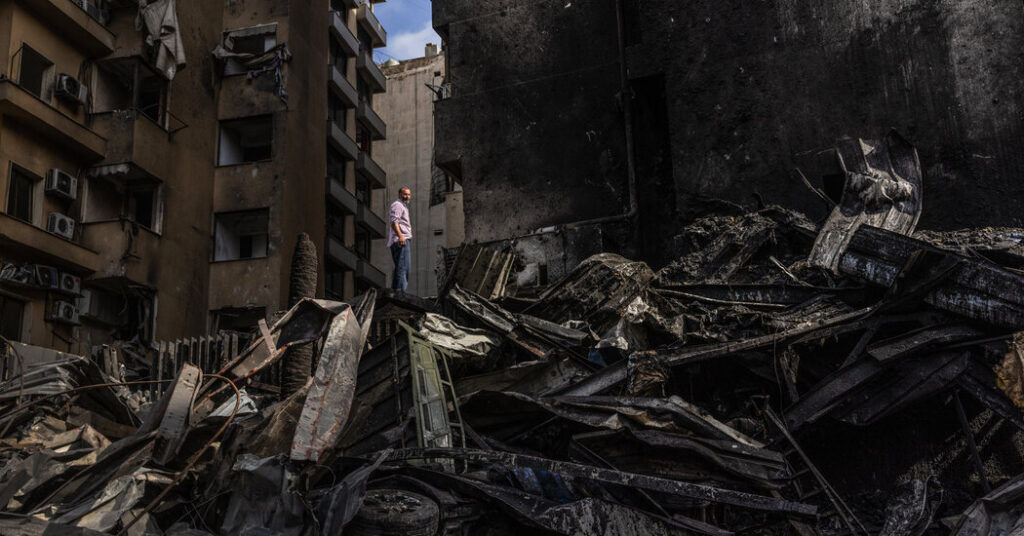
For a third day, work to prop up the cease-fire, which was announced on Tuesday, focused on Israel’s attacks on Lebanon. Iran says the continued assault violates its deal with Mr. Trump to stop U.S. and Israeli attacks on Iran in exchange for safe passage of ships through the Strait of Hormuz.
Prime Minister Benjamin Netanyahu of Israel has resisted international pressure to halt his country’s related campaign against Iran-backed Hezbollah militants in southern Lebanon.
Iran had threatened to call off its meeting with Mr. Vance at a luxury hotel in Islamabad, set for Saturday morning local time. The arrival of an Iranian delegation in Islamabad on Friday, even after Mr. Netanyahu vowed to continue his Lebanon offensive, suggested that the talks would commence as planned.
With the future of the world economy at stake, several foreign nations worked to keep diplomacy between Washington and Tehran on track. On Friday, the World Bank’s president, Ajay Banga, told Reuters that a return to war and further Iranian disruption of commercial shipping traffic through the Strait of Hormuz could significantly slow global economic growth and exacerbate inflation.
Mindful of such bleak scenarios, top officials from across Europe and Asia joined countless calls and meetings on the subject with their counterparts. France’s president pressured Israel to halt its attacks in Lebanon. Britain’s prime minister finished a three-day visit to Gulf Arab capitals to discuss the strait’s reopening. Saudi Arabian officials urged China to continue its pressure on Iran to remain engaged in diplomacy.
In a Friday address to his nation, Pakistan’s prime minister, Shehbaz Sharif, said the planned U.S. meeting with Iran was a “make or break” moment. And Mr. Sharif — until now not known as a kingpin of international diplomacy — said on social media that he had fielded calls from a slew of world leaders, including from Qatar, Germany, Australia and Britain.
Even if the dispute over Lebanon does not derail the Islamabad talks, said Vali R. Nasr, a professor at the Johns Hopkins School of Advanced International Studies, it will have further poisoned the atmosphere for discussions between the two sides after five weeks of warfare and decades of distrust.
That will make bridging the wide divide between Washington and Tehran on Iran’s nuclear program, the Strait of Hormuz and other matters even more difficult. Veteran diplomats were already doubtful that a larger agreement was possible without at least extending the two-week clock established by Tuesday’s cease-fire.
“Lebanon has changed the context of the talks,” Mr. Nasr said. Iran has stressed its view that the cease-fire was supposed to apply to Lebanon. Although Mr. Vance on Wednesday claimed there had been a “misunderstanding” over the status of Lebanon, Mr. Sharif’s announcement of the deal — which was edited in advance by the Trump White House — called for an end to the fighting there.
“If you’re already thinking that this guy, Mr. Trump, may cheat you, that doesn’t augur well,” Mr. Nasr said.
Tehran has other reasons to distrust Mr. Trump and his emissaries, he noted. During his first term as president, Mr. Trump abandoned a 2015 nuclear deal that Iran had painstakingly negotiated with the Obama administration over roughly 20 months. And twice in the past year, Mr. Trump has begun talks with Tehran only to launch devastating attacks without warning.
Mr. Vance will be joined in Islamabad by Mr. Trump’s special envoy, Steve Witkoff, and son-in-law, Jared Kushner, who participated in the previous rounds of nuclear talks with Iran — and who came away insisting the Iranians were the deceitful party. The three Americans plan to negotiate with Iran’s foreign minister, Abbas Araghchi, and the Iranian parliament speaker, Mohammad Bagher Ghalibaf.
It is unclear whether the two sides will meet in person or pass messages through Pakistani intermediaries. Diplomats say that direct meetings are far more efficient and less prone to miscommunication, but can also bring political risk by appearing conciliatory.
The talks are to be held at Islamabad’s five-star Serena Hotel, whose guests were abruptly instructed this week to check out because Pakistan’s government had “requisitioned our hotel for an important event,” according to Russia’s TASS news service.
The talks may be shaped by outside powers invested in their success. Among them is China, whose economy depends heavily on gas and oil shipped from Gulf Arab nations through the Strait of Hormuz.
“Any escalation or expansion of the conflict would run counter to China’s interests in stable and functioning global energy markets,” said Ryan Hass, a former career diplomat and White House national security official who directs the China center at the Brookings Institution. Mr. Hass said that would support reports that Beijing urged Tehran to accept the cease-fire, including Mr. Sharif’s message of public thanks to several nations, including China, after the deal was concluded.
A Saudi official said that Riyadh has encouraged China to remain involved as the diplomacy proceeds.
Liu Pengyu, the spokesman for the Chinese Embassy in Washington, said in a statement that China has been working since the conflict began “to help bring about a cease-fire and end to the conflict.”
Experts said the cease-fire has held despite serious flaws because both sides are eager for some kind of deal. Iran has been under crushing military and economic pressure but has considerable leverage in its demonstrated ability to close the Strait of Hormuz. Mr. Trump has endured rising gas prices, tepid support for the war and dissent from within his political base.
But few actors foresaw Lebanon as posing so much danger to peace efforts.
Mr. Trump has never expressed much interest in the country, which is smaller than Connecticut, with a battered economy and few natural resources.
But Lebanon is of critical importance to Mr. Netanyahu as the home base of Hezbollah, a Shiite militant group formed with Iran’s backing after Israel’s 1982 invasion of southern Lebanon. Israel has long traded cross-border fire and occasionally gone to war with Hezbollah.
But after the Oct. 7, 2023, Hamas attacks highlighted the threat Israel faces from armed militias on its borders, Mr. Netanyahu has vowed to see the group — which regularly launches rocket attacks into Israel from southern Lebanon — disarmed under a long-stalled United Nations mandate or destroyed.
After a call on Wednesday from Mr. Trump asking him to scale back attacks in Lebanon, Mr. Netanyahu announced that Israel would join talks with Lebanon’s government to discuss Hezbollah’s disarmament. The State Department then announced that it would host the parties for a meeting in Washington next week.
On Thursday, Mr. Trump sounded reassured, saying that Mr. Netanyahu would be “scaling back” operations in Lebanon.
But there has been little evidence of that, and Mr. Netanyahu seemed to double down in a public statement, saying he had not agreed to a cease-fire in Lebanon and vowing he would continue “to strike Hezbollah with full force.”
Fearing for the survival of the Iran talks, other world leaders have sought to pressure Mr. Netanyahu. On Wednesday, President Emmanuel Macron of France condemned what he called Israel’s “indiscriminate strikes” in Lebanon that day.
Israel’s ambassador to Washington, Yechiel Leiter, said in a statement on Friday that he had discussed the matter earlier with the Lebanese ambassador to Washington and the U.S. ambassador to Lebanon. He added that “Israel refused to discuss a cease-fire with the Hezbollah terrorist organization, which continues to attack Israel and is the main obstacle to peace between the two countries.”
Mr. Nasr said that Iran most likely sees Lebanon as a key test not only of Mr. Trump’s trustworthiness, but also of his ability to control Mr. Netanyahu.
From Iran’s perspective, if Mr. Trump cannot make the Israeli leader stand down in Lebanon, he said, “at best that means the U.S. is unable to control Bibi” and Israeli officials, “which doesn’t give Iran much confidence.”
“At worst,” he added, “that means they can control him, and they have something else up their sleeve.”
Edward Wong contributed reporting.
Michael Crowley covers the State Department and U.S. foreign policy for The Times. He has reported from nearly three dozen countries and often travels with the secretary of state.
The post World Leaders Push to Save Iran Talks Amid Israel’s Attacks in Lebanon appeared first on New York Times.