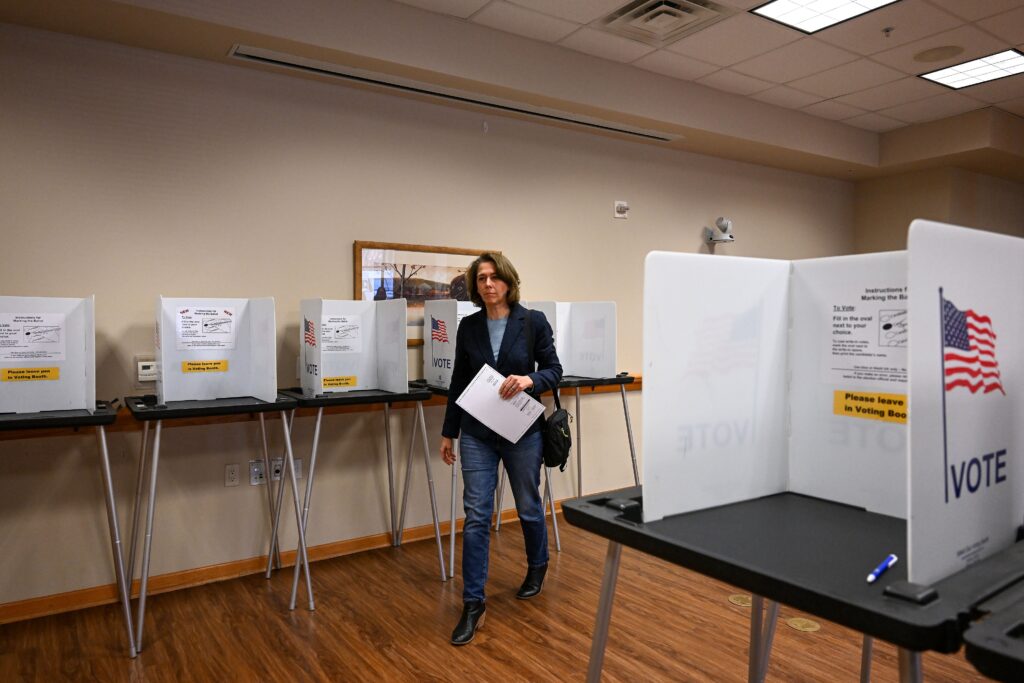
In the April 5 letters package “The United States needs a second Reconstruction,” readers offered ideas for “structural changes [that] could make the United States more democratic and accountable to its citizens.”
Here’s an easy one: Get out and vote, and get all your friends to vote. Or pay a fine. Improved election outcomes would be guaranteed.
Ray Ruggiero, San Rafael, California
One idea that was raised in 1976 still has merit: adding a third chamber of Congress with 100 members, each elected from the entire nation. This would boost representation for constituencies who lack a particular geographic base. (The Philippines, for instance, has 24 senators, each elected by the entire nation.)
In addition, expand the Senate, by reducing (but not eliminating) the antidemocratic geographic aspects. Each state would get at least two senators, plus two more for every 5 million inhabitants. Thus, California would have nine senators, a multiple of Wyoming’s two but a far smaller multiple than the population difference alone would produce.
Barry Saiff, Chicago
Expand the House of Representatives so that the least populous state gets one representative and every other state gets a representative for each multiple of that small state’s population. (If Wyoming has 600,000 and California has 39,000,000, then California gets 65 representatives.) Apply the same rule to the electoral college; if Wyoming gets three votes, then California gets 195.
Ted Burg, Pembroke Pines, Florida
Make it so that all U.S. citizens are represented by a voting member of the House of Representatives, including those living in U.S. territories and the District of Columbia. Representation should be proportional to population; thus, the three territories in Oceania would share a single representative, D.C. would have one and Puerto Rico would have four. Note that the citizens in Oceania and Puerto Rico enlist in the U.S. military at higher rates than almost all states. Those soldiers — like every U.S. citizen — deserve a vote in Congress.
Edwin McCleskey, Silver Spring
We need to focus on reforms that would be both broadly beneficial and have a reasonable chance of gaining broad support.
Gerrymandering is at the top of my list; does a bipartisan bill to outlaw it have a chance of passage in this Congress or the next? I also find merit in the idea of replacing party primaries with “all-in primaries.” Is there a realistic path to that sort of reform?
Some people want to expand the House of Representatives, but that would just make the House more unwieldy. Some people like the idea of creating more parties, but that could create its own chaos.
Sally Cameron, North Bethesda
These United States must permanently eject the radical Republican Party from power. The Democrats have become the actual party of conservativism, and so a new party advocating progressive values is required.
Dion Blundell, Cathedral City, California
The first action is to disallow companies being considered as people who have free-speech rights and the ability to get involved in politics. If these companies choose to leave the country, they must pay fines to compensate for their closure, plus additional tariffs for the benefits they derived while setting up shop in the United States.
Phil Roettcher, Westfield, Indiana
To avoid what are becoming routine government shutdowns, we should do as Britain and other European nations do: dissolve the government and hold new elections. I propose the following constitutional amendment:
- When Congress fails to fund the government, senators and representatives are removed from office.
- States shall perform new congressional elections within 30 days.
- All members of the congressional term that failed to fund the government shall be ineligible for reelection for one term. Dissolution of Congress may not be repeated for another four years.
Dave Allen, Mokelumne Hill, California
It is generally appropriate that the voice of the people be filtered through representation. That said, it is ludicrous that the people have no direct say in the structure and operation of a government derived from a constitution that begins “We the People.” The result is government officials who are more responsive to specific interests (primarily political parties) than the common good.
Though any structural change must be carefully thought out to balance constriction and promiscuity, I do firmly believe that all constitutional amendments should be ratified by direct plebiscite of the American people (and not on a state-by-state basis). Among the numerous benefits would be relaxing the institutional stranglehold on modifying the Constitution, which, while useful in preserving the items that work well, makes it effectively impossible to correct those that don’t.
To paraphrase the long-standing observation on democracy, “The people are the worst group to trust, except for all the others.”
John Polcari, Lottsburg, Virginia
The quotable court
The April 2 front-page article “Birthright citizenship looks likely to survive” included a quote of the year.
Solicitor General D. John Sauer told the Supreme Court that “we’re in a new world now” because circumstances are different today than when the 14th Amendment was passed to give children born in the U.S. citizenship. Chief Justice John G. Roberts Jr. snapped back, “Well, it’s a new world, but it’s the same Constitution.”
Robert Weiner, Accokeek
It’s great that at least one Supreme Court justice, Samuel A. Alito Jr., can see that “what we are dealing with is something that was unknown at the time — illegal immigration.” I’m confident that the justice will say the same thing next time the court considers an assertion that semiautomatic, large-magazine rifles firing bullets designed to maim an enemy are what the Framers had in mind when they proposed the Bill of Rights in 1789. After all, to do otherwise might give the impression … that … uh …
Barney Gorin, Gaithersburg
From marble to granite
Regarding the April 4 Metro article “$10 billion proposed to fund D.C. beautification”:
Every year for 20 years, a group of friends and I walk from the Iwo Jima Memorial in Arlington over the Memorial Bridge to see the cherry blossoms and stroll around the Tidal Basin. We always walk up the stairs to pay tribute to Mr. Jefferson and read his quotes on the walls.
Our visits lately have been dispiriting. The monuments are dirty. The marble is mud-covered, and the trash bins are overflowing. Litter blows around the steps. Even so, we see couples posing for wedding pictures and 15-year-old girls in their quinceañera dresses. We wish their backdrop looked better. This year, there were National Guard troops standing around, looking bored and trying to stay out of the photos. Weren’t those guys going to beautify Washington? How is it that our president, who seems to care so much about shiny marble and pristine monuments, has allowed our most visible monuments to look like they need a power wash?
Mary Byrne, Arlington
President Donald Trump recently revealed he was replacing the Tennessee flagstone in the West Colonnade — the walkway that leads from the main part of the White House to the Oval Office and runs alongside the Rose Garden — with black granite. “It’s a great contrast. The white, with the black,” Trump told reporters. “It’s a beautiful, black granite.”
There is a reason the walkway is Tennessee flagstone: That stone is porous. Water seeps through it, and it does not become slippery.
Polished granite is slippery even when dry, and with the slightest moisture, it is like walking on ice. Wipe a little water on your granite kitchen countertops and try walking on them. But you better call 911 first.
Joseph A. Schlatter, Manassas
Post Opinions wants to know: Are you in a relationship with someone who holds different religious beliefs? If so, how do you make it work? Any upsides or downsides? Send us your response, and it might be published as a letter to the editor. wapo.st/house_of_worship
The post How to fix America: Fine everyone who doesn’t vote appeared first on Washington Post.