“Things at the worst will cease,” a certain playwright ensured about a Scottish king, “or else climb upward to what they were before.” In London’s case that may be overstating it, but 10 years after a referendum that cut Britain off from the continent, and kneecapped the capital’s creative industries and universities, London in 2026 is going through a palpable cultural renewal.
New leaders at the British Museum, the National Theater and the Royal Opera House have brought fresh hopes to storied institutions. The National Gallery recently opened a major new wing, while a new home for the Museum of London (in the historical meat market) and a satellite of the Victoria & Albert Museum (in the city’s Olympic eastern stretches) will both open this year.
When I lived here in the 2000s, London welcomed me in as the newly confident cultural capital of a united Europe; it may be a bit less effervescent today, or I may just be older. Either way, London’s in action again, and its formidable cultural history has life in it yet.
Find these five and discover more art on our Google map of London.
1. A flawless self-portrait, in 360 degrees
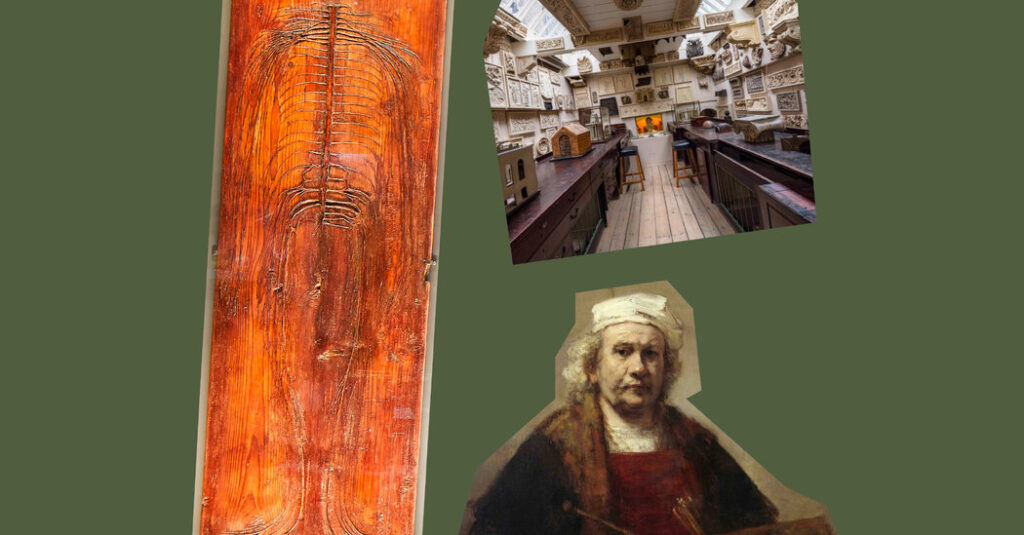
If you want to see the most impressive self-portrait in London, make sure to wear mud boots. At the top edge of Hampstead Heath, the sprawling and often mucky grasslands to the north of the capital, the villa known as Kenwood House contains a Rembrandt self-portrait from the last years of his life: white cap over his shaggy hair, fur collar sketched in washy browns, a palette and a maulstick (to steady the hand) alongside his brushes. This is one of 40-odd Rembrandt self-portraits, but in no other does he present himself with such matter-of-fact authority — above all in the curious backdrop.
Against a plain background of drab ecru, Rembrandt has dipped his brush in black and painted a perfect circle. Actually, two of them. In the early Renaissance, Giotto was said to have proved his talent to the pope by drawing just an O, and three centuries later Rembrandt is doing the same. The aging body can still deliver geometric perfection: the ultimate can-you-top-that move.
The “Self-Portrait With Two Circles,” painted during the late 1660s, is one of many Dutch old masters at Kenwood House. The Rembrandt, like the Vermeer and the Hals and the others, were collected by Edward Cecil Guinness, manufacturer of the namesake Irish beer, who converted stout into splendor when he bought Kenwood in 1925. All the luscious details in those other pictures, though, can feel pompous in the company of Rembrandt’s two circles. This is all you need for beauty: a hand, a brush, a form without fault.
Kenwood House, 3 Hampstead Lane, Hampstead.
2. A tortoiseshell comb, potent as an Atlantic wave
At the principal west London home of the Victoria & Albert Museum, London’s higgledy-piggledy storehouse of decorative arts and design, the objects I seek out every visit are about seven inches tall. They’re a pair of tortoiseshell hair combs, along with a carrying case of the same hard material, brushed with yellow resin to make them shine. The combs have floral patterns on the handles — twirling tulips and vines from any English garden. But look at what’s on the case: a sumptuous palm tree, laden with coconuts and climbing to the sky. A clump of sugar cane. A cotton bush. On the back, beneath a Taino man and woman and a cross specked with pineapples, the maker of this case incised a place and date: IAMAICA 1673.
The combs and case hide in one of what the V&A calls its “British Galleries.” But British art and design became a global enterprise in the 17th century, and the objects I love most here map the oceanic movement of people, ideas, money and materials in the early modern era. Here in Room 56c are London-made satins festooned with Chinese patterns, and porcelain bottles and teapots that reached Britain from closed Japan.
The little tortoiseshell objects (sent from Jamaica to Britain along with “400 lbs of the best white sugar from Barbados”) are the ones that grab me hardest, though. Exploration, exploitation, communication, creolization: Museums wants things to stay put, but art is always on the move.
Victoria & Albert Museum, Cromwell Road, South Kensington.
3. The ultimate party house, with a map of modern London
London had a curious relationship to modernism in the early 20th century: not many Cubist smash-ups, no bulldozer-happy Futurists, but many forward-thinking Britons who kept one foot in tradition. When Steven and Virginia Courtauld, stylish and offbeat and very rich, decided they needed a new home, they built an Art Deco mansion next to a Tudor palace in ruins. Then they decorated it with acres of lacquered Australian wood paneling and pounds of gold mosaic.
My favorite element is in the boudoir of Mrs. Courtauld, for which she commissioned a massive map of surrounding southeast London, stitched together piece by piece from tan, green and white leather panels. A (painted) map wall like this one might have been fashionable in centuries past, when aristocratic landowners would show off their property. But the Courtaulds modernized theirs: flatter, brighter, picking out dockways and golf courses, the now destroyed Crystal Palace, and even some local pubs.
Call it three-martini chic. Eltham Palace may not be the most architecturally innovative house of the 20th century, but its head-on collision of Henri VIII’s London with Noël Coward’s delights me. And the stitched leather map, the yacht-grade built-ins and the marquetry of Romans and Vikings reaffirms that modern architecture can be sexy and not just utilitarian. This was interwar London’s ultimate party house, and its marriage of old and new is the strongest of cocktails.
Eltham Palace and Gardens, Court Road, Greenwich.
4. A rediscovered attic in a classical treasure trove
The most accessible time travel in central London takes place in three adjoining townhouses that the architect and obsessive collector Sir John Soane knocked together a little more than two centuries ago. But only in 2023 could members of the public climb a little spiral stair in the back of the house, to enter a narrow and undiscovered room.
This is the drawing office, where Soane’s pupils learned the fundamentals of the trade. Six days a week, the boys sketched Soane’s plaster copies of Ionic capitals, his mascarons of gods and satyrs. Just a few people can fit in this narrow corridor (so you will need to book a tour, on Thursdays and Saturdays), and you can imagine the apprentices laboring over the florettes and entablatures hanging from every wall and rafter, even the ceiling. This was their life now, and it hemmed them in.
There are grander plaster casts in the jam-packed main hall of Sir John Soane’s Museum, lorded over by a full-size copy of the Apollo Belvedere. The equally crowded picture gallery has lots of Georgian drunkenness and debauchery, courtesy of William Hogarth. It is so foreign to us, now, this mode of artistic display: dense and distinctive, free of long labels, its power less in the components than the ensemble. What is so special about the drawing office, then, is that it makes the little parts of Soane’s universe visible again: things of beauty and units of work.
Sir John Soane’s Museum, 13 Lincoln’s Inn Fields, Holborn.
5. The facts of life, served up on wood planks
Just across the square from Sir John Soane’s Museum, I have a visceral appointment for you: a 400-year-old marvel made of dried flesh and blood.
The Evelyn Tables, as they’re called, are believed to be the world’s oldest surviving dissections of the human body, prepared by physicians in mid-17th-century Parma, Italy. For each of the tables, they carefully excised one of the systems of a (lucky?) cadaver, then painstakingly pasted down the veins, the spinal cord and the vagus nerves as they would appear in a living body. They look like preserved botanicals, these human tissues on planks of pine: the circulatory system with its aorta and arteries, the nervous system branching like tree roots. The art of life is nowhere else so literal.
OK, this one isn’t for you if you have a weak stomach. But I love a medical museum, especially a place like the Hunterian, overseen by the Royal College of Surgeons of England and established in 1799 — a time when art and science were much better acquainted. The collection recounts the history of surgery from handsaws to LASIK, and thousands of zoological specimens float in glass jars filled with alcohol. Like the Evelyn Tables, these wondrous (and not especially gruesome) organisms were teaching objects and not gross-out attractions. What you’re looking at, in these flat panels that were once skin and gristle, is naked knowledge.
Hunterian Museum, 38-43 Lincoln’s Inn Fields, Holborn.
More Art to Discover
Find all of these on our Google map of London.
-
St. Dunstan-in-the-East, City of London: remains of a Christopher Wren church destroyed in the Blitz. The bombed-out steeple and overgrown walls now constitute a very beautiful public garden.
-
2 Willow Road, Hampstead: low-slung brick house from 1939, designed by the Hungarian exile Erno Goldfinger. The rectilinear facade was divisive in its day (Ian Fleming named a Bond villain “Goldfinger” in revenge).
-
Courtauld Institute of Art, West End: two-headed museum and university (my alma mater, full disclosure), home to the single greatest painting in London: Édouard Manet’s perspective-shattering, etiquette-shattering “Bar at the Folies-Bergère.”
-
25 St. James’s Street, St. James’s: the finest Brutalist (or Brutal-ish) building in town, designed by the husband-and-wife architects Alison and Peter Smithson as the headquarters of The Economist. The Portland stone and concrete lords over Piccadilly; imagine getting planning permission now.
-
Freud Museum, Hampstead: home of the couch, topped with a somewhat ratty Qashqai carpet, which traveled with Sigmund when he fled Vienna for London in 1938. The museum also puts on exhibitions of contemporary art with a psychoanalytic bent.
-
Banqueting House, Whitehall: Roman Revival party venue for feasts and masques built by James VI and I; his son, Charles I, would be beheaded right outside. Open only on select days but worth it for the ceiling, painted in grand manner by Peter Paul Rubens.
-
Donlon Books, Hackney: the rarest of rare art book shops, a dense commingling of out-of-print fashion titles and head-scratching philosophy.
-
Toklas, West End: Culture industry canteen and solid pre-theater dinner, founded by the Frieze doyens Amanda Sharp and Matthew Slotover. The walls are covered in contemporary art posters; the chef is a wonder with artichokes.
Jason Farago, a critic at large for The Times, writes about art and culture in the U.S. and abroad.
The post My 5 Favorite Places for Art in London appeared first on New York Times.