This has been an adventurous and entertaining season for the New York Philharmonic. Its programming has balanced modern and contemporary pieces with more expected fare, but also real imagination.
The program this week at David Geffen Hall is exceptionally broad, even motley, stylistically. The orchestra plays works by Samuel Barber both familiar (“Knoxville: Summer of 1915”) and less so (the rangy Second Essay for Orchestra); a scene from Stravinsky’s “The Rake’s Progress”; an aria from Carlisle Floyd’s “Susannah”; Ives’s “The Unanswered Question”; and, most notably, the world premiere of a meaty new piece by the composer, trombonist, scholar and computer music pioneer George Lewis.
There were multiple soloists: the South African soprano Golda Schultz in the vocal works, and the new-music specialists of the percussion quartet Yarn/Wire in the Lewis. Holding it all together was the conductor Kwamé Ryan, impressive in his Philharmonic subscription debut.
It was a stacked cast for a heavy program. And on Thursday night, Schultz had to trim her sails a bit. After announcing a bout of bronchitis, she thanked the audience in advance for its patience — and said that she would need to excise the Floyd aria from her set in the second half of the program.
Even so, she managed to bring her entrancing, warm instrument — which she has used as a winning Pamina in Mozart’s “The Magic Flute” — to “No Word from Tom,” a showstopping sequence for the character of Anne Trulove in “The Rake’s Progress.” If not as free with some climactic high notes as she was in this role at the Metropolitan Opera in 2022, Schultz’s performance was worth hearing for its mellowness and controlled vibrato. She was similarly affecting in Barber’s “Knoxville.”
The Philharmonic players reveled in Ives’s mystic morsel, Stravinsky’s Neo-Classicism and Barber’s lush-then-tough Americana. They also rose to the hyper-modernist challenges of Lewis’s premiere, yet I found this work to be more fitfully engaging than many of his recent scores.
After making his name in the 1970s and ’80s by leading the downtown performance space the Kitchen while performing with other improvising composers like Anthony Braxton and John Zorn, Lewis has since notched a notable career as an academic alongside his work as a composer. The title of his Philharmonic premiere, “…Ohne Festen Wohnsitz,” is inspired by the 18th-century philosopher Anton Wilhelm Amo, who was born in Ghana and worked in Germany “without a fixed abode.”
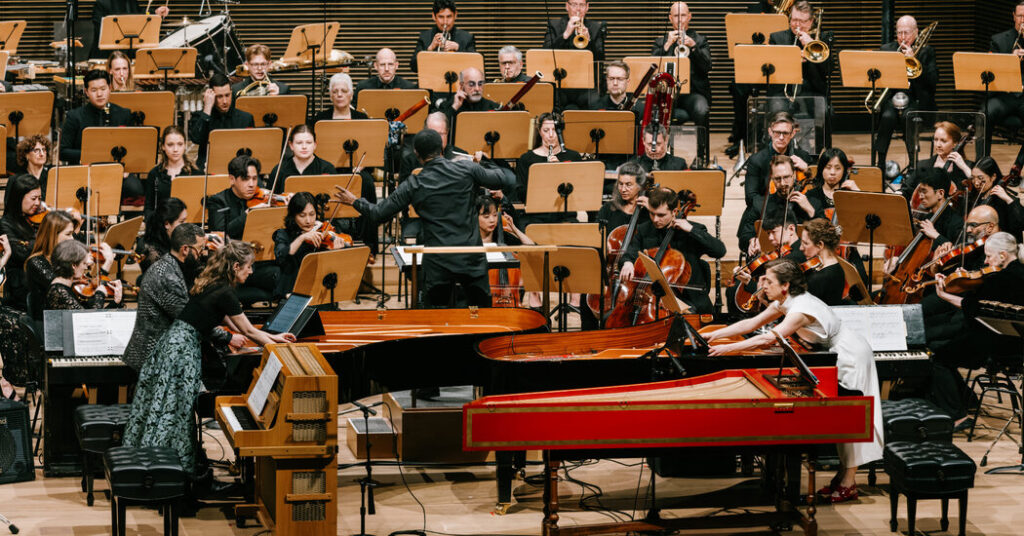
This nearly half-hour, modernist concerto grosso was also designed for the pianistic and percussion talents of Yarn/Wire (in its Philharmonic debut). Midway through, I began to wonder if the piece’s form was responsible for making it droop in a way that felt uncharacteristic for Lewis.
At various junctures on Thursday, there was terrifically queasy, extended technique writing for the woodwinds; the bassoons in particular sounded like they were giving their all. Then, just as some delectable and unearthly trill seemed like it wanted to be taken to yet new vistas, perhaps by the looming brass and percussion players nearby, the piece would grind to a halt — all to make space for the guest ensemble.
The Yarn/Wire players were assigned cadenzas that allowed for improvisation, which felt more rote than the fully written-out material that Lewis had given the Philharmonic. Elsewhere, the quartet — a roving group that can switch from booming percussion to dreamy vibraphone, between dense Cecil Taylor-style grand piano clusters and luminous celesta lines — seemed to either cover the orchestra, or just duplicate its assigned range.
That was too bad, particularly given the quality of Lewis’s other recent works. At the 2022 edition of the Time Spans Festival, the Talea Ensemble nailed his dizzying “Tales of the Traveller” in a performance that also featured a computer-controlled Disklavier piano running Lewis’s Voyager software system. It was some of the most thrilling music I heard that year.
I felt similarly about his unprecitably grooving symphonic piece “Weathering,” which I’d like to hear at Geffen Hall. Or his magisterial 2014 work “Memex.” Or any new Lewis piece focused purely on the orchestra. His wide-ranging career may make him seem like a composer working “without a fixed abode,” but here’s hoping the Philharmonic will keep its doors open to him.
New York Philharmonic
This program repeats on Friday at David Geffen Hall, Manhattan; nyphil.org.
The post Review: The Philharmonic Surrounds a Premiere With a Motley Crowd appeared first on New York Times.